SESSION – 2
Subject Code: MO
Series: AM211
Roll No.: T R 8 6 1 3 0 0 2 8 9 1
Candidates must write the Roll No on the title page of the Question Paper.
Mathematics | Level 2
Time allowed: 1.5 hours
Maximum Marks: 150
Instructions for Candidates:
- Please verify that this question paper contains 12 printed pages and ensure that the paper contains a total of 50 questions.
- Use of mobile phones, smartphones, iPads during examination is STRICTLY PROHIBITED.
- On the OMR sheet, enter all required information carefully in the space provided ONLY IN BLOCK CAPITALS and by properly darkening the corresponding bubbles. Incomplete, incorrect, or careless entries may lead to disqualification.
- Use only a BLUE or BLACK BALL POINT PEN for writing entries and filling bubbles. Pencils or other pens are not permitted.
- Marking Scheme:
- Each question has four alternatives, only one of which is correct. Select the correct option and darken the respective bubble.
- Each correct answer = 3 marks
- Each incorrect answer = –1 mark (penalty)
- No marks are awarded for unanswered questions.
- Use only the space provided in the question paper for rough work.
- Candidates must remain in the examination hall until the exam is officially over. Early exit is not allowed.
- Do not make stray marks, symbols, or extra writing on the OMR sheet. Fill only the designated bubbles neatly.
- Since OMR sheets are machine-evaluated, changes in entries are strictly not allowed.
- Avoid scratching, overwriting, or erasing, as these may result in wrong evaluation.
- DO NOT write anything on the back side of the OMR sheet.
1.
The weight of three bags X, Y and Z is 346.2 kg.
The weight of Bag X is twice the weight of Bag Y and the weight of Bag Z is 5 kg more than thrice the weight of Bag Y.
Find the approximate weight of Bag X.
(A) 114.634 kg
(B) 113.734 kg
(C) 110.524 kg
(D) 105.254 kg
2.
If a scooterist drives at the rate of 25 km per hour, he reaches his destination 7 minutes late, and if he drives at 30 km per hour, he reaches 5 minutes earlier.
How far is his destination?
(A) 20 km
(B) 25 km
(C) 30 km
(D) 32 km
3.
A bag contains 50p, 25p and 10p coins in the ratio 2 : 3 : 4 amounting to ₹129.
Find the number of coins of each type.
(A) 120, 180, 240
(B) 180, 150, 200
(C) 200, 180, 120
(D) 180, 200, 140
4.
The base angle of a trapezium is 45°.
If the shorter side and both the equal sides are 10 cm each, find the area of the trapezium.
(A) (50 + 100/2) sq cm
(B) (100 + 50√2) sq cm
(C) (50 + 50√2) sq cm
(D) (25 + 25√2) sq cm
5.
Select the correct option.
(A) The length of both diagonals of a rectangle are equal.
(B) Square, rectangle and rhombus are all different types of parallelograms.
(C) The diagonals of a square are perpendicular bisectors of each other.
(D) All of these
6.
A group of students decided to collect as many paise from each member of the group as is the number of members.
If the total collection amounts to ₹ 22.09, the number of members in the group is:
(A) 37
(B) 47
(C) 107
(D) 43
7.
A general wishes to draw up his 36,562 soldiers in the form of a solid square.
After arranging them, he found that some of them are left over.
How many are left?
(A) 36
(B) 65
(C) 81
(D) 97
8.
By what least number should 25,920 be divided to obtain a number which is a perfect cube?
(A) 35
(B) 25
(C) 15
(D) 5
9.
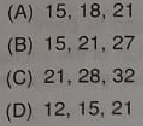
Three numbers are in the ratio 5 : 6 : 7.
The sum of their cubes is 18468.
Find the numbers.
10. Read the statements carefully and select the correct option.
Statement I:
If a trader offers two successive discounts of 13% and 8% on an almirah marked for ₹ 20000, then its selling price is ₹ 16008.
Statement II:
On selling a laptop for ₹ 84000, the shopkeeper lost 20%. To gain 10%, he should have sold it for ₹ 115500.
(A) Statement I is true but Statement II is false.
(B) Statement I is false but Statement II is true.
(C) Both Statement I and Statement II are false.
(D) Both Statement I and Statement II are true.
11. The figure shows a rectangle ABCD.
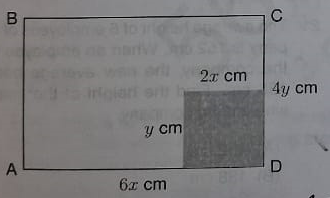
Calculate the unshaded area.
(A) 4x + 3y
(B) 8x + 5y
(C) 12xy
(D) 22xy
12.
The scale on a map is 1 mm : 4 m.
Find the distance on the map for an actual distance of 52 m.
(A) 14 m
(B) 52 mm
(C) 13 mm
(D) 6 mm
13.
If the length of a rectangle is increased by 50% and its breadth is decreased by 25%, what is the change percent in its area?
(A) 12.5% increase
(B) 10% increase
(C) 25% increase
(D) 20% increase
14.
If 4 women or 3 men earn the same amount, then earnings of 11 women and 7 men in a day will be:
(A) ₹ 4880
(B) ₹ 4200
(C) ₹ 4860
(D) ₹ 4480
15.
A prime number is called a “Superprime” if doubling it and then subtracting 1 results in another prime number.
The number of Superprimes less than 15 are:
(A) 2
(B) 3
(C) 4
(D) 5
16. Match the column:
| Column–1 | Column–2 |
|---|---|
| (I) 9 − {7 − 24 ÷ (8 + 6 × 2 − 16)} | (p) 16 |
| (II) (−3) × (−12) ÷ (−4) + 3 × 6 | (q) 13 |
| (III) 17 − {8 − (2 × 3 − 4)} | (r) 9 |
| (IV) 5 × 2 − [3 − {5 − (7 ÷ 2 + 4 − 19)}] | (s) 8 |
AM211 – Mathematics
17. Which of the following statements are correct?
(i) Division by zero is not defined.
(ii) –3 is greater than zero.
(iii) Any number multiplied by zero will give zero.
(iv) 0 is an integer.
(A) (i), (ii), (iii) and (iv)
(B) (i) and (ii)
(C) (i), (iii) and (iv)
(D) (iii) and (iv)
18. The product of the 9 fractions:
[
\left(1 – \frac12\right), \left(1 – \frac13\right), \left(1 – \frac14\right), \ldots , \left(1 – \frac1{10}\right)
]
(A) ( \frac{10}{11} )
(B) ( \frac{1}{9} )
(C) ( \frac{1}{10} )
(D) ( \frac{1}{2} )
19. Read the given statements carefully and select the correct option.
Statement I:
From a ball of string, Rohit cut a 9.25 m length of string and Saransh cut a length 3.6 m longer than Rohit. If the remaining length of string in the ball was twice the total length cut by Rohit and Saransh, then the original length of the string in the ball before it was cut was 78.2 m.
Statement II:
Mr. Sharma painted 2/3 of the kitchen and his son painted 1/12 of it.
Their neighbour helped to paint 1/4 of the kitchen.
So, the fraction of the kitchen that Mr. Sharma and his son painted more than their neighbour is 1/2.
(A) Both Statement I and Statement II are true
(B) Both Statement I and Statement II are false
(C) Statement I is true but Statement II is false
(D) Statement I is false but Statement II is true
20.
A bag contains 30 blue ribbons, 15 red ribbons and 5 black ribbons.
If a ribbon is drawn at random from the bag, find the probability of getting a red ribbon.
(A) ( \frac{3}{10} )
(B) ( \frac{1}{5} )
(C) ( \frac{15}{50} )
(D) ( \frac{2}{11} )
21.
The average height of 6 employees of a company is 152 cm.
When an employee leaves the company, the new average becomes 156 cm.
Find the height of the employee who left the company.
(A) 132 cm
(B) 138 cm
(C) 152 cm
(D) 140 cm
22.
A shopkeeper sells mangoes in two types of boxes — one small and one large.
A large box contains 8 small boxes plus 4 loose mangoes.
Which one of the options given below is the correct equation which gives the number of mangoes in each small box?
The number of mangoes in a large box is 100.
23. Solve:
[
3(x – 3) = 5(2x + 1)
]
(A) 2
(B) 4
(C) –2
(D) ( \frac{3}{7} )
24.
If
( x = \frac{1}{3} ) of right angle,
( y = \frac{2}{3} ) of right angle,
and ( z = \frac{1}{2} ) of right angle,
then ( \angle POS = )
(A) 60°
(B) 45°
(C) 90°
(D) 135°
25.
If the angles of a triangle are in the ratio 1 : 2 : 1, then which of the following statements is/are correct?
(i) Triangle is a right-angled triangle.
(ii) Triangle is an isosceles triangle.
(iii) Angles of triangle are 45°, 45° and 90° respectively.
(A) (i) and (iii) are correct
(B) Only (iii) is correct
(C) (ii) and (iii) are correct
(D) (i), (ii) and (iii) are correct
26.
Find the area of the shaded portion of the figure given below where ABCD is a rectangle and EF ∥ DC.
- AB = 32 cm
- AD = 22 cm
- EF = 19 cm
- BF = 14 cm
Options:
(A) 133 cm²
(B) 143 cm²
(C) 153 cm²
(D) 163 cm²
27. Read the given statements carefully and select the correct option.
Statement I:
If Sujata lost 5% on a laptop which was sold for ₹ 24,700, then the cost price of the laptop was ₹ 26,000.
Statement II:
3% of 1 hour = 108 seconds.
(A) Both Statement I and Statement II are true
(B) Both Statement I and Statement II are false
(C) Statement I is true but Statement II is false
(D) Statement I is false but Statement II is true
28.
If a : b = 3 : 8, find the ratio of
[
(8a + 8b) : (12a + 5b)
]
(A) ( \frac{12}{19} )
(B) ( \frac{9}{24} )
(C) ( \frac{15}{27} )
(D) ( \frac{12}{27} )
29. Which of the following is true about rational numbers?
(i) Every natural number is a rational number and vice-versa.
(ii) Zero is a rational number and it is neither negative nor positive.
(iii) Every negative rational number is less than 0.
(A) (ii) and (iii)
(B) (i) and (ii)
(C) (i), (ii) and (iii)
(D) None of these
30. What is the total on the face opposite to 4 + 3 on the dice given?
Image shows a standard dice net.
(A) 3
(B) 5
(C) 12
(D) 7
31. What is the least number of squares that must be added so that the line PQ becomes a line of symmetry?
(A) 3
32. What must be subtracted from
[
x^4 + 2x^3 – 3x + 7
]
to get
[
x^3 + x^2 + x – 12?
]
(A) ( x^4 – x^3 + x^2 – 4x + 8 )
(B) ( x^4 + x^2 – 4x + 8 )
(C) ( 4 – x^3 + x^2 + 8 )
(D) ( x^4 – x^3 – x^2 + 4x – 8 )
33. If x = 2 and y = 4, then ( x^x + y^y = )
(A) 6
(B) 4
(C) 20
(D) 272
34.
A plot is in the form of a rectangle ABCD having a semi-circle on BC as shown in the figure.
- AB = 60 m
- BC = 28 m
- Semi-circle region on BC is grassy
- Remaining plot is without grass
Find the area of plot without grass.
(A) 3722 m²
(B) 1372 m²
(C) 926 m²
(D) None of these
35. Which of the following statements are correct?
(i) Division by zero is not defined.
(ii) –3 is greater than zero.
(iii) Any number multiplied by zero will give zero.
(iv) 0 is an integer.
(A) (i), (ii), (iii) and (iv)
(B) (i) and (ii)
(C) (i), (iii) and (iv)
(D) (iii) and (iv)
36. In a class test of 20 questions, 5 marks are given for every correct answer and (–2) marks for every incorrect answer. Gurpreet attempts all questions but only 8 of her answers are correct.
If Gurpreet gives 10 correct answers, how many more marks could she get?
(A) 16
(B) 14
(C) 12
(D) 18
37. The numerator and denominator of a fraction are in the ratio 3 : 7.
If 225 is subtracted from both the numerator and the denominator, the ratio becomes 33 : 152.
Find the fraction.
(A) 351/819
(B) 393/917
(C) 423/987
(D) 357/833
38. David throws a die 10 times and the outcomes are:
2, 5, 6, 6, 1, 5, 4, 1, 4, 6
The mean of these observations is:
(A) 3
(B) 4.5
(C) 5
(D) 4
39. In which data set are the mean, median, mode and range all the same numbers?
(A) 1, 2, 3, 3, 2, 1, 2
(B) 1, 2, 3, 1, 2, 3, 1
(C) 1, 3, 3, 3, 2, 3, 1
(D) 2, 2, 1, 2, 3, 2, 3
40. Which of the following options is incorrect?
(A) ( x = 5 ) is the solution of ( 3x + 7 = 22 ).
(B) The equation ( 3x + 5 = 13 ) represents “5 more than 3 times a number x gives 13”.
(C) The solution of the equation ( 5x – 8 = 2 ) is ( x = 2 ).
(D) The solution of the equation ( 10 – 3x = 1 ) is ( x = 4 ).
41. Karan is 4 times as old as Varun.
Five years ago, Karan was 7 times as old as Varun.
Find the present age of Karan.
(A) 10 years
(B) 42 years
(C) 40 years
(D) 28 years
42. Steve and Jack borrowed ₹2000 and ₹2350 respectively at simple interest at the same rate for 5 years.
If the interest paid by Jack is ₹60 more than that paid by Steve, find the rate of interest per annum for Jack.
(A) 3.4%
(B) 8%
(C) 5.2%
(D) None of these
43. A candidate must get 33% marks to pass.
He gets 220 marks and fails by 11 marks.
What is the maximum marks of the exam?
(A) 500
(B) 689
(C) 711
(D) 700
44. Divide ₹21,000 into two parts such that the simple interest on the first part for 3 years at 5% per annum is equal to the simple interest on the second part for 5 years at 4% per annum.
(A) ₹8,000 and ₹13,000
(B) ₹9,000 and ₹12,000
(C) ₹11,000 and ₹10,000
(D) ₹15,000 and ₹6,000
45. Out of the rational numbers
(-\frac{5}{11}, -\frac{5}{17}, -\frac{5}{12}),
which is greater?
(A) (-\frac{5}{11})
(B) (-\frac{5}{12})
(C) (-\frac{5}{17})
(D) None
46. (Directions for Questions 46 to 49)
A rectangular park is 90 m × 80 m.
Four paths pass through the park such that:
- Two paths each of width 2 m are parallel to the breadth
- Two paths each of width 3 m are parallel to the length
Total area of the two roads along the length is:
(A) 270 m²
(B) 810 m²
(C) 540 m²
(D) 504 m²
47. Total area of the two roads along the breadth is:
(A) 320 m²
(B) 160 m²
(C) 230 m²
(D) 270 m²
48. Total area of the four roads is:
(A) 386 m²
(B) 836 m²
(C) 863 m²
(D) 368 m²
49. Area of the remaining portion of the park is:
(A) 6364 m²
(B) 6463 m²
(C) 6634 m²
(D) 6346 m
50. Reciprocal of