Learn about different types of quadrilaterals, their properties, and theorems. Our Class 8 Maths Ganita Prakash NCERT Solutions simplify geometry problems and make exam preparation easier.
Textbook Page 94
Figure it Out
1. Find all the other angles inside the following rectangles.
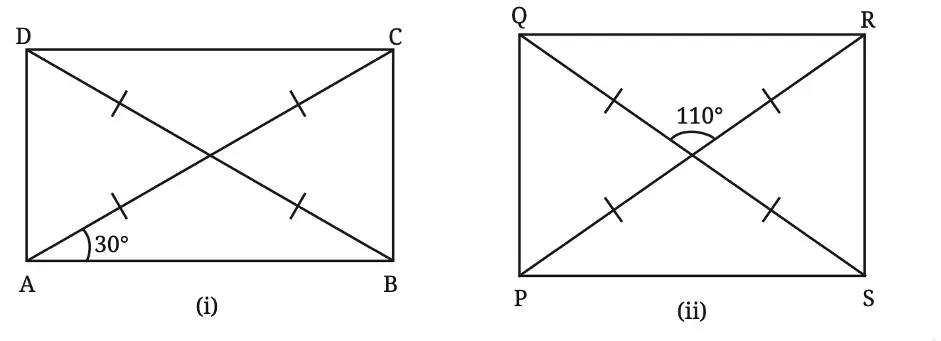
Solution:
(i)
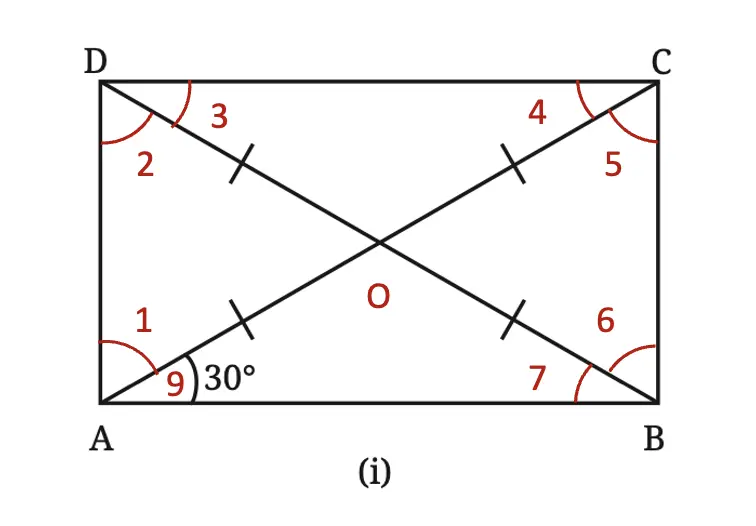
Here, we have : ∠1 + ∠9 = 90° (All corner angles of a rectangle are 90°)
∠1 + 30° = 90° => ∠1 = 90° – 30° = 60° ∠1 = ∠5 = 60° and ∠9 = ∠4 = 30° (Alternate interior angles)
In △AOB, OA = OB, so, angles opposite them are equal
∴ ∠9 = ∠7 = 30° also, ∠7 = ∠3 = 30° (Alternate interior angles)
In △AOD, OA = OD, so, angles opposite them are equal
∴ ∠2 = ∠1 = 60° also, ∠2 = ∠6 = 60° (Alternate interior angles)
In △AOB, ∠9 + ∠7 + ∠AOB = 180° (Sum of angles of a triangle)
30° + 30° + ∠AOB = 180° => 60° + ∠AOB = 180°
∠AOB = 180° – 60° = 120°
∠AOB = ∠COD = 120° (Vertically opposite angles)
∠AOB + ∠AOD = 180° (Linear pair)
120° + ∠AOD = 180° , ∠AOD = 180° – 120°= 60°
∠AOD = ∠BOC = 60° (Vertically opposite angles)
Therefore, ∠1 = ∠5 = ∠2 = ∠6 = ∠AOD = ∠BOC = 60°
∠AOB = ∠COD = 120° and, ∠9 = ∠4 = ∠7 = ∠3 = 30°
(ii)
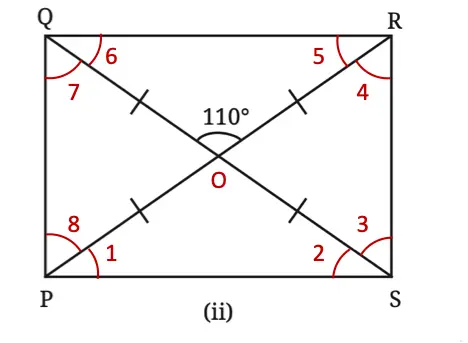
Here we have, ∠POS = ∠ROQ = 110° (Vertically opposite angles)
∠POS + ∠POQ = 180° (Linear Pair)
110° + ∠POQ = 180° so, ∠POQ = 180° – 110° = 70°
∠POQ = ∠SOR = 70° (Vertically opposite angles)
now, In △POS, OP = OS, then the angles opposite them are equal.
∴ ∠1 = ∠2 = a In △POS, ∠1 + ∠2 + ∠POS = 180° (Sum of angles of a triangle)
a + a + 110° = 180° so, a = 35°
∴ ∠1 = ∠2 = a = 35°
∠1 = ∠5 = 35° and ∠2 = ∠6 = 35° (Alternate interior angles)
Since ABCD is a rectangle, ∠P = 90°
∠9 = ∠1 + ∠8 so, 90° = 35° + ∠8 => ∠8 = 90° – 35° = 55°
also, ∠8 = ∠4 = 55° (Alternate interior angles)
Now, In △POQ, OP = OQ, then the angles opposite them are equal
so, ∠7 = ∠8 = 55° and ∠7 = ∠2 = 55° (Alternate interior angles)
Therefore, ∠POS = ∠ROQ = 110° and ∠POQ = ∠SOR = 70°
∠1 = ∠2 = ∠5 = ∠6 = 35° and ∠8 = ∠4 = ∠7 = ∠2 = 55°
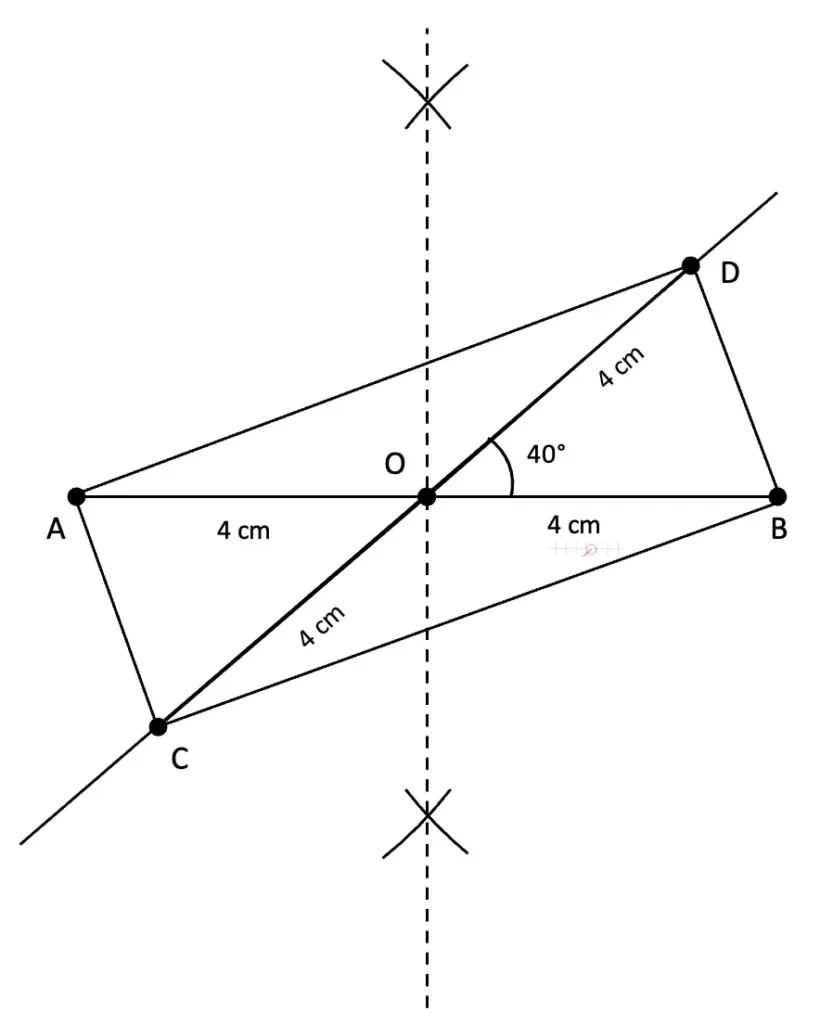
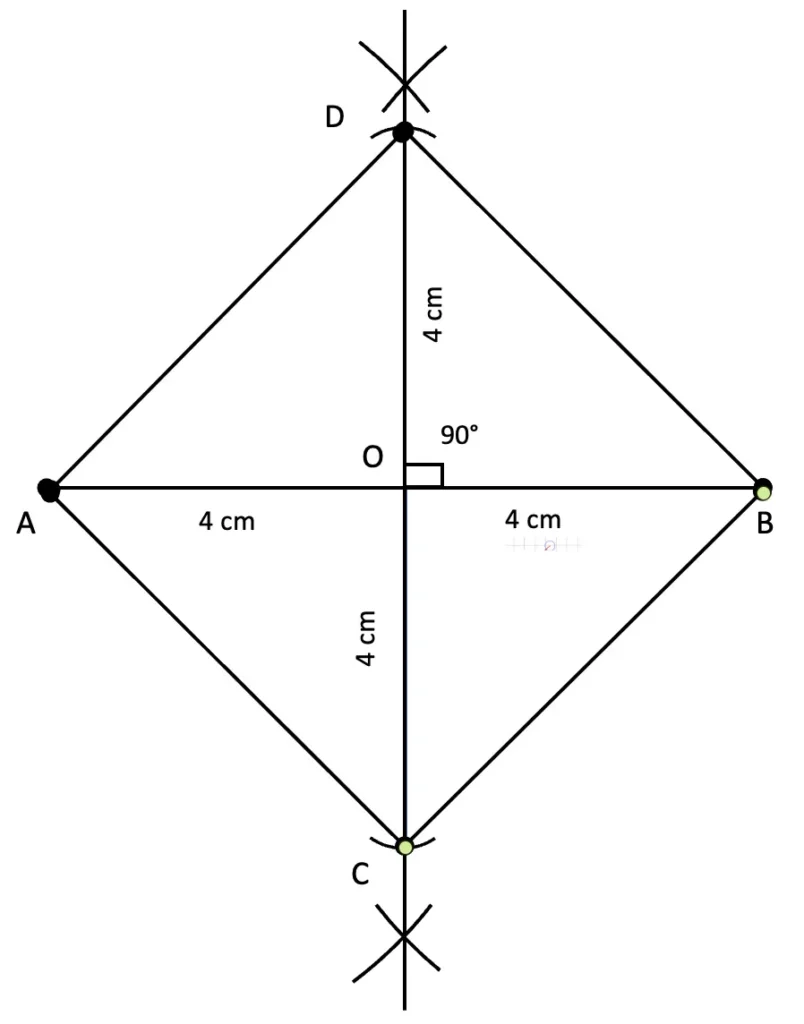
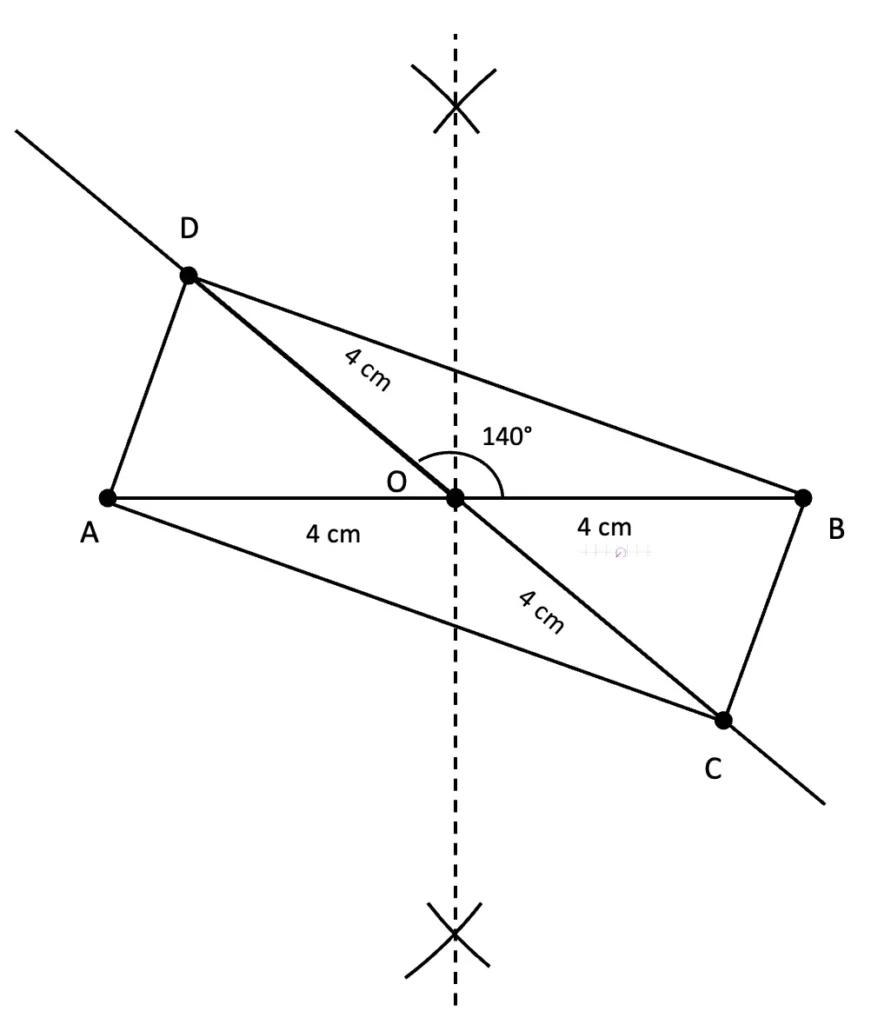
2. Draw a quadrilateral whose diagonals have equal lengths of 8 cm that bisect each other, and intersect at an angle of
(i) 30° (ii) 40° (iii) 90° (iv) 140°
Solution:
(i) 30°
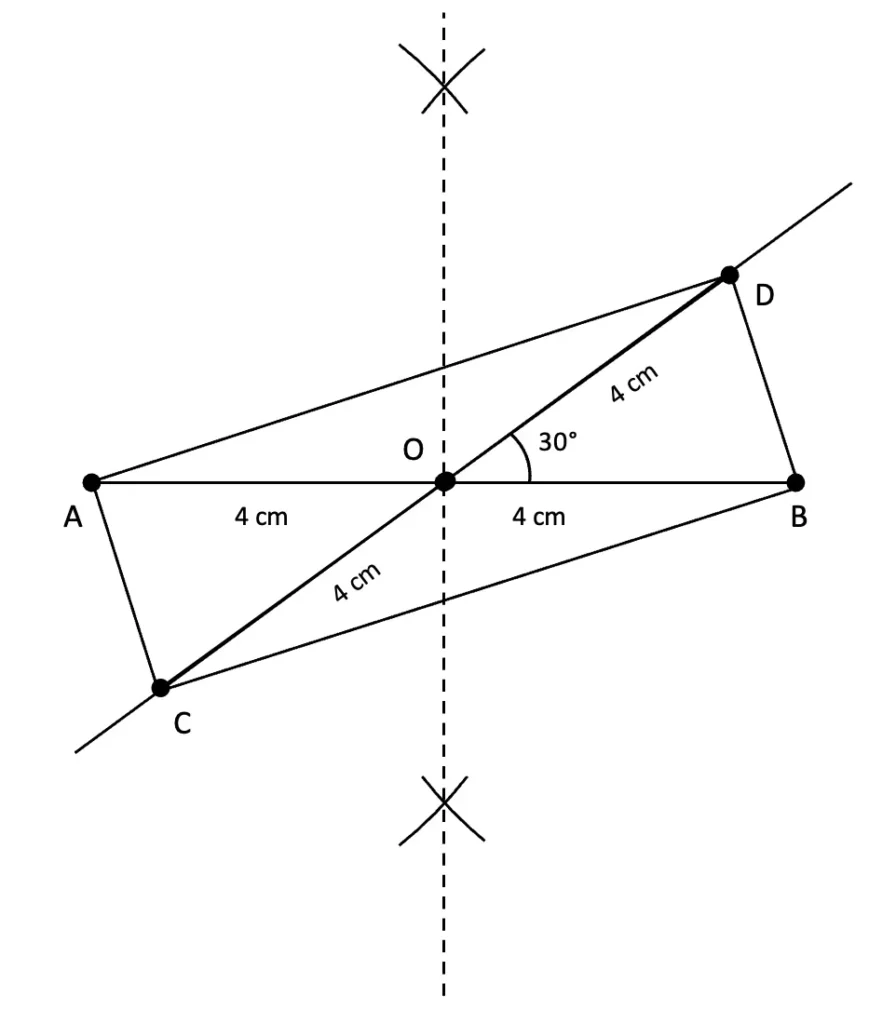
(ii) 40°
(iii) 90°
(iv) 140°
3. Consider a circle with centre O. Line segments PL and AM are two perpendicular diameters of the circle. What is the figure APML? Reason and/or experiment to figure this out.
Solution:
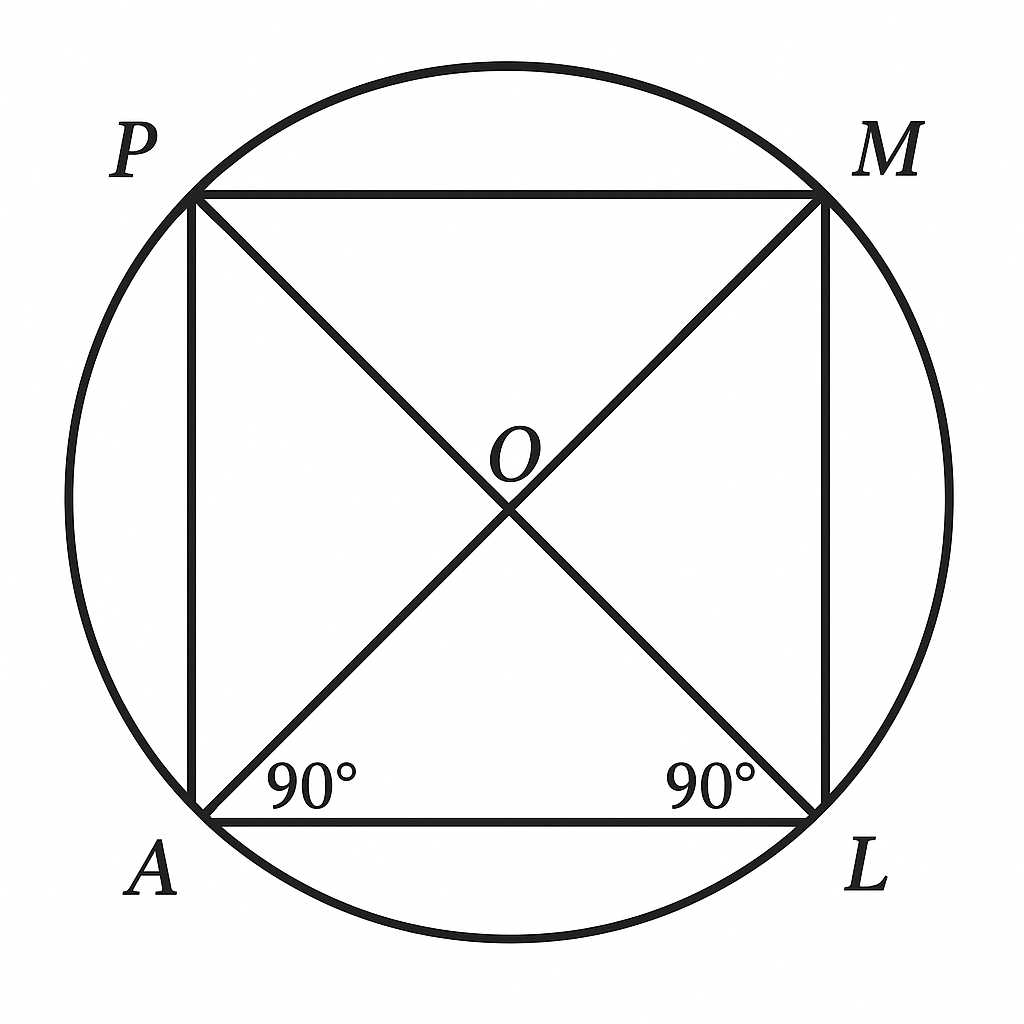
APML is a square.
Reason:
- AM and PL are diameters and are perpendicular, so the central angles ∠AOP=∠POM=∠MOL=∠LOA=90∘.
- Equal central angles subtend equal chords ⇒ AP=PM=ML=LA.
- Also, any angle subtending a diameter is a right angle ⇒ ∠APM=∠PML=∠MLA=∠LAP=90∘.
So the quadrilateral has all sides equal and all angles 90∘ ⇒ it is a square.
4. We have seen how to get 90° using paper folding. Now, suppose we do not have any paper but two sticks of equal length, and a thread. How do we make an exact 90° using these?
Solution:
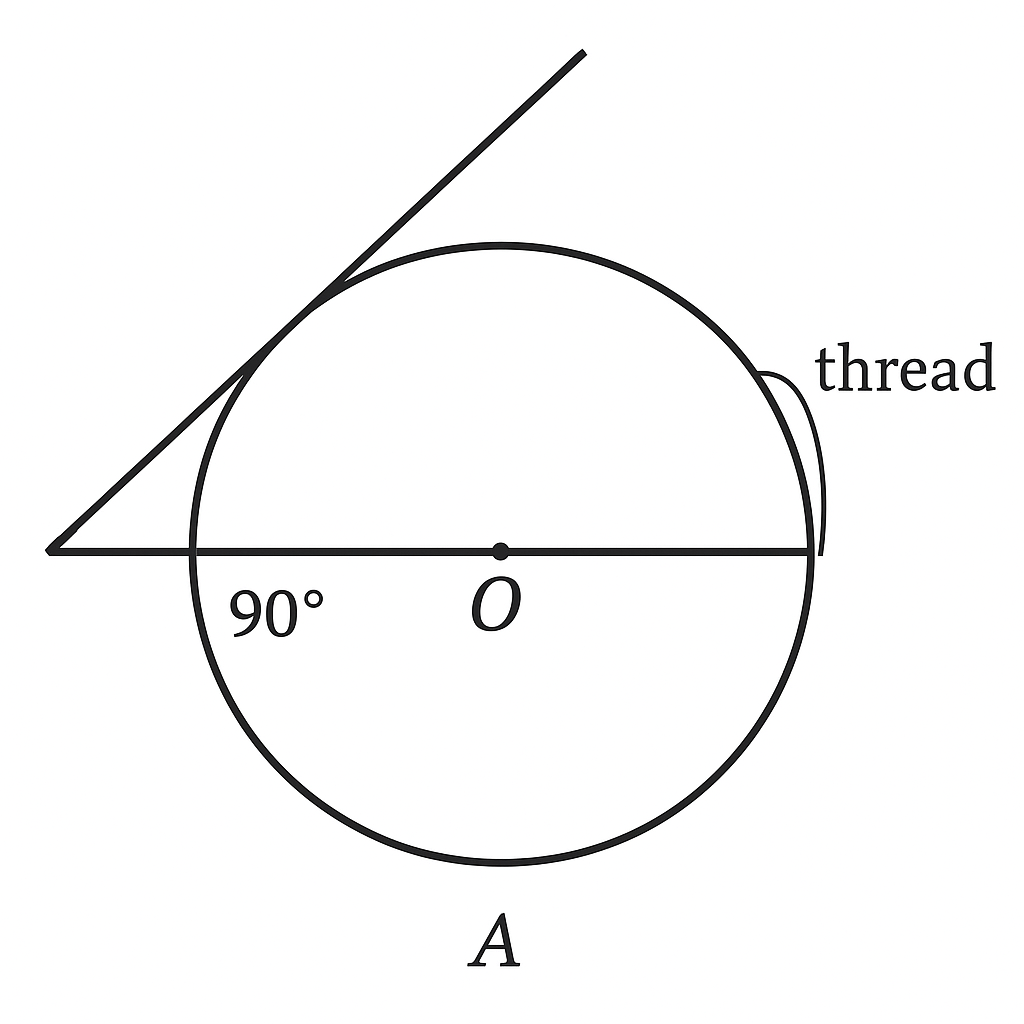
Steps:
- Form a circle:
- Tie the thread to one stick’s end.
- Stretch the thread to the other stick’s end.
- Now use the thread as a radius to imagine/mark a circle with the first stick’s end as the center.
- Draw a diameter:
- Place both sticks end to end in a straight line, across the circle (so that their combined length is equal to the diameter of the circle).
- Find the right angle:
- Any angle in a semicircle is a right angle (Thales’ theorem).
- So, if you connect the two ends of the diameter to any other point on the circle (using the thread to measure the radius), the angle at that point will be exactly 90°.
5. We saw that one of the properties of a rectangle is that its opposite sides are parallel. Can this be chosen as a definition of a rectangle? In other words, is every quadrilateral that has opposite sides parallel and equal a rectangle?
Solution:
Property being tested
“A rectangle is a quadrilateral whose opposite sides are parallel and equal.”
Step 1: Opposite sides parallel and equal
A quadrilateral with opposite sides parallel and equal is by definition a parallelogram.
Step 2: Does every parallelogram become a rectangle?
- In a parallelogram, opposite sides are parallel and equal.
- But for a rectangle, we also need all angles = 90°.
- A rhombus and a parallelogram (tilted) both have opposite sides parallel and equal, but their angles are not 90∘.
Conclusion-
No, we cannot define a rectangle only by “opposite sides parallel and equal.” That condition defines a parallelogram. To make it a rectangle, we must also require all interior angles are right angles (90°). So the correct definition of a rectangle is: A rectangle is a parallelogram with all angles equal to 90 degree.
Textbook Page 102
1. Find the remaining angles in the following quadrilaterals.
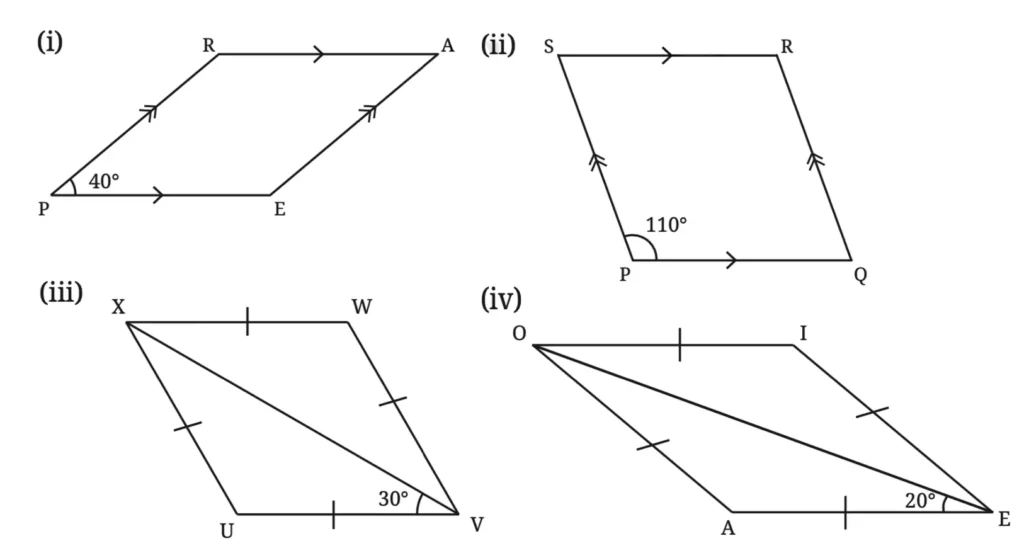
Solution:
(i) Here we have, PR ∥ EA, and PE ∥ RA
so, PEAR is a parallelogram.
∠P = ∠A = 40° (Opposite angles of parallelogram are equal)
∠P + ∠R = 180° (The sum of adjacent angles of a parallelogram is 180°)
40° + ∠R = 180° , ∠R = 180° – 40°= 140°.
∠R = ∠E = 140° (Opposite angles of parallelogram are equal)
(ii) Here we have, PQ ∥ SR, and PS ∥ QR
so PQRS is a parallelogram.
∠P = ∠R = 110° (Opposite angles of parallelogram are equal)
∠P + ∠S = 180° (sum of adjacent angles of parallelogram is 180°)
110° + ∠S = 180° , ∠S = 180° – 110° = 70°.
∠S = ∠Q = 70° (Opposite angles of parallelogram are equal)
(iii) Here we have, XWUV is a rhombus (all sides are equal).
now, In △VUX, UV = UX, therefore angles opposite them are equal.
∴ ∠UXV = ∠UVX = 30° => ∠UXV = ∠WXV = 30° (The diagonals of a rhombus bisect its angles)
Also we have, ∠UVX = ∠WVX = 30° (diagonals of a rhombus bisect its angles) now, ∠E = 2 × ∠UVX = 2 × 30° = 60°
∠V = ∠X = 60° (Opposite angles of rhombus are equal)
∠V + ∠U = 180° (sum of adjacent angles of rhombus is 180°)
60° + ∠U = 180°, ∠U = 180° – 60° = 120°
∠U = ∠W = 120° (Opposite angles of rhombus are equal)
(iv) Here we have, AEIO is a rhombus (all sides equal).
In △EAO we have , AE = AO, then angles opposite them are equal.
so, ∠AOE = ∠AEO = 20°
∠AEO = ∠IEO = 20° (diagonals of rhombus bisect its angles)
Also we have, ∠AOE = ∠IOE = 20° (diagonals of rhombus bisect its angles) ∠E = 2 × ∠AEO = 2 × 20° = 40°
∠E = ∠O = 40° (Opposite angles of rhombus are equal)
∠E + ∠A = 180° (sum of adjacent angles of rhombus is 180°)
40° + ∠A = 180°, ∠A = 180° – 40°= 140°
∠A = ∠I = 140° (Opposite angles of rhombus are equal)
2. Using the diagonal properties, construct a parallelogram whose diagonals are of lengths 7 cm and 5 cm, and intersect at an angle of 140°.
Solution:
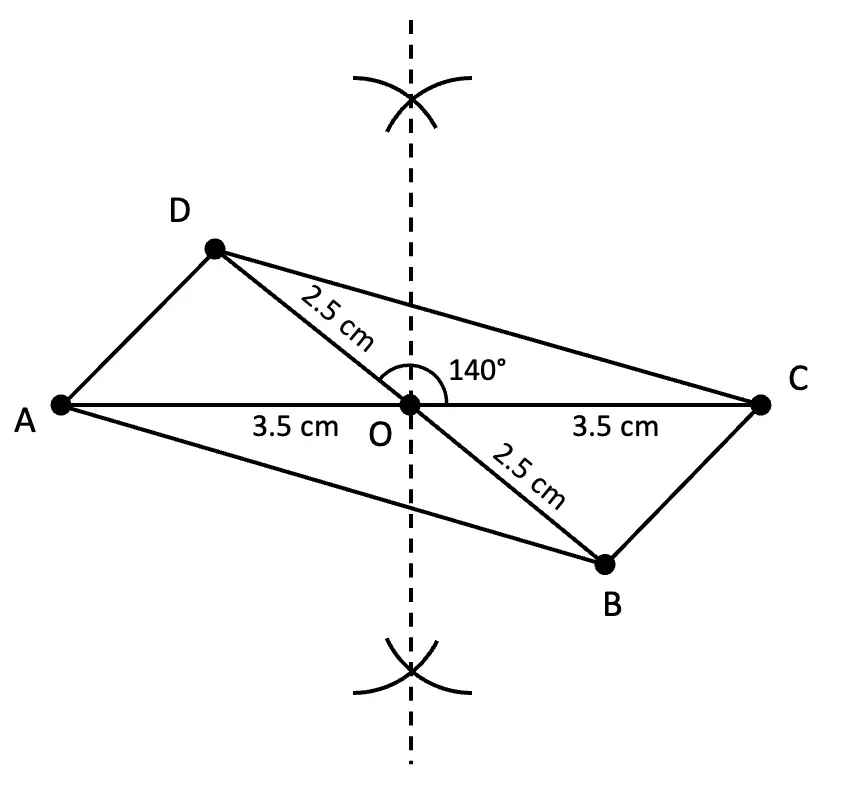
Steps of Construction:
- Draw a line segment AC = 7 cm and mark its midpoint as O.
- At O, construct an angle of 140° with respect to diagonal AC.
- On this line, mark points B and D such that OB = OD = 2.5 cm.
- Join D to A and C.
- Join B to A and C.
Thus, ABCD is the required parallelogram.
3. Using the diagonal properties, construct a rhombus whose diagonals are of lengths 4 cm and 5 cm.
Solution:
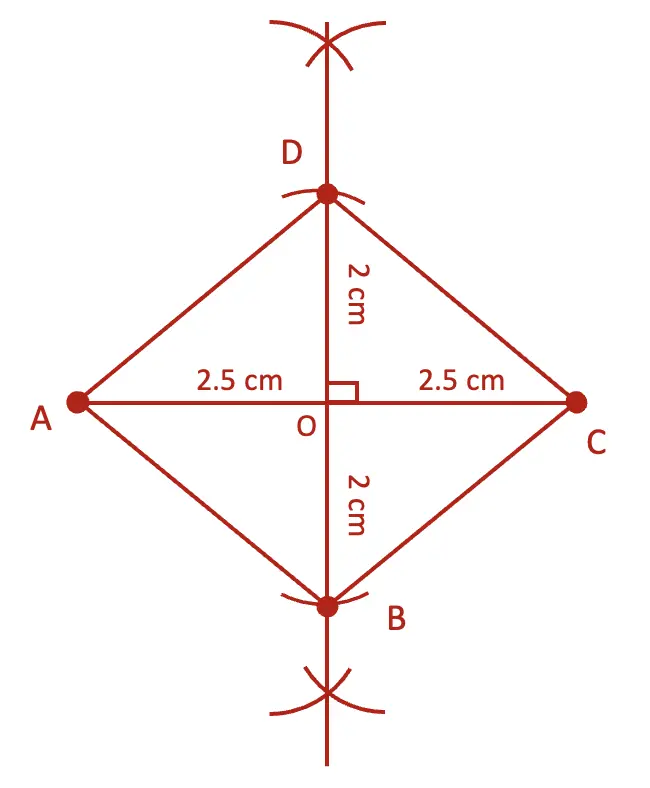
Steps of Construction:
- Draw a line segment AC = 5 cm.
- Construct the perpendicular bisector of AC, meeting it at O.
- With O as the centre and radius 2 cm, mark points B (below) and D (above) on the bisector.
- Join A–D, D–C, C–B, and B–A.
Thus, ABCD is the required rhombus.
Textbook Page 107
1. Find all the sides and the angles of the quadrilateral obtained by joining two equilateral triangles with sides 4 cm.
Solution:
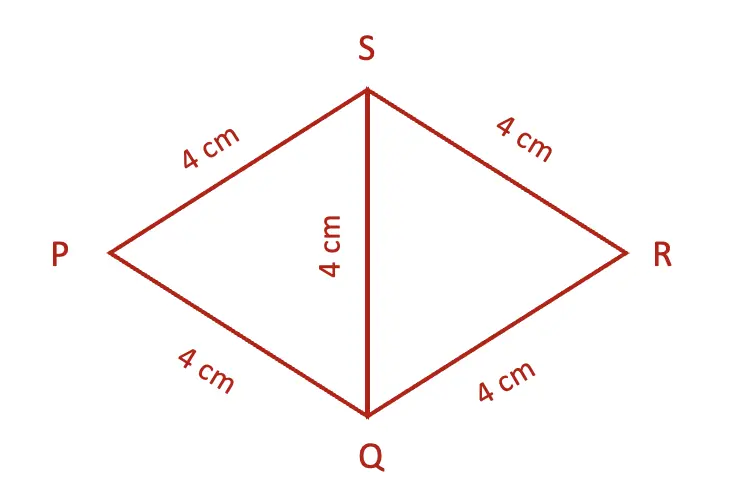
Since all sides of an equilateral triangle are equal, the sides of the quadrilateral formed are also equal.
PQ=QR=RS=SP=4 cm
Each angle of an equilateral triangle measures 60°.
∠P=∠R=60∘
At vertex S:
∠S=∠PSQ+∠RSQ=60∘+60∘=120∘
At vertex Q:
∠Q=∠PQR+∠RQS=60∘+60∘=120∘
Thus, the quadrilateral PQRS has all sides equal to 4 cm, with angles:
∠P=∠R=60∘,∠Q=∠S=120∘
2. Construct a kite whose diagonals are of lengths 6 cm and 8 cm.
Solution:
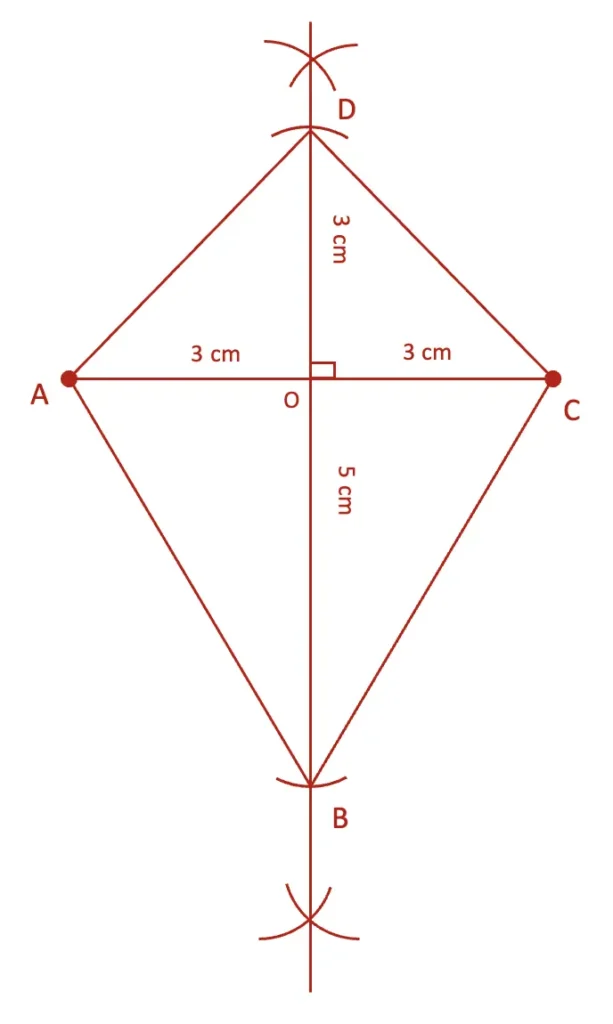
To construct kite ABCD:
- Draw segment AC=6 cm.
- Find midpoint O of
AC and draw its perpendicular bisector. - From O, draw an arc with radius 3 cm above AC to mark point D. Draw an arc with radius 5 cm below AC to mark point B.
- Connect A−B, B−C, C−D, and D−A.
Quadrilateral ABCD is the required kite.
3. Find the remaining angles in the following trapeziums —
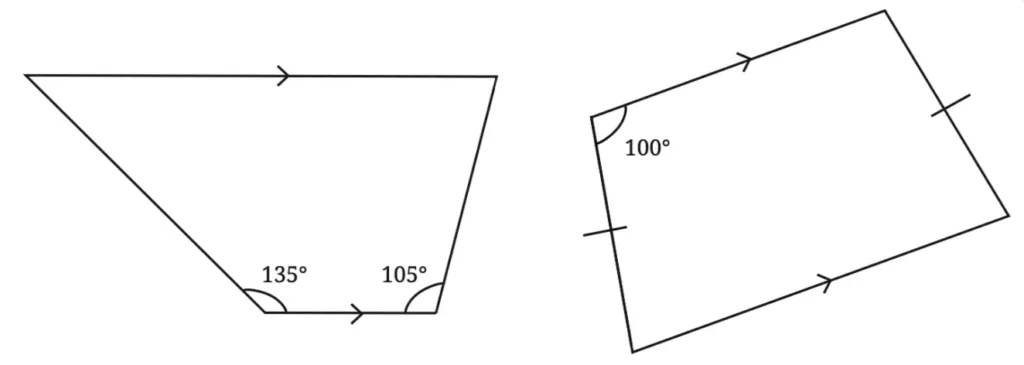
Solution:
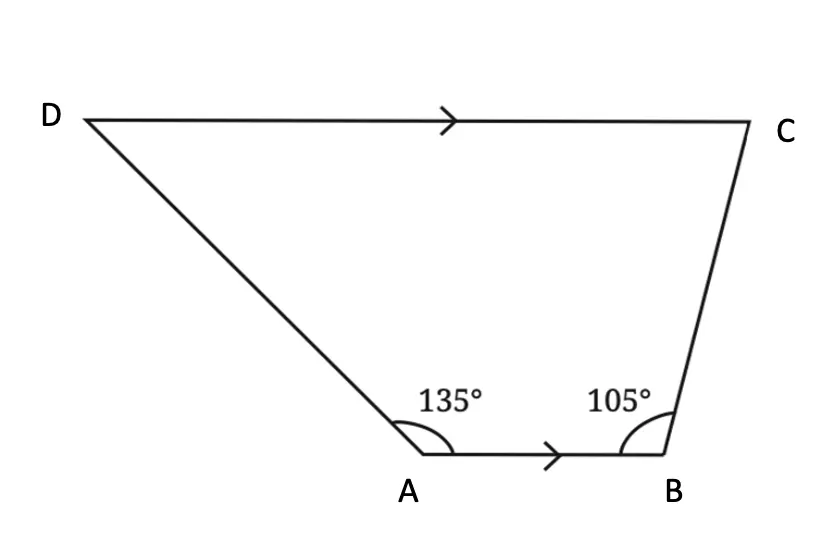
Since AB ∥ DC & AD is a tranversal line , we have
∠A + ∠D = 180° (Sum of angles on same side of transversal)
135° + ∠D = 180°, ∠D = 180° – 135°= 45°
now, since AB ∥ DC & BC is a tranversal line , we have
∠B + ∠C = 180° (Sum of angles on same side of transversal)
105° + ∠C = 180°, ∠C = 180° – 105°, ∠C = 75°
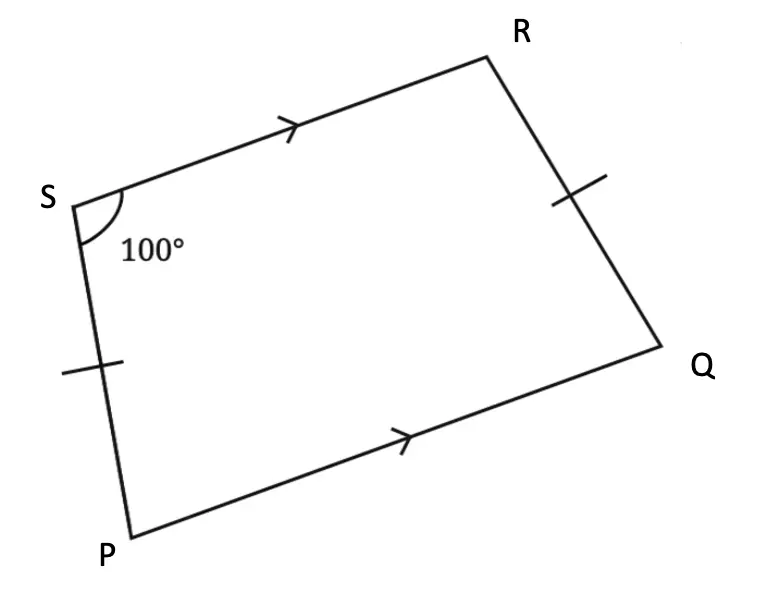
we have PQ ∥ SR & PS is a tranversal, we have
∠P + ∠S = 180° (Sum of angles on same side of transversal)
∠P + 100° = 180°, ∠P = 180° – 100° = 80°
∠S = ∠R = 100° (Angles opposite to equal sides are equal)
Also, we have PQ ∥ SR, and QR is a tranversal, so
∠Q + ∠R = 180° (Sum of angles on same side of transversal)
∠Q + 100° = 180°, ∠Q = 180° – 100° = 80°.
4. Draw a Venn diagram showing the set of parallelograms, kites, rhombuses, rectangles, and squares. Then, answer the following questions —
(i) What is the quadrilateral that is both a kite and a parallelogram?
(ii) Can there be a quadrilateral that is both a kite and a rectangle?
(iii) Is every kite a rhombus? If not, what is the correct relationship between these two types of quadrilaterals?
Solution:
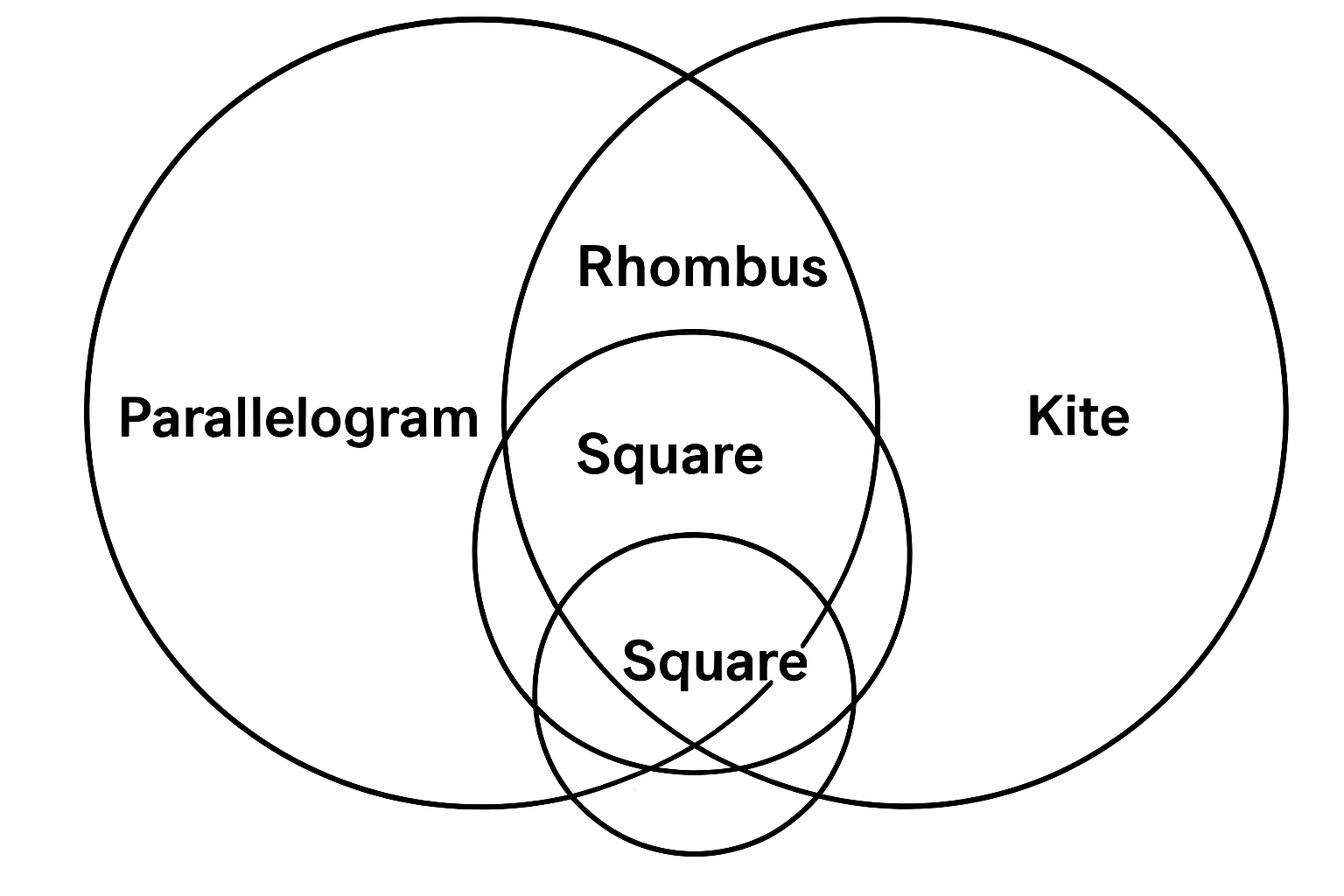
(i) Quadrilateral that is both a kite and a parallelogram → Rhombus (since it has both properties).
(ii) Quadrilateral that is both a kite and a rectangle → Yes, the square (because it is a special kite and also a rectangle).
(iii) Is every kite a rhombus? → No.
- A kite only requires two pairs of adjacent equal sides.
- A rhombus requires all four sides equal.
Correct relationship: Every rhombus is a kite, but not every kite is a rhombus.
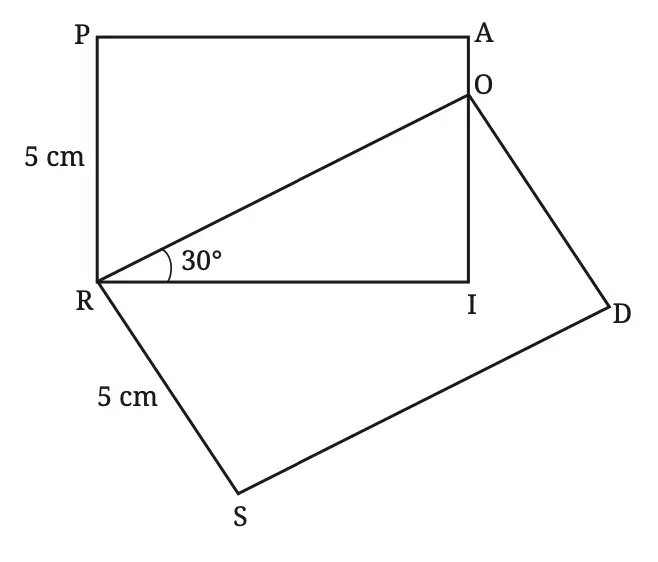
5. If PAIR and RODS are two rectangles, find ∠IOD.
Solution:
Since PAIR and RODS are triangles, and
∠RIO=90∘ (corner angle of a rectangle).
In △RIO:
∠IRO+∠IOR+∠RIO=180∘30∘+∠IOR+90∘=180∘120∘+∠IOR=180∘ ⇒ ∠IOR=60∘
Therefore,
∠IOD=90∘−∠IOR=90∘−60∘=30∘
Hence, ∠IOD=30∘.
6. Construct a square with a diagonal 6 cm without using a protractor.
Solution:
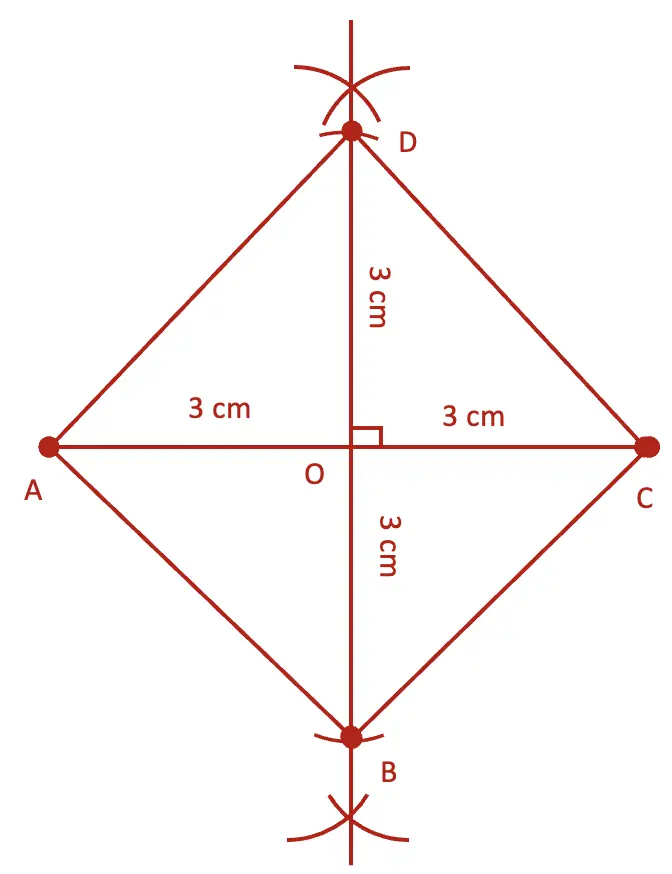
Steps of Construction:
- Draw a line segment AC = 6 cm and mark its midpoint as O.
- With O as the centre and radius greater than half of AC, draw arcs above and below the line from points A and C.
- Join the intersections of these arcs to obtain a line perpendicular to AC through O.
- With O as the centre and radius 3 cm, mark points B and D on this perpendicular line.
- Join the points in order: A–B–C–D–A.
Thus, ABCD is the required square whose diagonal is 6 cm.
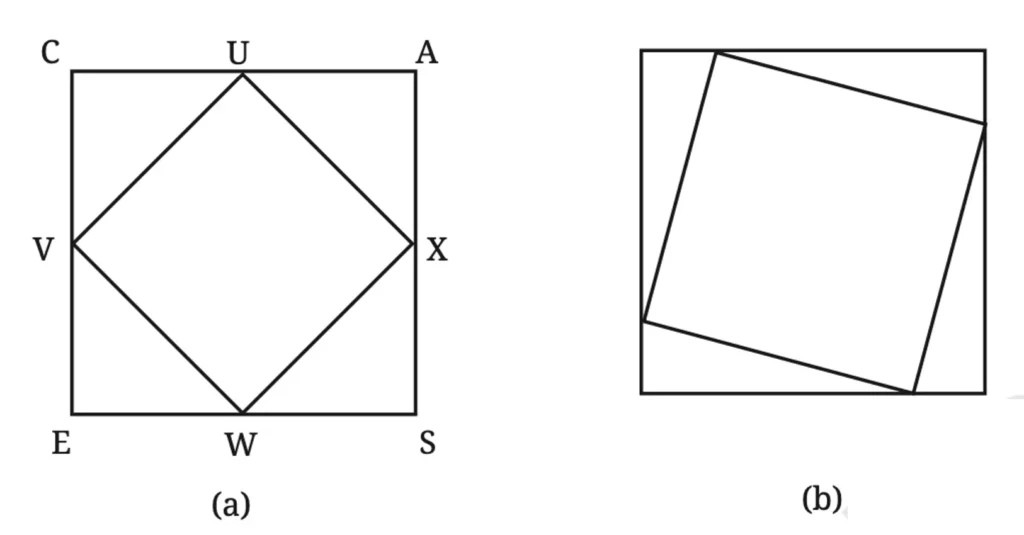
7. CASE is a square. The points U, V, W and X are the midpoints of the sides of the square. What type of quadrilateral is UVWX? Find this by using geometric reasoning, as well as by construction and measurement. Find other ways of constructing a square within a square such that the vertices of the inner square lie on the sides of the outer square, as shown in Figure (b).
Solution:
- In a square CASE, join the midpoints of the four sides → quadrilateral UVWX.
- By Varignon’s theorem, UVWX is a parallelogram.
- Here, all sides are equal and adjacent sides are perpendicular ⇒ UVWX is a square, rotated 45∘.
- If outer side = s, inner side = s/2, area = s2/2.
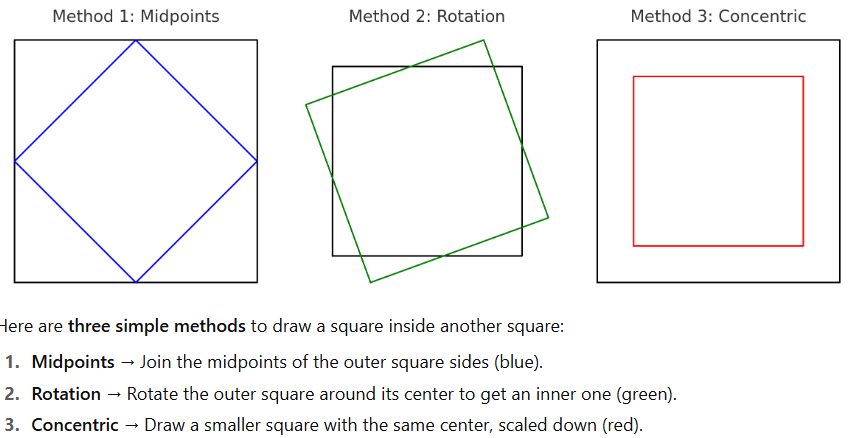
Other constructions for a square inside a square (vertices on sides):
- Rotate the outer square about its centre by any angle → intersections with sides form the inner square.
- Pick a point on one side, reflect through centre to opposite side, then draw perpendiculars through these points to get the other two vertices.
- Draw a smaller concentric square, then rotate it so its vertices touch the sides.
8. If a quadrilateral has four equal sides and one angle of 90°, will it be a square? Find the answer using geometric reasoning as well as by construction and measurement.
Solution: Yes — it must be a square.
Geometric reasoning
- “Four equal sides” ⇒ the quadrilateral is a rhombus ⇒ a parallelogram (opposite sides parallel).
- In any parallelogram, adjacent angles are supplementary.
If one angle is 90∘, then the adjacent angle is 180∘−90∘=90∘.
By opposite-angle equality in a parallelogram, all four angles are 90∘. - Thus we have a parallelogram with all sides equal and all angles right ⇒ square.
Straightedge–compass construction (to verify)
- Draw AB=s.
- At A, construct a perpendicular and mark AD=s.
- Draw circles: center B radius s, and center D radius s. Let them meet at C.
- Join BC,CD.
Then AB=BC=CD=DA=s and ∠A=90∘. By the reasoning above, the other angles also measure 90∘. Measuring confirms a square ABCD.
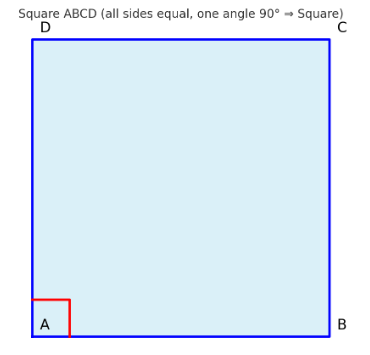
Here’s the diagram. A quadrilateral with all sides equal and one right angle becomes a square, since the right angle forces all four angles to be 90°.
9. What type of quadrilateral is one in which the opposite sides are equal? Justify your answer.
Hint: Draw a diagonal and check for congruent triangles.
Solution:
IA quadrilateral in which the opposite sides are equal is a parallelogram.
Justification:
- If opposite sides are equal, then they are also parallel (by the Converse of the Parallelogram Law).
- In a parallelogram, both pairs of opposite sides are parallel and equal.
- Hence, the given quadrilateral must be a parallelogram.
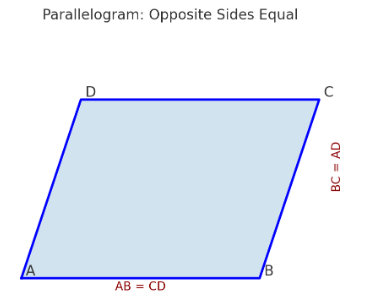
Here’s the diagram showing a quadrilateral with opposite sides equal.
Such a quadrilateral is a parallelogram, since equality of opposite sides guarantees parallelism and the parallelogram property.
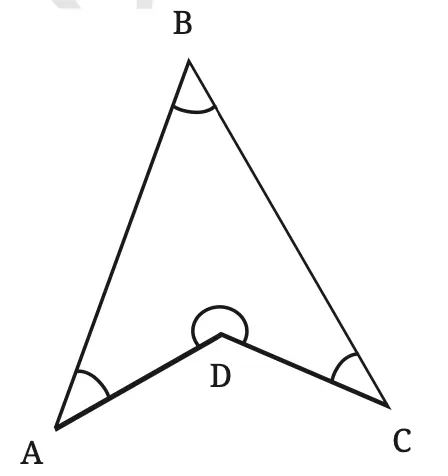
10. Will the sum of the angles in a quadrilateral such as the following one also be 360°? Find the answer using geometric reasoning as well as by constructing this figure and measuring.
Solution:
Yes, the sum of the angles in any quadrilateral is always 360°.
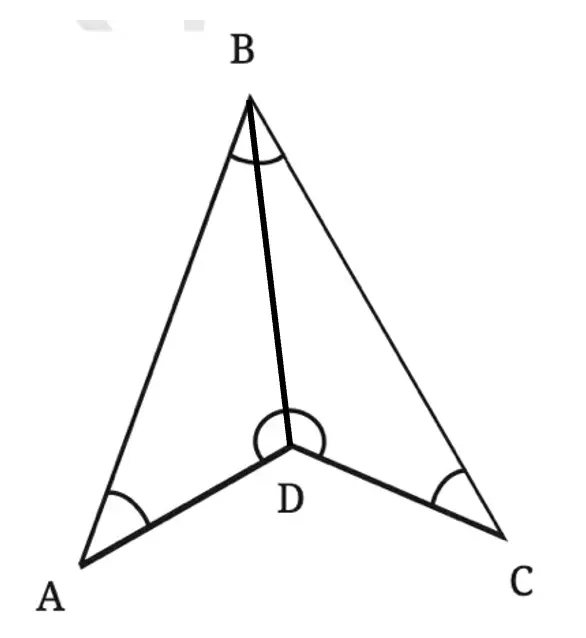
Construction: Plot four non-collinear points A,B,C, and D, then join them in order to form quadrilateral ABCD.
Geometric reasoning:
In quadrilateral ABCD, draw diagonal BD, dividing it into two triangles.
In △BAD:
∠DBA+∠BAD+∠ADB=180∘ ……….(1)
In △BCD:
∠BCD+∠CDB+∠DBC=180∘ ……….(2)
Adding (1) and (2):
∠DBA+∠BAD+∠ADB+∠BCD+∠CDB+∠DBC=360∘
Rearranging:
(∠DBA+∠DBC)+(∠ADB+∠CDB)+∠BAD+∠BCD=360∘
∠ABC+∠ADC+∠BAD+∠BCD=360∘
Hence, the sum of the angles of a quadrilateral is always 360°.
11. State whether the following statements are true or false. Justify your answers.
(i) A quadrilateral whose diagonals are equal and bisect each other must be a square.
Solution: False.
A quadrilateral with equal diagonals that bisect each other is called a rectangle. When all its sides are also equal, it becomes a square, which is a special type of rectangle.
(ii) A quadrilateral having three right angles must be a rectangle.
Solution: True.
If a quadrilateral has three right angles, the fourth angle must also be a right angle. Hence, a quadrilateral with four right angles is a rectangle.
(iii) A quadrilateral whose diagonals bisect each other must be a parallelogram.
Solution: True.
If the diagonals of a quadrilateral bisect each other, they divide the figure into two congruent triangles. This implies that opposite sides are parallel, and therefore, the quadrilateral is a parallelogram.
(iv) A quadrilateral whose diagonals are perpendicular to each other must be a rhombus.
Solution: False.
Squares, kites, and certain other quadrilaterals also have perpendicular diagonals. Hence, perpendicular diagonals alone do not guarantee that the quadrilateral is a rhombus.
(v) A quadrilateral in which the opposite angles are equal must be a parallelogram.
Solution: True.
If both pairs of opposite angles are equal, then each pair of adjacent angles becomes supplementary, implying that opposite sides are parallel. Therefore, the quadrilateral is a parallelogram.
(vi) A quadrilateral in which all the angles are equal is a rectangle.
Solution: True
If all four angles are equal, then each angle = 360° ÷ 4 = 90°. A quadrilateral with four right angles is a rectangle.
(vii) Isosceles trapeziums are parallelograms.
Solution: False.
An isosceles trapezium has one pair of parallel sides with the non-parallel sides equal, whereas a parallelogram has two pairs of parallel sides. Hence, an isosceles trapezium is not a parallelogram.