Exercise Questions (Page 82)
Question 1: Analyse how geography (particularly mountains and coastlines) guided Maratha military strategy and state formation.
Answer:
- Mountains: The Western Ghats gave Shivaji natural defenses and bases like Raigad and Pratapgad, vital for guerrilla warfare and controlling routes. Forests around Pratapgad enabled the 1659 ambush of Afzal Khan.
- Coastlines: The Konkan coast helped Shivaji build a navy to secure trade and challenge Europeans. Forts like Sindhudurg protected resources, while Kanhoji Angre used the coast to outmaneuver foreign ships.
- State Formation: Rugged terrain and forts let the Marathas resist stronger powers, while coastal trade funded wars and cultural growth, linking to ports like Mocha and Muscat.
Question 2: Imagine you are creating a short biography of a Maratha leader for younger students. Choose one personality (Kanhoji Angre, Baji Rao I, Mahadji Shinde, Ahilyabai Holkar, or Tarabai) and write 3-4 paragraphs highlighting what makes them inspirational. Include at least one challenge they overcame.
Answer:
Ahilyabai Holkar: A Beacon of Compassion and Leadership
Ahilyabai Holkar (1725–1795), the Maratha queen of Indore, ruled for 30 years with wisdom, compassion, and dedication. Born into a humble family, she rose to power after losing her husband and son, showing resilience and empathy in leadership. Her reign was marked by fair governance and public works—building roads, wells, and temples from Kedarnath to Rameswaram—earning her the title of the “people’s queen.”
Ahilyabai faced the great loss of her husband in 1754 and later her son, leaving her to rule alone in a male-dominated era. Yet, she confidently managed finances, military, and justice, turning personal grief into strength. Her resilience and leadership make her a timeless role model.
Beyond governance, Ahilyabai rebuilt sacred sites like the Kashi Vishwanath temple and promoted the Maheshwar weaving industry, keeping traditional crafts alive. Her devotion to public welfare across caste and religion reflected her inclusive vision, inspiring youth to value fairness and service.
Ahilyabai’s legacy shows that true leadership blends strength with kindness. Despite personal loss, she prioritized people’s welfare, becoming a lasting symbol of courage and compassion for young learners.
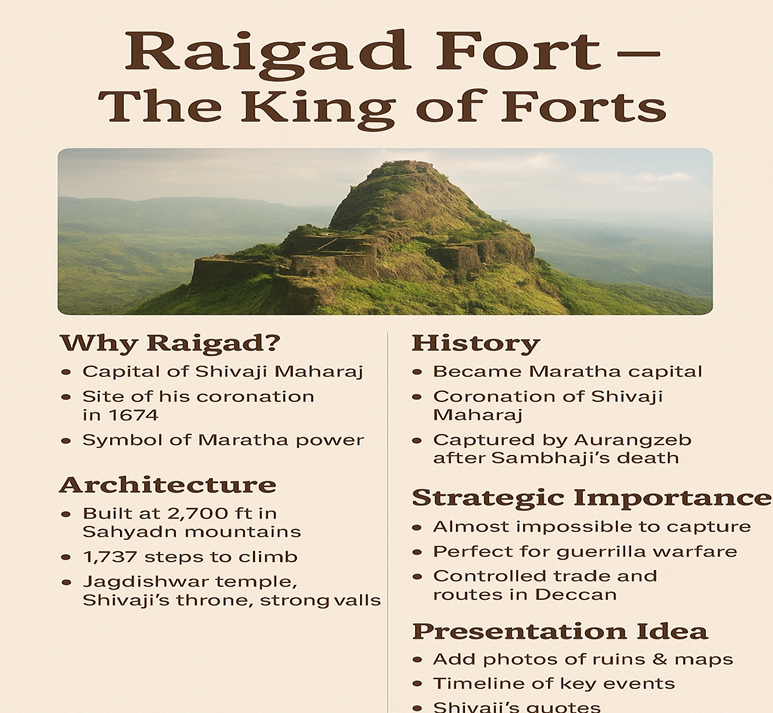
Question 3: If you could visit one Maratha fort today (such as Raigad, Sindhudurg, Gingee, or Pratapgad), which would you choose and why? Research its history, architecture, and strategic importance. Present your findings as a digital presentation or a poster in class.
Answer:
Chosen Fort: Raigad
- Why: Raigad, called the “King of Forts,” was Shivaji’s capital and the place of his 1674 coronation. It is important because of its history, design, and role in the Maratha empire.
- History: Raigad became the Maratha capital and the site of Shivaji’s coronation. Later, it was captured by Aurangzeb after the death of Shivaji’s son Sambhaji.
- Architecture: The fort is built 2,700 feet high in the Sahyadri mountains. It has 1,737 steps, strong walls, natural cliffs for protection, and important sites like the Jagdishwar temple and Shivaji’s throne.
- Strategic Importance: Its high location and tough terrain made it very hard to capture. It was useful for guerrilla warfare and for controlling routes in the Deccan. It also gave shelter to the Marathas during Mughal invasions.
- Presentation Idea: A digital slideshow or poster with pictures of Raigad’s ruins, maps, a timeline of key events, and quotes from Shivaji’s time.
Question 4: The chapter states, “The British took India from the Marathas more than from the Mughals or any other power.” What do you think this means? What evidence from the chapter supports this idea?
Answer: The Marathas, at their peak in the 18th century, were the main power the British had to defeat to establish rule in India, unlike the weakened Mughals.
Evidence:
- They controlled vast regions, including Lahore, Attock, and Delhi (recaptured in 1771 by Mahadji Shinde).
- The three Anglo-Maratha Wars (1775–1818) show they were the British’s chief rivals.
- Nana Phadnavis even built an anti-British alliance with Hyder Ali and the Nizam, proving Maratha dominance.
Question 5: Compare how Shivaji and later Marathas treated religious places and people of different faiths. What evidence from the chapter shows their approach to religious diversity?
Answer:
- Shivaji’s Approach: A devout Hindu who respected all faiths, sparing religious sites during the Surat raid, rebuilding temples, and promoting Sanskrit and Marathi over Persian without intolerance. His saffron flag symbolized cultural pride, not discrimination.
- Later Marathas: Ahilyabai Holkar rebuilt temples like Kashi Vishwanath and supported public works for all. Thanjavur Marathas fostered a syncretic culture, patronizing Carnatic music and Bharatanatyam. Yet, some campaigns (e.g., Bengal) showed lapses.
- Comparison: Both upheld Hindu traditions without widespread persecution. Shivaji’s rule was more disciplined, while later Marathas’ decentralized power led to occasional deviations.
Question 6: The chapter describes how forts were ‘the core of the state’ for Marathas. Why were they so important? How did they help the Marathas survive against larger enemies?
Answer:
- Importance of Forts: As noted in Adnyapatra, forts were vital to Maratha power—securing the state, guarding routes, housing armies, and symbolizing resilience.
- Survival Against Larger Enemies:
- Defense: Mountain forts like Raigad and Pratapgad were nearly impregnable.
- Guerrilla Warfare: Served as bases for ambushes, e.g., Pratapgad (1659).
- Strategic Control: Hundreds of forts let Marathas dominate Deccan routes and disrupt supplies.
- Evidence: Even after Aurangzeb took Bijapur and Golconda, forts sustained Maratha resistance under Tarabai and enabled later expansion.
Question 7: You have been appointed as the chief designer for Maratha coins. Design a coin that represents Maratha achievements and values. Explain the symbols you chose.
Answer:Coin Design
Obverse: Saffron flag with sun (Swarajya & revival), inscription in Modi script: “Shri Raja Shiva Chhatrapati.”
Reverse: Fort (Raigad) with ship (naval power), Devanagari inscription invoking Ganesha.
Symbols:
- Flag & Sun: Maratha pride and Shivaji’s self-rule.
- Fort: Strategic core of Maratha power (Adnyapatra).
- Ship: Navy’s resistance to Europeans.
- Scripts & Ganesha: Cultural revival and tradition in governance
Question 8: After this introduction to the Maratha period, what do you think was their most important contribution to Indian history? Write a paragraph supporting your opinion with examples from the chapter. Then share and discuss your ideas with classmates.
Answer:
Marathas’ Contribution:
The Marathas inspired self-rule and cultural pride, laying foundations for India’s freedom movement. Shivaji’s Swarajya, forts, and navy defied Mughals and Europeans, while his inclusive policies promoted unity. Leaders like Tarabai and Ahilyabai revived traditions and built temples without bias. Thanjavur Marathas enriched arts like Bharatanatyam and Carnatic music. By ruling vast regions and resisting the British till 1818, they proved Indians could govern themselves, inspiring later independence struggles.