🌟 Introduction
In today’s fast-changing digital era, Artificial Intelligence (AI) is transforming the way humans think, learn, communicate, and solve problems. Technologies such as voice assistants, smart devices, recommendation systems, facial recognition, and automated decision-making are all powered by AI. To prepare students for this technology-driven future, CBSE has introduced Artificial Intelligence as a structured and meaningful subject at the middle school level, starting from Class 8.
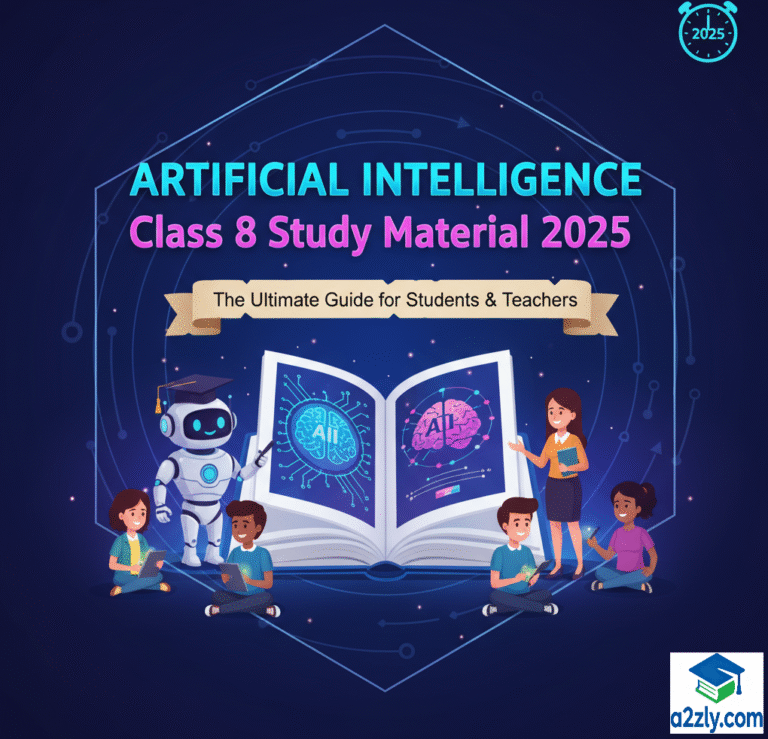
This Artificial Intelligence Class 8 Study Material – 2025 Edition, developed by a2zly.com, is a complete, syllabus-aligned, and student-centric learning resource created to ensure conceptual clarity, real-life connection, and ethical awareness. The content strictly follows the prescribed curriculum framework and is organized into five progressive units—Excite, Relate, Purpose, Possibilities, and AI Ethics—making learning logical, engaging, and future-oriented.
Why this study material by a2zly.com stands out
✔ Covers 100% of the official Class 8 AI syllabus in a structured manner
✔ Designed so that students do not need to refer back to the textbook
✔ Uses simple language, clear explanations, and real-life examples
✔ Fully aligned with NEP 2025 and competency-based education
✔ Ideal for students, teachers, and exam-oriented preparation
✔ Supports projects, activities, and skill-based learning
Through this guide, students will:
- Understand the basics, types, techniques, and domains of Artificial Intelligence
- Explore real-world applications of AI in daily life and smart environments
- Learn how AI contributes to Sustainable Development Goals
- Gain awareness about AI-based career opportunities
- Develop ethical thinking, responsibility, and digital values while using AI
Teachers can use this material as a ready-to-use teaching companion, while students can rely on it for concept mastery, revision, assessments, and AI projects.
📚 Overview of Class 8 Artificial Intelligence Syllabus 2025–26
📘 AI Textbook – Class 8 (2025–26)
Aligned with CBSE Skill Education Curriculum & Sustainable Development Goals (SDGs)
DOWNLOAD TEXTBOOK OF ARTIFICIAL INTELLIGENCE CLASS 8| LEARNING LESSONS | RAPID RECAP | EXERCISE EPISODES |
|---|---|---|
| UNIT–1: Introduction to AI Project Cycle & AI Ethics CHAPTER 1- Artificial Intelligence: Basics and Project Cycle CHAPTER 2- Data and Problem Scoping in Artificial Intelligence CHAPTER 3- Ethics in Artificial Intelligence UNIT–2: Project 0: Presentation CHAPTER 4- Domains of Artificial Intelligence CHAPTER 5- AI Use Cases and Project Cycle Applications | VIEW | VIEW |
| VIEW SAMPLE QUESTION PAPER | VIEW |
❓ FAQ – Class 8 Artificial Intelligence Study Material 2025
1. What is Artificial Intelligence for Class 8 students?
Artificial Intelligence (AI) is the ability of machines and computer systems to think, learn, and make decisions like humans. In Class 8, AI is introduced in a simple and conceptual manner, helping students understand how AI works in daily life through examples such as smartphones, voice assistants, recommendation systems, and smart homes.
👉 This concept is explained in detail on a2zly.com with easy language and real-life examples.
2. Is Artificial Intelligence a compulsory subject in Class 8?
Artificial Intelligence is introduced by CBSE as a skill-based subject and is offered by many schools as part of their curriculum. It focuses on future-ready skills, logical thinking, and ethical technology use, which are strongly recommended under NEP 2025.
3. Which syllabus is followed in this Class 8 AI study material?
This study material strictly follows the CBSE–NCERT Artificial Intelligence syllabus (2025) and is fully aligned with NEP 2025 guidelines. All units—Excite, Relate, Purpose, Possibilities, and AI Ethics—are covered completely and systematically on a2zly.com.
4. Is this study material enough for exams, or do I need the textbook?
Yes, this study material is designed to be 100% self-sufficient. After studying from a2zly.com, students do not need to open the textbook again for concept clarity, revision, or exam preparation.
5. Does this material include real-life examples and applications of AI?
Yes. The content includes daily-life examples, smart gadgets, AI applications, case studies, and future technology scenarios, making learning practical, interesting, and easy to understand. This approach is a key feature of AI content on a2zly.com.
6. Are Sustainable Development Goals (SDGs) covered in Class 8 AI?
Yes. The syllabus includes a full unit on Sustainable Development Goals (SDGs) and explains how Artificial Intelligence can help solve global issues such as healthcare, education, environment, and energy conservation. This topic is explained clearly on a2zly.com.
7. Will this study material help in AI projects and activities?
Absolutely. This guide supports AI-based projects, classroom activities, assignments, and practical tasks. Students and teachers can use a2zly.com as a reliable reference for project ideas and explanations.
8. Are AI careers explained at the Class 8 level?
Yes. The syllabus introduces students to basic AI career paths, industry applications, and skills needed for future learning. This helps students develop early career awareness, which is explained in a simple and age-appropriate way on a2zly.com.
9. Why is AI Ethics important for Class 8 students?
AI Ethics teaches students how to use technology responsibly, safely, and fairly. It helps them understand issues like data privacy, bias, misuse of AI, and digital responsibility, which are essential life skills in today’s digital world.
👉 This topic is given special importance on a2zly.com.
10. Who can use this Class 8 AI study material?
This study material is useful for:
- Class 8 students
- AI teachers and subject educators
- Parents supporting their children’s learning
- Schools following CBSE / NEP 2025 guidelines
Everyone can benefit from the clear, structured, and exam-ready content available on a2zly.com.
✅ Conclusion
With this, the entire Artificial Intelligence Class 8 syllabus (2025) has been completely and systematically covered in this blog article. From the fundamentals of Artificial Intelligence to its types, techniques, domains, real-life applications, role in sustainable development, career possibilities, and ethical concerns, every unit has been explained to ensure full conceptual clarity for students and ease of teaching for educators.
This comprehensive guide has been created to function as a single, dependable learning resource, so that students do not need to refer back to the textbook again. The content strictly follows CBSE, NCERT, and NEP 2025 guidelines, making it ideal for classroom learning, self-study, revision, examinations, and project work.
By studying this complete article on a2zly.com, students can:
- Revise the entire Class 8 AI syllabus in one place
- Build a strong foundation in Artificial Intelligence
- Understand the real-world impact and future scope of AI
- Develop ethical awareness and responsible technology usage
- Prepare confidently for assessments and higher classes
For teachers, this article serves as a ready-made teaching companion, saving preparation time while ensuring accurate, syllabus-aligned explanations.
🔗 Internal Links
- CBSE Skill Subjects 2025 Overview
- Generative AI Projects for Students Class 8
- AR–VR–MR Classroom Activities
- AI Ethics and Bias Lesson Plans