
Introduction
Preparing for the CBSE Class 8 Science exam becomes much easier when students practice with well-designed question papers that follow the latest exam pattern. The CBSE Class 8 Science Practice Paper 2026 with Answer Key (Set 2) on a2zly.com has been created to help students strengthen their concepts and familiarize themselves with the CBSE Class 8 Science Practice Paper 2026, improve answer-writing skills, and understand how questions may appear in the final examination.
This practice paper is carefully structured according to the CBSE syllabus and NCERT guidelines, covering important chapters. By solving this paper, students can evaluate their preparation level, identify weak areas, and build confidence before their exams.
Practicing with the CBSE Class 8 Science Practice Paper 2026 will also aid students in becoming adept at handling different question formats and enhance their problem-solving abilities.
By using the CBSE Class 8 Science Practice Paper 2026, students will learn how to manage their study time effectively, ensuring they cover all necessary topics before the exam.
The included detailed answer key allows students to check their responses instantly and learn the correct way to present answers in the examination. Whether you are revising the syllabus or testing your knowledge through self-assessment, this practice paper from a2zly.com will serve as an effective study resource for achieving better results in the CBSE Class 8 Science Exam 2026.
MODEL QUESTION PAPER – 2026
Subject: Science Class: VIII Maximum Marks: 60 Time: 2½ Hours SET 2
GENERAL INSTRUCTIONS
1. All questions are compulsory. Internal choices are provided in some questions.
2. Section A contains 10 MCQs and 2 Assertion–Reason questions of 1 mark each.
3. Section B contains 6 questions of 2 marks each.
4. Section C contains 6 questions of 3 marks each.
5. Section D contains 2 case-based questions of 4 marks each.
6. Section E contains 2 long answer questions of 5 marks each.
7. Draw neat and properly labelled diagrams wherever required.
SECTION – A (1 × 12 = 12 marks)
(Multiple Choice Questions)
Q1. An increase in wind speed generally leads to: (a) No change in air pressure (b) Decrease in air pressure (c) Only rainfall (d) Increase in air pressure
Answer: (b) Decrease in air pressure
Explanation: According to Bernoulli’s principle, faster-moving air has lower pressure. High wind speed → lower pressure area (e.g., in cyclones).
Q2. Which process changes a solid directly into a gas without passing through the liquid state? (a) Condensation (b) Evaporation (c) Sublimation (d) Freezing
Answer: (c) Sublimation
Explanation: Sublimation: solid → gas directly (e.g., dry ice, camphor, naphthalene balls, frost disappearance).
Q3. Which of the following is a pure substance? (a) Air (b) Salt solution (c) Distilled water (d) Soil
Answer: (c) Distilled water
Explanation: Distilled water is pure H₂O (compound). Air = mixture of gases; salt solution = mixture; soil = mixture of minerals, organic matter, water, air.
Q4. Increasing temperature generally __________.
(a) Increases the solubility of most solids in liquids
(b) Increases the solubility of gases in liquids
(c) Has no effect on solubility
(d) Decreases the solubility of solids in liquids
Correct Answer: (a) Increases the solubility of most solids in liquids
Explanation:
For most solid substances (like sugar or salt), solubility increases as temperature rises because the particles gain more kinetic energy and dissolve more easily. In contrast, the solubility of gases decreases with increasing temperature.
Q5. The phases of the Moon are caused by: (a) Earth’s rotation on its axis (b) The Moon’s rotation on its axis (c) The relative positions of the Earth, Moon and Sun (d) Clouds covering the Moon
Answer: (c) The relative positions of the Earth, Moon and Sun
Explanation: Moon phases result from changing angles of sunlight illuminating the Moon as seen from Earth due to relative positions in orbit.
Q6. Which of the following is an example of mutualism? (a) Tapeworm in the human intestine (b) Cuscuta plant on a host plant (c) Lichen (association of algae and fungus) (d) Mosquito sucking blood from humans
Answer: (c) Lichen (association of algae and fungus)
Explanation: Mutualism: both benefit. Algae (photosynthesis → food) and fungus (protection, water/minerals) in lichen. Others are parasitism.
Q7. What is the main cause of strong winds during a cyclone? (a) Movement of tectonic plates (b) Sudden snowfall (c) Formation of a low-pressure system (d) High air pressure in the region
Answer: (c) Formation of a low-pressure system
Explanation: Cyclone forms over warm ocean → low pressure at centre → air rushes in from high-pressure surroundings → strong winds.
Q8. Which of the following processes involves the change of a liquid into a gas at any temperature? (a) Boiling (b) Freezing (c) Evaporation (d) Condensation
Answer: (c) Evaporation
Explanation: Evaporation occurs at any temperature from surface. Boiling occurs at specific boiling point throughout liquid.
Q9. Which type of mirror is used as a rear-view mirror in vehicles? (a) Plane mirror (b) Concave mirror (c) Convex mirror (d) Periscope mirror
Answer: (c) Convex mirror
Explanation: Convex mirrors give wide field of view, erect (though diminished) image → safer for rear view.
Q10. Which of the following is an example of parasitism? (a) Lichen (b) A tick sucking blood from a dog (c) Cattle egret eating insects near grazing cattle (d) Bees collecting nectar from flowers
Answer: (b) A tick sucking blood from a dog
Explanation: Parasitism: parasite (tick) benefits, host (dog) harmed. Others: mutualism or commensalism.
Choose the correct option:
(a) Both A and R are true and R is the correct explanation of A
(b) Both A and R are true but R is not the correct explanation of A
(c) A is true but R is false
(d) A is false but R is true
Q11.
Assertion (A): Loosening of soil during ploughing helps in better crop growth.
Reason (R): Loose soil allows roots to penetrate deeper and improves aeration in the soil.
Answer: (a) Both A and R are true and R is the correct explanation of A.
Explanation:
Ploughing loosens the soil, which allows plant roots to grow deeper and improves air circulation in the soil. This helps plants absorb nutrients and water more effectively.
Q12.
Assertion (A): All consumers ultimately depend on producers for their food.
Reason (R): Herbivores feed on plants, and carnivores feed on herbivores.
Answer: (a) Both A and R are true and R is the correct explanation of A.
Explanation:
Producers (green plants) prepare food through photosynthesis. Herbivores depend directly on plants, while carnivores depend on herbivores. Therefore, all consumers are indirectly or directly dependent on producers.
Utilizing the CBSE Class 8 Science Practice Paper 2026 as part of your study routine can significantly boost your confidence and readiness.
SECTION – B (2 × 6 = 12 marks)
Short Answer Questions – I (2 × 6 = 12 marks)
Q13. An elephant stands on four feet. If the area of one foot is 0.25 m², calculate the pressure exerted by the elephant on the ground when its weight is 20,000 N.
Answer: Pressure = 20,000 N / (4 × 0.25 m²) = 20,000 / 1 = 20,000 Pa
Explanation: Total area in contact = 4 × 0.25 = 1 m². Pressure = Force / Area = Weight / Total area.
Q14. Draw diagrams to show the arrangement of particles in: (a) An instrument box (b) Honey
Answer:
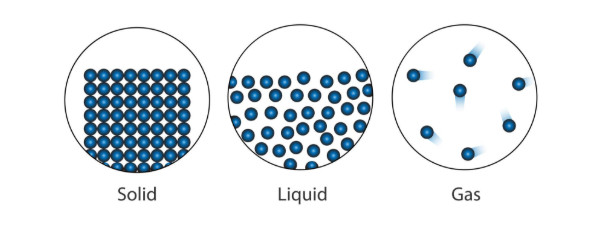
(a) Instrument box (solid): Particles closely packed, fixed positions, regular pattern (lattice-like).
(b) Honey (viscous liquid): Particles close but irregular, can slide slowly past each other (less ordered than solid).
Q15. What is galvanization? Why is it done?
Answer: Galvanization is coating iron/steel with a layer of zinc to prevent rusting.
Why: Zinc acts as sacrificial metal (corrodes first) and forms protective zinc oxide layer → prevents oxygen/water from reaching iron.
Q16. A wooden block has a mass of 150 g and a volume of 300 cm³. Calculate its density. Will it float or sink in water? Give reason.
Answer: Density = Mass / Volume = 150 g / 300 cm³ = 0.5 g/cm³
It will float in water.
Reason: Density of wood (0.5 g/cm³) < density of water (1 g/cm³) → buoyant force > weight.
Q17. (i) Identify ray A and ray B in the given diagram. (ii) State one law related to the diagram shown.

Answer: (Assuming standard reflection diagram) (i) Ray A = Incident ray; Ray B = Reflected ray (ii) Law of reflection: Angle of incidence = Angle of reflection (i = r); incident ray, reflected ray and normal lie in same plane.
Q18. What is a food web? How is it different from a food chain?
Answer: Food web: Interconnected network of multiple food chains in an ecosystem showing complex feeding relationships.
Difference: Food chain is linear (one path: producer → herbivore → carnivore). Food web is branched/complex (multiple paths, shows real ecosystem interactions).
SECTION – C (3 × 6 = 18 marks)
Short Answer Questions – II (3 × 6 = 18 marks)
Q19. Why can gases be compressed easily whereas solids cannot?
Answer:
- Gases have large intermolecular spaces and very weak forces of attraction → particles can be pushed closer → easily compressed.
- Solids have particles closely packed with very strong intermolecular forces → almost no space to compress → incompressible.
Q20. Draw a labelled diagram showing the different layers of the Earth. Which layer is the lightest?
Answer:
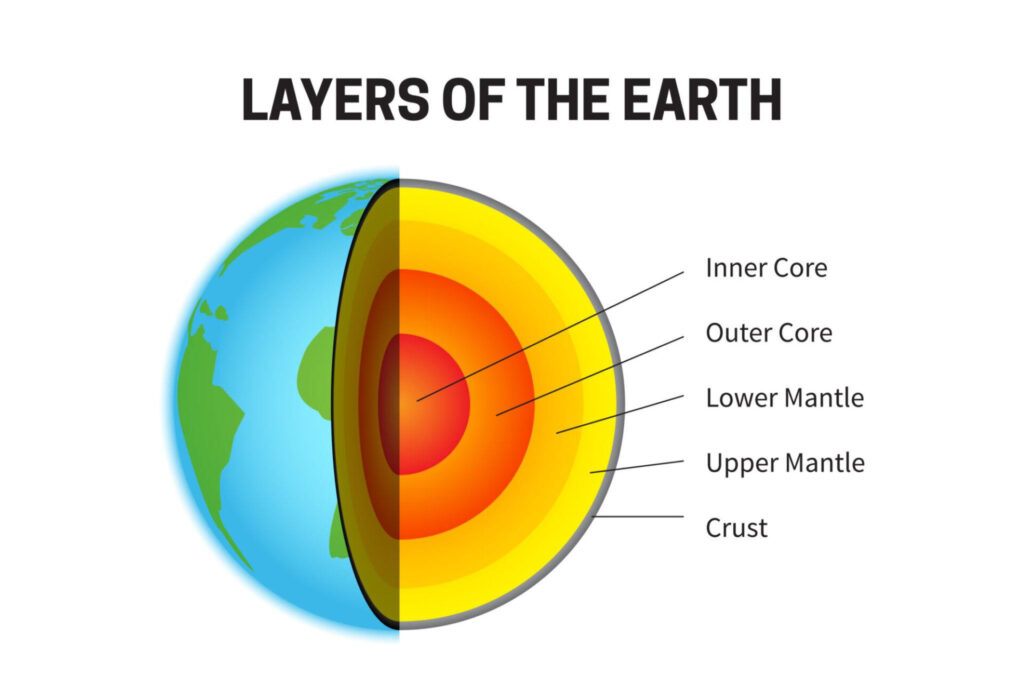
(Diagram description:) Crust (outer, thinnest) → Mantle (thickest) → Outer core (liquid) → Inner core (solid).
Lightest layer: Crust (density ~2.7–3.0 g/cm³, mainly lighter rocks like granite/basalt).
Q21. State the laws of reflection of light.
Answer:
- The angle of incidence is equal to the angle of reflection (∠i = ∠r).
- The incident ray, the reflected ray, and the normal at the point of incidence all lie in the same plane.
Q22. Expand ISRO. Mention any two uses of artificial satellites.
Answer: ISRO = Indian Space Research Organisation
Two uses of artificial satellites:
- Communication (TV, radio, telephone signals).
- Weather forecasting / Remote sensing (monitoring crops, disasters, natural resources).
Q23. Name any three greenhouse gases responsible for the greenhouse effect.
Answer:
- Carbon dioxide (CO₂)
- Methane (CH₄)
- Water vapour (H₂O) (Also: Nitrous oxide (N₂O), Chlorofluorocarbons (CFCs))
Q24. Explain how the fish population in a pond can influence seed production in nearby plants.
Answer:
- Fish eat insects/larvae that feed on plants or pollinators.
- Fish waste (excreta) provides nutrients (phosphorus, nitrogen) → enriches water → plants near pond grow better → more flowers → higher seed production.
- Healthy fish population controls pests → indirect benefit to nearby vegetation pollination/seed set.
SECTION – D (4 × 2 = 8 marks)
Case-Based Questions (4 × 2 = 8 marks)
Q25. Rahul conducted an experiment to demonstrate the effect of air pressure. He hung two identical balloons from a rod with the help of two strings so that the balloons were close to each other but not touching. Rahul then blew air into the space between the two balloons. Answer the following questions:
(a) What happens to the balloons when air is blown between them?
(b) What change occurs in air pressure between the balloons?
(c) Explain the reason behind the movement of the balloons.
Answer: (a) The balloons move towards each other / come closer.
(b) Air pressure between the balloons decreases (low-pressure region created).
(c) Bernoulli’s principle: Fast-moving air (blown) has lower pressure than still air outside. Higher pressure outside pushes balloons together → they move towards each other.
Q26. Riya observed the Moon every night for a month and noticed that its shape appeared to change from a thin crescent to a full circle and then gradually decrease again. Based on her observations, answer the following questions:
(a) What causes the Moon to appear in different shapes during the month?
(b) On which day of the lunar month does the Moon appear fully illuminated?
(c) Why does the Moon not produce its own light?
Answer: (a) Different relative positions of Sun, Earth, Moon → changing portion of Moon illuminated and visible from Earth (phases).
(b) Full Moon day (around 14th–15th day of lunar month).
(c) Moon reflects sunlight; it does not produce its own light (only reflects).
SECTION – E (5 × 2 = 10 marks)
Long Answer Questions (5 × 2 = 10 marks)
Q27. When a piece of zinc is dropped into dilute hydrochloric acid, a gas is produced. a) Name the gas. b) Describe a simple test to confirm its presence. c) Write the word equation for the reaction.
Answer: a) Hydrogen gas (H₂)
b) Test: Bring a burning candle/matchstick near mouth of test tube → gas burns with pop sound (characteristic of hydrogen).
c) Word equation: Zinc + Dilute Hydrochloric acid → Zinc chloride + Hydrogen gas
Q28.
A. A city has cleared a large forest area for the construction of roads and buildings. Discuss the possible impacts of this action on the local climate and biodiversity.
B. Name any three global agreements aimed at protecting the environment.
Answer: A.
- Local climate:
- Temperature increases (loss of shade, less evapotranspiration → urban heat island).
- Reduced rainfall / altered local weather (forests regulate moisture, less transpiration).
- Increased soil erosion, dust → poorer air quality.
- Biodiversity:
- Habitat destruction → loss of species (plants, animals, insects).
- Disruption of food chains/webs.
- Reduced genetic diversity, extinction risk for endemic species.
- Soil nutrient loss, affecting future plant growth.
B. Three global agreements:
- Paris Agreement (2015) – limits global warming, reduces greenhouse gas emissions.
- Kyoto Protocol (1997) – binding emission reduction targets for developed countries.
- Convention on Biological Diversity (CBD) (1992) – conservation of biodiversity, sustainable use, fair sharing of benefits.
Conclusion
Regular practice is the key to scoring well in exams. By attempting the CBSE Class 8 Science Practice Paper 2026 with Answer Key (Set 2), students can become familiar with the exam format, improve time management, and strengthen their understanding of important scientific concepts.
Students are encouraged to first attempt the paper independently and then verify their answers using the provided answer key. This method not only helps in self-evaluation but also improves conceptual clarity and confidence.
For more CBSE study materials, practice papers, model question papers, and exam preparation resources, keep visiting a2zly.com. Our goal is to provide students with high-quality, easy-to-understand learning content that supports their academic success.
Practice regularly, stay curious, and keep learning with a2zly.com! 📚✨
For optimal results, integrate the CBSE Class 8 Science Practice Paper 2026 into your study sessions and watch your performance improve.
Remember, consistent practice with the CBSE Class 8 Science Practice Paper 2026 will yield the best outcomes on exam day.