Let us do these activities before we read (Page 17)
I. Read the names of items you usually find in a garden and write their names against each picture given below.
garden hose, sapling, hedge, flower beds, flower pot, pebbles, rockery, fence, vine, wheelbarrow
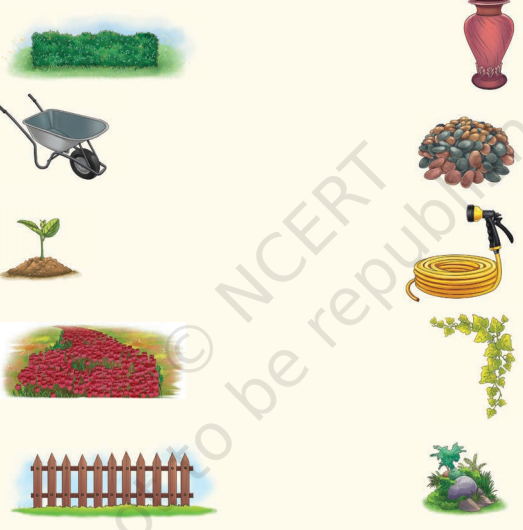
Answer:
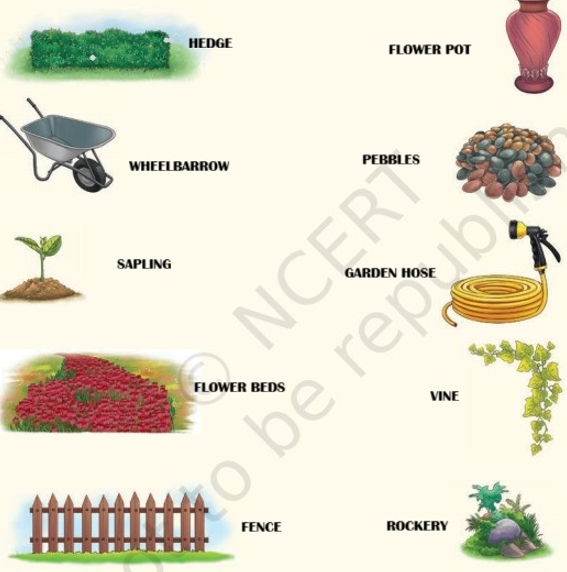
II. Work in groups of four. What kind of garden would you like to have? Mention the features that you can include and the reasons for your choice. Share your answers with your classmates and teacher.
Answer:
I would love to have a butterfly garden with vibrant flowers like marigolds, sunflowers, and lavender. It would include a small fountain, benches, and a pebble pathway. The garden would be surrounded by a wooden fence and decorated with stone sculptures. I like this type of garden because it would attract butterflies and birds, making the space lively and peaceful. It would be an ideal place to relax and enjoy nature.
III. Read the title of the poem. What comes to your mind when you read the word ‘concrete’? Does it have more than one meaning? Share your answers with your classmates and teacher.
Answer:
When I hear the word ‘concrete’, I first think of hard grey cement or building material. But it can also mean something clear, real, or specific, like a ‘concrete example’.
- Literal meaning: Cement or stone, as in a garden pathway.
- Figurative meaning: Something definite, specific, or real, like a clear example.
This double meaning creates a play on words, which makes the poem’s title interesting and thought-provoking.
Let us discuss (Pages 19-20)
I. Complete the following summary with exact words from the poem. One example has been done for you. Share your answers with your classmates and teacher.
The poem describes Mrs. Jones, the speaker’s next-door neighbour, who has a unique garden filed with 1. _________. Her garden includes a peculiar 2. _________, a pond, and a rockery, along with an unusual 3. _________ that she fids charming. Mrs. Jones plants tiny, 4. _________ plants between the stones, which the speaker thinks must be so small that they are planted with a 5. _________. One day, Mrs. Jones invites the speaker to see her garden, and they discuss a 6. _________ that Mrs. Jones treasures. When the speaker asks where the 7. _________ flwer is, Mrs. Jones says that the speaker has been 8. _________ on it all along.
Answer:
1. stones 2. path 3. device 4. delicate 5. pin 6. flower 7. lovely 8. standing
II. Select the correct option to fill in the blanks for the following sentences.
Question 1.
The tone of the poem is _________
(i) mocking
(ii) humorous
(iii) mournful
(iv) amusing
(v) light-hearted
A. (i), (ii), and (iii)
B. (i), (ii), and (v)
C. (ii), (iii), and (iv)
D. (ii), (iv), and (v)
Answer:
D. (ii), (iv), and (v)
Question 2.
The speaker in the poem is
(i) Mrs. Jones
(ii) the poet
(iii) a gardener
(iv) a child
Answer:
(ii) the poet
Question 3.
The rhyme scheme of the poem is
(i) AABBCC
(ii) ABABCC
(iii) AABCAC
(iv) ABBACC
Answer:
(i) AABBCC
III. Complete the following sentences by choosing the correct answer given in the brackets.
1. The poet uses the word ‘stones ’ in all stanzas in order to emphasise her _________ (obsession with a stony garden/pride in gardening skills)
2. The poet uses imagery to describe the features of the garden that help readers _________ (understand Mrs. Jones love for plants /visualise the garden’s peculiar nature)
Answer:
1. obsession with a stony garden
2. visualise the garden’s peculiar nature
IV. Pick examples of alliteration from the poem.
Answer:
puts plants, flower for quite a quarter
V. A refrain is a repeated line or phrase that appears in each stanza. Identify the refrain from the poem.
Answer:
My next-door neighbour, Mrs. Jones.
VI. Irony is a literary device that emphasises the difference between what is expected and what actually happens. It often involves a situation where the outcome is the opposite of what is expected, creating a surprising or a humorous effect. For example, Mrs. Jones’ excitement about her garden contrasts with the speaker’s disappointment on how ordinary it is. Identify the line(s) from the poem that display(s) situational irony.
Answer
“You’re standing on it,” she replied.
VII. Complete the following sentences appropriately.
1. The word ‘concrete’ can refer to _________ in Mrs. Jones’ garden.
Answer:
the stones and hard surfaces
2. The title also has a symbolic meaning, as the poem provides a clear or ‘concrete’
example of Mrs. Jones’ _________ gardening habits.
Answer:
clear or fixed
VIII. The title ‘A Concrete Example’ carries both literal and symbolic (metaphorical) meaning. Such word play is called a pun. A pun is a figure of speech that uses words with multiple meanings or words that sound alike but have different meanings, creating a humorous effect.
1. I tried arguing with my pencil but it kept making sharp points, (suggests the idea of an actual sharp pencil point and strong argument points)
Answer:
Literal: Garden made of concrete/stones
2. My pencil and I had a disagreement but we finally got to the point, (refers to solving an argument and the pencil’s tip
Answer:
Metaphorical: Clear example of Mrs. Jones’ strange gardening style
Let us think and reflect (Pages 20-21)
I. Read the extracts given below and answer the questions that follow.
(i) What can be inferred about Mrs. Jones’s taste in gardening from the description of her garden being ‘full of stones’?
Answer: She likes a minimalist style with unique and unconventional garden designs.
(ii) Identify whether the following statement is true or false.
The garden serves as a means to reveal more about Mrs. Jones herself.
Answer: True
(iii) What does the poet mean by ‘crazy path’?
Answer:
By ‘crazy path,’ the poet means a path that is irregular or unusually arranged.
(iv) What does the sundial with a ‘strange device’ suggest about Mrs. Jones’ personality?
A. She has a fascination with unusual items.
B. She prefers traditional garden decorations.
C. She is uninterested in her garden’s appearance.
D. She likes modern and expensive items.
Answer:
A. She has a fascination with unusual items.
II. Answer the following questions.
Question 1.
How does Mrs. Jones feel about her garden? Support your answer with evidence from the poem.
Answer:
Mrs. Jones takes great pride in her garden and appreciates the beauty in even its tiniest details.
Question 2.
Why do you think the speaker describes the plants as being so small that they could be planted with a pin?
Answer:
The speaker describes the plants this way to show how delicate and tiny they are.
Question 3.
What do we get to know about Mrs. Jones—based on her gardening style and her interaction with the speaker?
Answer:
Mrs. Jones is detail-oriented, eccentric, and values things that others might easily overlook.
Question 4.
The poem portrays Mrs. Jones in a positive light. Support this statement.
Answer:
She is shown as someone with a strong sense of taste and a passion for gardening, which reflects creativity and dedication.
Question 5.
What does the poem tell us about the way people think differently about the world around them?
Answer:
The poem shows that people find beauty in different ways, teaching us to respect diverse perspectives.
Let us learn (Pages 21-23)
I. Select the appropriate word from the brackets that correctly replaces the underlined word in the sentences from the text.
1. A sundial with a strange device, (unusual, peculiar, new, rare, external)
2. … which Mrs. Jones thinks rather nice. (pleasant, superior, agreeable, gentle, charming)
3. They are so delicate… (delicious, fragile, dainty, graceful, weak)
4. “Where is this lovely thing?” I cried. (exclaimed, wept, shouted, announced, whispered)
Answer:
1. Strange → peculiar
2. Nice → charming
3. Delicate → fragile
4. Cried → exclaimed
II. The ‘sundial’ is referred to as a ‘device’ in the poem. Work in pairs to infer the meaning of ‘device’. Share your thoughts with your classmates and teacher.
Answer:
The word ‘device’ refers to a piece of equipment designed to perform a specific task.
Now, match the type of instruments in Column 1 with their definitions in Column 2. Column 3 shows one example of each type of instrument. Add more examples in Column 3.
Answer:
| Column 1 | Column 2 | Column 3 |
|---|---|---|
| 1. implement | (iii) something that works on being moved by hand | spade, knife, scissors |
| 2. tool | (v) something used by hand to make or repair | hammer, saw |
| 3. equipment | (iv) a set of necessary items for a particular purpose | cricket bat, helmet, batting gloves, seat belt |
| 4. appliance | (i) something that is electrical and is used to do work in the house | mixer grinder, microwave, toaster |
| 5. gadget | (ii) something small that is mechanical or electronic | mobile phone, laptop, remote control |
III. Complete the table by making new words in Column 1 using the hints given in Column 2. Replace the first letter of the given word to create new words. One example has been done for you.
Answer:
(i) dice
(ii) rice
(iii) mice
(iv) vice
Answer:
(i) boil
(ii) toil
(iii) coil
(iv) foil
Let us listen (Pages 23-24)
Answers–
- Indian postage stamp
- Colourful sculptures
- Three distinct phases
- Toilet pots
- 5,000 statues
Let us speak (Page 23)
I. The speaker of the poem might have felt sorry for stepping on Mrs. Jones’ flower. When we make a mistake, we must express regret and apologise for our actions.
Question 1.
When we apologise to a friend or a family member, we use informal language.
Take turns to apologise for the following situations and respond to the apology,
(i) You have eaten your brother’s share of sweets.
(ii) You have broken your sister’s flower craft.
(iii) You accidentally spilled ink on your mother’s important documents.
(iv) You forgot to bring your friend’s notebook to the school after borrowing it.
You may use the following phrases given below.
Answer:
(i) Apology: I’m really sorry for eating your share of sweets. I didn’t mean to upset you!
Response: That’s okay. It happens.
(ii) Apology: Please forgive me for breaking your flower craft. I didn’t do it intentionally.
Response: Don’t worry. I can make another one.
(iii) Apology: Sorry, Mom, I didn’t mean to spill ink on your documents. It was an accident, and I’m really sorry!
Response: It’s alright. Just be more careful next time.
(iv) Apology: I’m sorry for forgetting your notebook. I’ll bring it tomorrow for sure!
Response: No worries. Just try not to forget it again.
Question 2.
When we apologise to someone in authority like a Principal or a teacher in a formal setting, we use formal language. Work in pairs and take turns to apologise for the following situations and respond to the apology.
(i) You did not bring an assignment that was due for submission.
(ii) You were late to school for the past three days and had to meet the Principal.
(ill) You did not submit your project work and were asked to explain.
You may use the following phrases given below.
Answer:
(i) Apology: I’m very sorry for not bringing the assignment due today. I truly regret my mistake.
Response: I accept your apology. Please make sure to submit it tomorrow without fail.
(ii) Apology: I apologize for being late to school the past three days. I promise it won’t happen again.
Response: I appreciate your honesty. Please ensure you arrive on time from now on.
(iii) Apology: I regret not submitting my project on time and promise it won’t happen again.
Response: I’m glad you acknowledged your mistake. Make sure to meet the next deadline.
Let us write (Page 25)
Answer:
NATURE CLUB
NOTICE
Date: 24th September 2025
Title: Inauguration of the Herb Garden
The Nature Club of [School Name] is pleased to announce the inauguration of the newly developed Herb Garden. The event will take place on 26th September 2025 at 10:00 AM in the school premises near the science block. The garden features various herbs such as Aloe Vera, Mint, Carom, and Holy Basil.
Students of grades 6–8 are invited to attend this exciting event. For further details, please contact the club coordinator, Mr. [Name], during school hours.
All students are encouraged to participate and make the event a success!
Name
Nature Club Member
Let us explore (Pages 25-26)
I. Amrit Udyan is a garden spread over an expanse of 15 acres around Rashtrapati Bhavan in New Delhi. It has multiple attractions that include a specially curated garden for children called Bal Vatika, a treehouse, nature’s classroom, etc. It also has the Bonsai, Herbal-I, Herbal-II, Tactile Garden, Arogya Vanam, and Circular Gardens with a diverse variety of flora and fauna.
Now, find out about popular gardens in your region and share with your classmates and teacher.
Answer:
Here are some popular gardens in different regions that you can explore:
1. Lodhi Garden (New Delhi)
- Location: New Delhi
- Attractions: A historical garden spread across 90 acres, Lodhi Garden features a mix of ancient tombs, vibrant flora, and peaceful surroundings. It’s a great place for walking, bird-watching, and picnicking.
2. Rose Garden (Chandigarh)
- Location: Chandigarh
- Attractions: Spanning over 30 acres, this is Asia’s largest Rose Garden. It houses thousands of varieties of roses and other plants like medicinal herbs and plants. It’s perfect for visitors who love flowers and serene landscapes.
3. Botanical Garden (Kolkata)
- Location: Kolkata
- Attractions: Located in Howrah, this garden is famous for its vast collection of tropical plants and the majestic Great Banyan Tree. The garden spans over 273 acres, making it one of the largest and oldest botanical gardens in India.
4. Nehru Park (New Delhi)
- Location: New Delhi
- Attractions: Known for its lush greenery and a variety of recreational activities, Nehru Park is located near Chanakyapuri. It hosts cultural events and is a peaceful place for relaxation, picnics, and morning walks.
5.Brindavan Gardens (Karnataka)
- Location: Near Mysuru, Karnataka
- Attractions: Famous for its musical fountain and well-maintained landscape, Brindavan Gardens is located near the Krishna Raja Sagara Dam. It is one of the most popular tourist destinations, especially during the evening light and sound show.
6. Sundar Nursery (New Delhi)
- Location: New Delhi
- Attractions: A heritage park, Sundar Nursery offers visitors a beautiful blend of lush gardens, fountains, and historical monuments. It’s a great spot for nature lovers and those looking to understand ecological conservation.
7. Tulip Garden (Srinagar)
- Location: Srinagar, Jammu & Kashmir
- Attractions: Famous for its vast stretch of blooming tulips, this garden attracts many tourists during the spring season. It’s known for its colorful display of tulips and other flowers, set against the backdrop of the Himalayas.
II. A herbarium is a collection of plant samples preserved for long-term study, usually in the form of dried and pressed plants mounted on paper.
Now, collect some fallen flowers and leaves from your neighbourhood.
Place them in folds of a newspaper carefully and put a pile of books on them. After one week, take .them out and use them to make a card, wall hanging or any other artwork. A sample has been given for your reference.
Answer:
Herbarium Art Activity
What you need:
- Fallen flowers and leaves from your surroundings
- Old newspapers
- Heavy books or a weight
- Cardboard/chart paper
- Glue
- Scissors, sketch pens, or decorative items
Steps to follow:
- Collect: Pick some fallen flowers and leaves from your neighbourhood (avoid plucking fresh ones).
- Press:
- Place them carefully between the folds of a newspaper.
- Put a pile of books or a heavy object on top.
- Leave them pressed for about a week so that they dry flat.
- Check: After one week, take them out carefully. The flowers and leaves will be dried, pressed, and ready for use.
- Create:
- Paste them on a card, a sheet of chart paper, or cardboard.
- Arrange in patterns to make a greeting card, wall hanging, bookmark, or collage.
- Decorate with sketch pens, borders, or quotes to enhance the artwork.
- Preserve: Cover your artwork with transparent sheet/plastic to protect the dried leaves and flowers.