This chapter focuses on ratios, proportions, and their real-life applications. Our Class 8 Maths Ganita Prakash NCERT Solutions help students solve proportion problems with clarity and confidence.
Textbook Page 165
Figure it Out
1. Circle the following statements of proportion that are true.
(i) 4 : 7 :: 12 : 21
(ii) 8 : 3 :: 24 : 6
(iii) 7 : 12 :: 12 : 7
(iv) 21 : 6 :: 35 : 10
(v) 12 : 18 :: 28 : 12
(vi) 24 : 8 :: 9 : 3
Solution:
(i) 4:7::12:21
- 4:7 is already simplest.
- 12:21÷3=4:7.
Ratios equal → Proportion true.
(ii) 8:3::24:6
- 8:3 simplest.
- 24:6÷6=4:1.
Ratios not equal → Proportion false.
(iii) 7:12::12:7
- Both in simplest form.
- Ratios not equal.
Proportion false.
(iv) 21:6::35:10
- 21:6÷3=7:2.
- 35:10÷5=7:2. Ratios equal → Proportion true.
(v) 12:18::28:12
- 12:18÷6=2:3.
- 28:12÷4=7:3.
Ratios not equal → Proportion false.
(vi) 24:8::9:3
- 24:8÷8=3:1.
- 9:3÷3=3:1.
Ratios equal → Proportion true.
2. Give 3 ratios that are proportional to 4 : 9.
Solution:
To find ratios proportional to 4 : 9, we multiply both terms by the same number:
- 4 × 2 : 9 × 2 = 8 : 18
- 4 × 3 : 9 × 3 = 12 : 27
- 4 × 5 : 9 × 5 = 20 : 45
Therefore, three ratios proportional to 4 : 9 are 8 : 18, 12 : 27, and 20 : 45.
3. Fill in the missing numbers for these ratios that are proportional to 18 : 24.
3 : ______, 12 : ______, 20 : ______, 27 : ______
Solution:
To simplify the ratio 18 : 24, we find the H.C.F = 6:
18÷6:24÷6=3:4
So any ratio proportional to 18 : 24 must equal 3 : 4.
(i) 3 : ____ = 3 : 4
(ii) 12 : ____ = 3 × 4 : 4 × 4 = 12 : 16
(iii) 20 : ____ = 3 × (20/3) : 4 × (20/3) = 20 : 80/3
(iv) 27 : ____ = 3 × 9 : 4 × 9 = 27 : 36
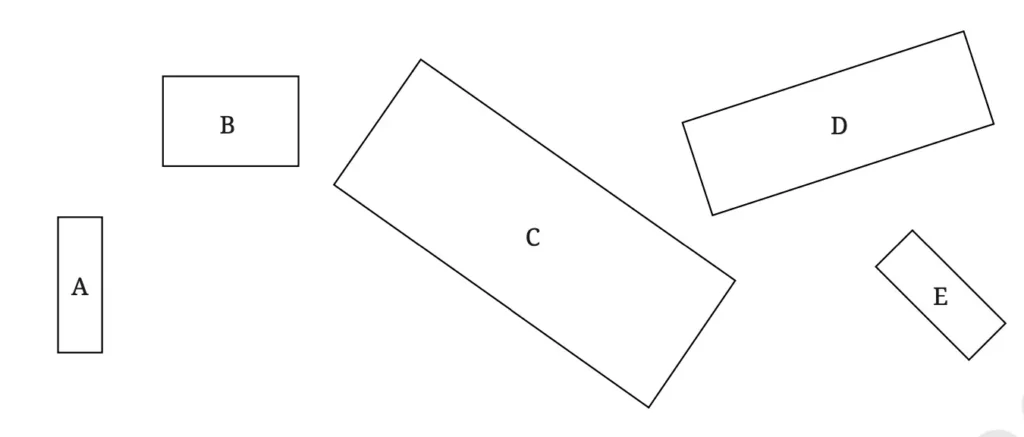
4. Look at the following rectangles. Which rectangles are similar to each other? You can verify this by measuring the width and height using a scale and comparing their ratios.
Solution:
| Rectangle | Width | Height | Ratio |
|---|---|---|---|
| A | 0.5 cm | 1.5 cm | 0.5 : 1.5 = 1 : 3 |
| B | 1.5 cm | 1 cm | 1.5 : 1 = 3 : 2 |
| C | 4.5 cm | 2 cm | 4.5 : 2 = 9 : 4 |
| D | 3.5 cm | 1 cm | 3.5 : 1 = 7 : 2 |
| E | 0.5 cm | 1.5 cm | 0.5 : 1.5 = 1 : 3 |
Rectangles A and E have the same simplified ratio of 1 : 3, which means they are similar to each other.
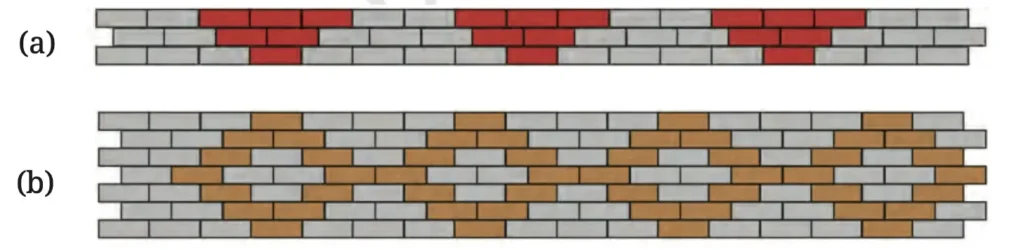
6. The following figure shows a small portion of a long brick wall with patterns made using coloured bricks. Each wall continues this pattern throughout the wall. What is the ratio of grey bricks to coloured bricks? Try to give the ratios in their simplest form.
Solution:
(a) we have ratio as Grey bricks : Coloured bricks = 18 : 33 = 6 : 11
(b) we have the ratio as Grey bricks : Coloured bricks = 48 : 71
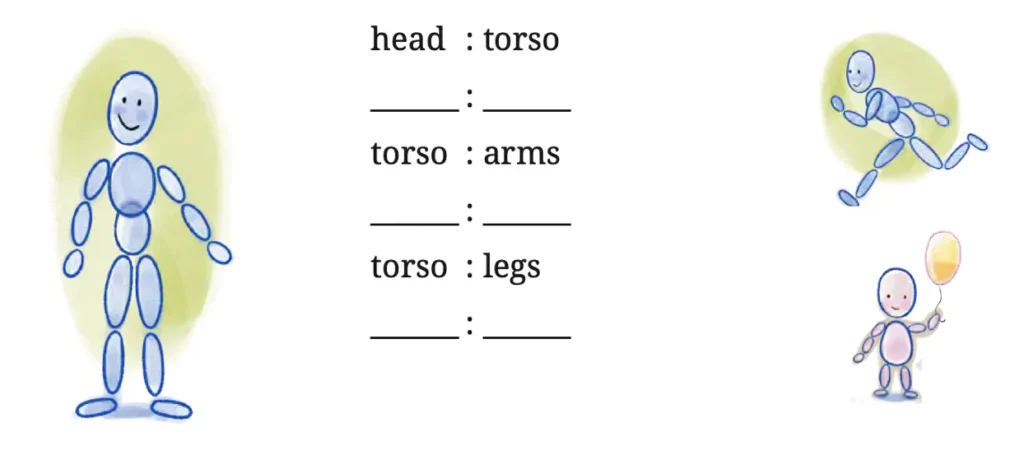
7. Let us draw some human figures. Measure your friend’s body—the lengths of their head, torso, arms, and legs. Write the ratios as mentioned below—
Solution:
My friend’s body measurements are:
- Head = 22 cm
- Torso (neck to hip) = 50 cm
- Arms (shoulder to fingertip) = 60 cm
- Legs (hip to foot) = 80 cm
The ratios are:
- Head : Torso = 22 : 50 → Simplify by dividing both by 2 → 11 : 25
- Torso : Arms = 50 : 60 → Simplify by dividing both by 10 → 5 : 6
- Torso : Legs = 50 : 80 → Simplify by dividing both by 10 → 5 : 8
Final ratios:
- Head : Torso = 11 : 25
- Torso : Arms = 5 : 6
- Torso : Legs = 5 : 8