Exercise Questions and Answers
Q1: Refer to the given diagram (Fig. 12.19) and select the wrong statement.
(i) A community is larger than a population.
(ii) A community is smaller than an ecosystem.
(iii) An ecosystem is part of a community.
A1:
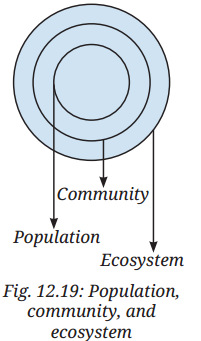
(i) True: A community includes multiple populations of different species in a habitat.
(ii) True: A community is part of an ecosystem, which includes both biotic (community) and abiotic components.
(iii) False: An ecosystem includes a community and abiotic components, not the other way around.
Answer: (iii) An ecosystem is part of a community.
Q2: A population is part of a community. If all decomposers suddenly disappear from a forest ecosystem, what changes do you think would occur? Explain why decomposers are essential.
A2: If decomposers (e.g., fungi, bacteria) disappear from a forest ecosystem:
- Dead plants, animals, and waste would accumulate, as decomposition would stop.
- Nutrients would not be recycled into the soil, reducing soil fertility.
- Plants (producers) would suffer from nutrient deficiency, impacting their growth.
- Herbivores and other consumers dependent on plants would decline due to food scarcity.
- The food web would collapse, disrupting the ecosystem’s balance.
Why decomposers are essential: Decomposers break down dead matter, recycling nutrients (e.g., nitrogen, carbon) into the soil, which plants use for growth. This supports the entire food web and maintains ecosystem stability (Page 11).
Answer: Nutrient recycling would stop, leading to reduced soil fertility, plant decline, and collapse of the food web. Decomposers are essential for breaking down dead matter and recycling nutrients for plant growth.
Q3: Selvam from Cuddalore district, Tamil Nadu, shared that his village was less affected by the 2004 Tsunami compared to nearby villages due to the presence of mangrove forests. This surprised Sarita, Shabnam, and Shijo. They wondered if mangroves were protecting the village. Can you help them understand this?
A3: Mangrove forests in Selvam’s village acted as a natural barrier during the 2004 Tsunami. Their dense roots and trees slowed down strong waves and winds, reducing the tsunami’s impact on the village. Mangroves also stabilize coastlines, prevent erosion, and absorb storm energy, protecting inland areas. This explains why Selvam’s village was less affected compared to nearby villages without mangroves (Page 15, Fig. 12.17).
Answer: Mangroves protected the village by slowing tsunami waves, stabilizing coastlines, and reducing storm impact.
Q4: Look at this food chain: Grass → Grasshopper → Frog → Snake. If frogs disappear from this ecosystem, what will happen to the population of grasshoppers and snakes? Why?
A4:
- Grasshoppers: Their population would increase because frogs, their predators, are gone, reducing predation pressure.
- Snakes: Their population would decrease because frogs are their primary food source. Without frogs, snakes would face food scarcity, leading to starvation or migration.
Why: The food chain shows frogs eat grasshoppers, and snakes eat frogs. Removing frogs disrupts the balance, allowing grasshoppers to proliferate and starving snakes (Page 10, Fig. 12.9).
Answer: Grasshopper population would increase due to lack of predation; snake population would decrease due to lack of food.
Q5: In a school garden, students noticed fewer butterflies the previous season. What could be the possible reasons? What steps can students take to have more butterflies on campus?
A5:
Possible reasons for fewer butterflies:
- Loss of host plants (e.g., milkweed) where butterflies lay eggs or feed.
- Pesticide use killing butterflies or their larvae.
- Reduced nectar sources due to fewer flowering plants.
- Habitat destruction from construction or landscaping.
- Increased predators (e.g., birds, dragonflies) or pollution affecting butterfly survival (Pages 6, 16).
Steps to increase butterflies: - Plant nectar-rich flowers (e.g., marigolds, zinnias) and host plants for larvae.
- Avoid synthetic pesticides; use natural pest control (e.g., ladybugs).
- Create a butterfly garden with diverse plants and water sources.
- Reduce mowing or clearing to preserve habitats.
- Educate the school community about butterfly conservation (Page 17).
Answer: Fewer butterflies could be due to loss of host plants, pesticides, or habitat destruction. Students can plant nectar and host plants, avoid pesticides, and create a butterfly garden.
Q6: Why is it not possible to have an ecosystem with only producers and no consumers or decomposers?
A6: An ecosystem with only producers (plants) is not possible because:
- Producers generate organic matter, but without consumers (herbivores, carnivores, omnivores), this matter would accumulate, leading to resource depletion (e.g., soil nutrients).
- Without decomposers, dead plant material would not break down, halting nutrient recycling, which plants need for growth.
- The absence of consumers and decomposers would disrupt energy flow and nutrient cycling, collapsing the ecosystem (Pages 9, 11).
Answer: Producers alone cannot sustain an ecosystem because consumers transfer energy, and decomposers recycle nutrients, both essential for ecosystem balance.
Q7: Observe two different places near your home or school (e.g., a park and a roadside). List the living and non-living components you see. How are the two ecosystems different?
A7:
Example observations:
- Park:
- Biotic: Trees, grass, birds, squirrels, insects, butterflies.
- Abiotic: Soil, water (pond or sprinklers), sunlight, air, benches.
- Roadside:
- Biotic: Weeds, stray dogs, ants, occasional birds.
- Abiotic: Soil, rocks, asphalt, air, sunlight, litter (plastic, paper).
Differences:
- Park: A managed ecosystem with diverse plants and animals, more water sources (e.g., ponds), and stable conditions supporting biodiversity.
- Roadside: A disturbed ecosystem with fewer species, dominated by hardy weeds and tolerant animals, affected by pollution, traffic, and less vegetation (Page 8).
Answer: Park has diverse biotic components and stable abiotic conditions; roadside has fewer species, more pollution, and disturbed conditions.
Q8: Human-made ecosystems like agricultural fields are necessary, but they must be made sustainable. Comment on the statement.
A8: Human-made ecosystems like agricultural fields are essential for food production to support growing populations. However, practices like monoculture, overuse of synthetic fertilizers, and pesticides degrade soil, reduce biodiversity, and harm ecosystems (e.g., killing pollinators, polluting water). Sustainable practices, such as organic farming, crop rotation, and natural pest control, maintain soil health, support biodiversity, and ensure long-term food security with minimal environmental impact (Pages 16-17).
Answer: Agricultural fields are necessary for food but must adopt sustainable practices like organic farming to protect soil, biodiversity, and ecosystems.
Q9: If the Indian hare population (Fig. 12.20) drops because of a disease, how would it affect the number of other organisms?
A9: If the Indian hare population drops:
- Herbivores (e.g., deer): May face increased competition for plants, as hares no longer consume them, potentially reducing plant diversity.
- Predators (e.g., foxes, eagles): Their populations would decrease due to food scarcity, as hares are a primary food source.
- Plants: May initially increase due to less grazing but could face overgrazing by other herbivores.
- Decomposers: May see less activity initially due to fewer hare carcasses but could stabilize as other populations adjust. The food web would be disrupted, affecting ecosystem balance (Page 11, Fig. 12.11).
Answer: Predators like foxes would decrease; plants may increase initially but face overgrazing; other herbivores may compete more, disrupting the food web.