
Table of Contents
EXERCISE QUESTIONS
CHAPTER 1: NATURAL RESOURSES AND THEIR USE
Exercise Questions (Page 19)
Question 1: What can make what is today a renewable resource non-renewable tomorrow? Describe some actions that can prevent this from happening.
Answer: A renewable resource can turn non-renewable if exploited faster than it regenerates, disrupting nature’s cycles—for example, over-harvesting timber or excessive groundwater use in Punjab.
Actions to Prevent This:
- Sustainable Harvesting: Use resources at regeneration rates, e.g., regulated logging or seasonal fishing bans.
- Restoration: Adopt reforestation, water harvesting, and organic farming (like Sikkim’s model).
- Reduce Waste: Encourage recycling and efficient use of water and energy.
- Policy & Awareness: Enforce rules and educate communities on sustainable practices to protect ecological balance.
Question 2: Name five ecosystem functions that serve humans.
Answer: Five Ecosystem Services Benefiting Humans
- Oxygen Production: Trees release oxygen vital for survival (a mature tree gives ~275 liters/day).
- Water Filtration: Forests and wetlands naturally purify water for drinking and irrigation.
- Soil Protection: Vegetation prevents erosion, safeguards farmland, and reduces landslides.
- Pollination: Bees and insects pollinate crops, ensuring food supply.
- Carbon Sequestration: Forests absorb CO₂, slowing climate change and improving air quality.
Question 3: What are renewable resources? How are they different from non-renewable ones? What can people do to ensure that renewable resources continue to be available for our use and that of future generations? Give two examples.
Answer:
- Renewable Resources: Naturally replenished if managed well (e.g., solar, wind, water, timber).
Non-Renewable Resources: Form over millions of years and cannot regenerate quickly (e.g., coal, petroleum, iron, gold). - Key Difference: Renewables can regenerate if not overused; non-renewables are finite and deplete with use.
- Ensuring Availability:
- Sustainable Use: Harvest at regeneration rate (regulated fishing, timber use).
- Restoration: Reforestation, water harvesting, organic farming.
- Innovation: Promote solar and wind energy.
- Awareness: Educate communities on sustainability.
- Examples:
- Sikkim: Organic farming restored soil health.
- Rajasthan: Traditional water harvesting sustained groundwater.
Question 4: Identify cultural practices in your home and neighborhood that point to mindfulness in the use of natural resources.
Answer: Cultural Practices for Mindful Resource Use-
- Tulasi Puja: Encourages cultivation, supports air quality & biodiversity.
- Arghyam to Surya: Builds gratitude for sunlight & water.
- Water Conservation: Ritual water reused for plants/household.
- Natural Materials: Clay diyas, leaf plates reduce plastic use.
- Tree Planting: Festivals & drives promote greenery, soil health.
Question 5: What are some considerations to keep in mind in the production of goods for our current use?
Answer: Sustainable Production Considerations
- Minimize Pollution: Cleaner methods (e.g., cement industry dust control per CPCB).
- Sustainable Materials: Use mud, stone, or recycled waste (Auroville’s mud buildings).
- Support Local: Source locally to cut emissions and create jobs.
- Ensure Regeneration: Harvest renewables (e.g., timber) at sustainable rates.
- Reduce Waste: Design for minimal waste, recycling, and reuse.
CHAPTER 2:-RESHAPING INDIA’S POLITICAL MAP-Q&A
Exercise Questions (Page 39)
Question 1: Compare the political strategies of the Delhi Sultanate and the Mughals. What similarities and differences existed between them?
Answer:
- Similarities: Expansion through military conquests and plunder (e.g., Ala-ud-din Khilji, Akbar’s early wars).Centralized power under ruler with ministerial support.Wealth extraction via taxes and plunder to fund armies.
- Differences:
- Strategy: Sultanate relied mainly on force; Mughals (esp. Akbar) mixed conquests with diplomacy (marriage alliances, sulh-i kul).
- Administration: Sultanate less structured; Mughals had mansabdari and Todar Mal’s revenue reforms.
- Religion: Sultanate enforced conformity; Akbar promoted tolerance (abolished jizya), though Aurangzeb reversed it.
- Stability: Sultanate had short, violent reigns (~9 years); Mughals enjoyed longer, more stable rule (~27 years).
Question 2: Why did kingdoms like the Vijayanagara Empire and the Ahom Kingdom manage to resist conquest for a longer time compared to others? What geographical, military, and social factors contributed to their success?
Answer:
- Vijayanagara Empire
- Geography: Hampi’s hills & Tungabhadra River gave natural defenses.
- Military: Strong armies under Krishnadevaraya, Portuguese horse trade, fortified cities.
- Society: Temple-based economy, cultural patronage, and Nayaka system ensured loyalty & resilience.
- Ahom Kingdom
- Geography: Assam’s forests, hills & Brahmaputra enabled guerrilla tactics (e.g., Battle of Saraighat, 1671).
- Military: Paik system made all men contribute to defense; leaders like Lachit Borphukan.
- Society: Diverse yet cohesive communities strengthened resistance.
- Why They Resisted Longer: Both used terrain, strong militaries, and social unity—advantages smaller, Delhi-near kingdoms lacked.
Question 3: Imagine you are a scholar in the court of Akbar or Krishnadevaraya. Write a letter to a friend describing the politics, trade, culture, and society you are witnessing.
Answer:
Dear Friend,
I write from Emperor Akbar’s court at Fatehpur Sikri, a city of grandeur and learning. Akbar blends conquest with diplomacy, marrying Rajput princesses, appointing Hindu officials, and promoting sulh-i kul (peace for all). His mansabdari army and Todar Mal’s revenue reforms keep the empire strong.Trade thrives as merchants from Persia and Central Asia fill Agra’s markets, using the hundi system for safe transactions. Art and culture flourish with miniature paintings and Persian translations of epics, while Abul Fazl records Akbar’s vision.Society is diverse, with Hindus and Muslims living in relative harmony under Akbar’s tolerance, unlike the violent raids of earlier sultans. It is a privilege to witness this era of prosperity.
Yours, [Your Name]
Question 4: How come Akbar, a ruthless conqueror in his young days, grew tolerant and benevolent after some years? What could have led to such a change?
Answer: Akbar’s transformation from a ruthless conqueror to a tolerant ruler was influenced by:
- Exposure to Diversity: Ruling Hindus, Jains, and others led him to interfaith dialogues.
- Political Strategy: Needed Rajput alliances, so arranged marriages and abolished jizya.
- Personal Growth: Regretted earlier brutality (e.g., Chittorgarh), showing maturity.
- Influence of Advisors: Scholars, Sufis, and Jesuits shaped his sulh-i kul policy.
- Long Reign: His 50-year rule gave time to reflect and reform.
Question 5: What might have happened in the Vijayanagara Empire had it won the Battle of Talikota? Imagine and describe how it could have changed the political and cultural history of south India.
Answer: Had the Vijayanagara Empire won the Battle of Talikota (1565):
- Political Impact: A victory would have secured Vijayanagara’s dominance in the Deccan, subdued Sultanates, delayed Mughal influence, and preserved centralized rule instead of Nayaka fragmentation.
- Cultural Impact: Krishnadevaraya’s patronage of temples, literature, and architecture would have continued, keeping Hampi a vibrant cultural and trade hub.
- Social & Economic Impact: Temple economies and trade (e.g., with Portuguese) would have prospered, possibly fostering Hindu-Muslim integration and reducing conflicts.
- Long-Term Outcome: A strong Vijayanagara could have resisted Mughal expansion, preserved southern cultural identity, and shaped later resistance to colonial powers.
Question 6: Many values promoted by early Sikhism, including equality, seva, and justice, remain relevant today. Select one of these values and discuss how it remains relevant in contemporary society.
Answer: Value: Equality
Guru Nanak’s early Sikhism stressed equality (Ek Onkar), rejecting caste and religious divisions.
- Social Inclusion: Relevant in tackling caste, gender, and economic gaps; reflected in langar where all eat together.
- Global Relevance: Promotes tolerance amid racial/religious divides; seen in Sikh aid during crises.
- Policy Impact: Inspires advocacy for equal rights in education, jobs, and justice, echoing constitutional ideals.Sikhism’s equality principle continues to foster inclusive and harmonious societies.
Question 7: Imagine you are a trader in a port city (Surat, Calicut, or Hogghly). Describe the scenes you see as regards goods, people you trade with, and movement of ships.
Answer: As a trader in 16th-century Surat, I see a bustling port alive with ships from Arabia, Persia, and Portugal unloading silk, horses, and metals, while Indian cotton, spices, and indigo are shipped abroad. Merchants—Marwaris, Arabs, and Europeans—haggle in markets, using hundi notes for safe trade. Artisans showcase textiles and jewelry, oxen haul goods, and the air is filled with shouts, coins clinking, and the scent of spices. Portuguese buyers mingle with local Jains and Muslims, making Surat a cosmopolitan hub linking India to the world.
CHAPTER 3:-THE RISE OF THE MARATHAS-Q&A
Exercise Questions (Page 82)
Question 1: Analyse how geography (particularly mountains and coastlines) guided Maratha military strategy and state formation.
Answer:
- Mountains: The Western Ghats gave Shivaji natural defenses and bases like Raigad and Pratapgad, vital for guerrilla warfare and controlling routes. Forests around Pratapgad enabled the 1659 ambush of Afzal Khan.
- Coastlines: The Konkan coast helped Shivaji build a navy to secure trade and challenge Europeans. Forts like Sindhudurg protected resources, while Kanhoji Angre used the coast to outmaneuver foreign ships.
- State Formation: Rugged terrain and forts let the Marathas resist stronger powers, while coastal trade funded wars and cultural growth, linking to ports like Mocha and Muscat.
Question 2: Imagine you are creating a short biography of a Maratha leader for younger students. Choose one personality (Kanhoji Angre, Baji Rao I, Mahadji Shinde, Ahilyabai Holkar, or Tarabai) and write 3-4 paragraphs highlighting what makes them inspirational. Include at least one challenge they overcame.
Answer:
Ahilyabai Holkar: A Beacon of Compassion and Leadership
Ahilyabai Holkar (1725–1795), the Maratha queen of Indore, ruled for 30 years with wisdom, compassion, and dedication. Born into a humble family, she rose to power after losing her husband and son, showing resilience and empathy in leadership. Her reign was marked by fair governance and public works—building roads, wells, and temples from Kedarnath to Rameswaram—earning her the title of the “people’s queen.”
Ahilyabai faced the great loss of her husband in 1754 and later her son, leaving her to rule alone in a male-dominated era. Yet, she confidently managed finances, military, and justice, turning personal grief into strength. Her resilience and leadership make her a timeless role model.
Beyond governance, Ahilyabai rebuilt sacred sites like the Kashi Vishwanath temple and promoted the Maheshwar weaving industry, keeping traditional crafts alive. Her devotion to public welfare across caste and religion reflected her inclusive vision, inspiring youth to value fairness and service.
Ahilyabai’s legacy shows that true leadership blends strength with kindness. Despite personal loss, she prioritized people’s welfare, becoming a lasting symbol of courage and compassion for young learners.
Question 3: If you could visit one Maratha fort today (such as Raigad, Sindhudurg, Gingee, or Pratapgad), which would you choose and why? Research its history, architecture, and strategic importance. Present your findings as a digital presentation or a poster in class.
Answer:
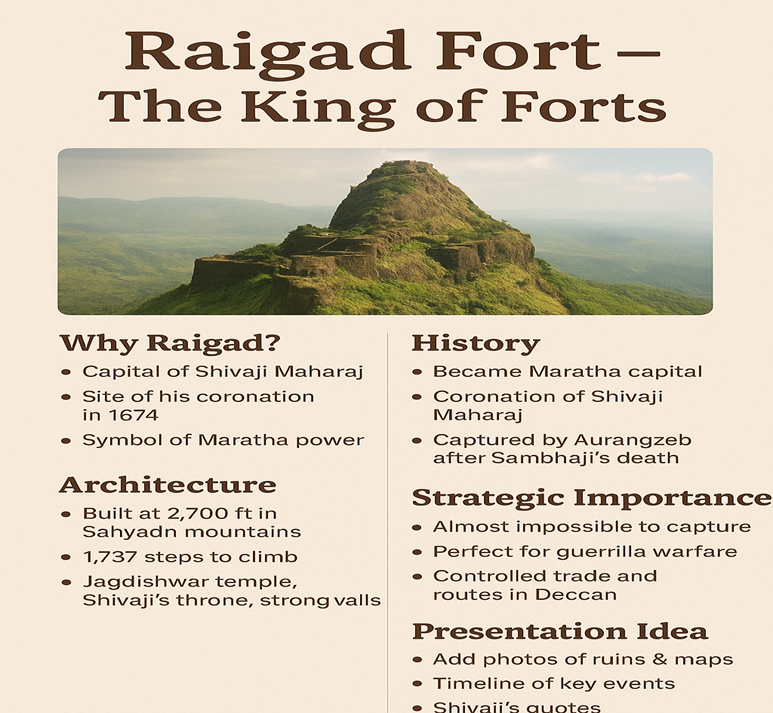
Chosen Fort: Raigad
- Why: Raigad, called the “King of Forts,” was Shivaji’s capital and the place of his 1674 coronation. It is important because of its history, design, and role in the Maratha empire.
- History: Raigad became the Maratha capital and the site of Shivaji’s coronation. Later, it was captured by Aurangzeb after the death of Shivaji’s son Sambhaji.
- Architecture: The fort is built 2,700 feet high in the Sahyadri mountains. It has 1,737 steps, strong walls, natural cliffs for protection, and important sites like the Jagdishwar temple and Shivaji’s throne.
- Strategic Importance: Its high location and tough terrain made it very hard to capture. It was useful for guerrilla warfare and for controlling routes in the Deccan. It also gave shelter to the Marathas during Mughal invasions.
- Presentation Idea: A digital slideshow or poster with pictures of Raigad’s ruins, maps, a timeline of key events, and quotes from Shivaji’s time.
Question 4: The chapter states, “The British took India from the Marathas more than from the Mughals or any other power.” What do you think this means? What evidence from the chapter supports this idea?
Answer: The Marathas, at their peak in the 18th century, were the main power the British had to defeat to establish rule in India, unlike the weakened Mughals.
Evidence:
- They controlled vast regions, including Lahore, Attock, and Delhi (recaptured in 1771 by Mahadji Shinde).
- The three Anglo-Maratha Wars (1775–1818) show they were the British’s chief rivals.
- Nana Phadnavis even built an anti-British alliance with Hyder Ali and the Nizam, proving Maratha dominance.
Question 5: Compare how Shivaji and later Marathas treated religious places and people of different faiths. What evidence from the chapter shows their approach to religious diversity?
Answer:
- Shivaji’s Approach: A devout Hindu who respected all faiths, sparing religious sites during the Surat raid, rebuilding temples, and promoting Sanskrit and Marathi over Persian without intolerance. His saffron flag symbolized cultural pride, not discrimination.
- Later Marathas: Ahilyabai Holkar rebuilt temples like Kashi Vishwanath and supported public works for all. Thanjavur Marathas fostered a syncretic culture, patronizing Carnatic music and Bharatanatyam. Yet, some campaigns (e.g., Bengal) showed lapses.
- Comparison: Both upheld Hindu traditions without widespread persecution. Shivaji’s rule was more disciplined, while later Marathas’ decentralized power led to occasional deviations.
Question 6: The chapter describes how forts were ‘the core of the state’ for Marathas. Why were they so important? How did they help the Marathas survive against larger enemies?
Answer:
- Importance of Forts: As noted in Adnyapatra, forts were vital to Maratha power—securing the state, guarding routes, housing armies, and symbolizing resilience.
- Survival Against Larger Enemies:
- Defense: Mountain forts like Raigad and Pratapgad were nearly impregnable.
- Guerrilla Warfare: Served as bases for ambushes, e.g., Pratapgad (1659).
- Strategic Control: Hundreds of forts let Marathas dominate Deccan routes and disrupt supplies.
- Evidence: Even after Aurangzeb took Bijapur and Golconda, forts sustained Maratha resistance under Tarabai and enabled later expansion.
Question 7: You have been appointed as the chief designer for Maratha coins. Design a coin that represents Maratha achievements and values. Explain the symbols you chose.
Answer:Coin Design
Obverse: Saffron flag with sun (Swarajya & revival), inscription in Modi script: “Shri Raja Shiva Chhatrapati.”
Reverse: Fort (Raigad) with ship (naval power), Devanagari inscription invoking Ganesha.
Symbols:
- Flag & Sun: Maratha pride and Shivaji’s self-rule.
- Fort: Strategic core of Maratha power (Adnyapatra).
- Ship: Navy’s resistance to Europeans.
- Scripts & Ganesha: Cultural revival and tradition in governance
Question 8: After this introduction to the Maratha period, what do you think was their most important contribution to Indian history? Write a paragraph supporting your opinion with examples from the chapter. Then share and discuss your ideas with classmates.
Answer:
Marathas’ Contribution:
The Marathas inspired self-rule and cultural pride, laying foundations for India’s freedom movement. Shivaji’s Swarajya, forts, and navy defied Mughals and Europeans, while his inclusive policies promoted unity. Leaders like Tarabai and Ahilyabai revived traditions and built temples without bias. Thanjavur Marathas enriched arts like Bharatanatyam and Carnatic music. By ruling vast regions and resisting the British till 1818, they proved Indians could govern themselves, inspiring later independence struggles.
CHAPTER 4:- THE COLONIAL ERA IN INDIA- Q&A
Exercise Questions (Page 33)
Question 1: What is colonialism? Give three different definitions based on the chapter or on your knowledge.
Answer:Colonialism:
- Political Control: Dominance of one nation over another, e.g., Britain’s takeover of India through the East India Company.
- Economic Exploitation: Extraction of wealth for the colonizer’s gain, like Britain draining India’s resources to fuel its Industrial Revolution.
- Cultural Imposition: Forcing culture, religion, or education, seen in the Portuguese Inquisition in Goa and Macaulay’s “brown Englishmen” policy.
Question 2: Colonial rulers often claimed that their mission was to ‘civilise’ the people they ruled. Based on the evidence in this chapter, do you think this was true in the case of India? Why or why not?
Answer: The British “civilizing mission” was false, as policies focused on exploitation: heavy taxes caused famines (e.g., Bengal Famine, 1769–72), deindustrialization crippled textiles, and village self-rule was dismantled. Macaulay’s education created loyal elites, not uplift. Railways and archaeology mainly served British interests. Resistance like the 1857 Rebellion, and voices such as Dadabhai Naoroji and Begum Hazrat Mahal, exposed British rule as oppressive.
Question 3: How was the British approach to colonising India different from earlier European powers like the Portuguese or the French?
Answer:
- Portuguese: Sought naval dominance (cartaz system) and conversions via the Goa Inquisition, but held only limited coastal control.
- French: Built trading posts like Pondicherry and, under Dupleix, trained sepoys and used indirect rule, but lost influence after the Carnatic Wars.
- British: Transitioned from traders to rulers through the East India Company, using “divide and rule,” Doctrine of Lapse, and subsidiary alliances to expand. Unlike Portuguese zeal or French limits, they restructured India’s economy, governance, and education for imperial gain, seen in deindustrialization and Macaulay’s policies.
Question 4: “Indians funded their own subjugation.” What does this mean in the context of British infrastructure projects in India like the railway and telegraph networks?
Answer: “Indians funded their own subjugation” means Indian tax revenues financed British projects like railways and telegraphs, which mainly served colonial trade and military control. Built with Indian money, these strengthened British dominance while burdening Indians, as noted in Dadabhai Naoroji’s drain of wealth theory.
Question 5: What does the phrase ‘divide and rule’ mean? Give examples of how this was used by the British in India?
Answer:
“Divide and rule” was the British strategy of exploiting divisions among Indian rulers and communities to maintain control.
Examples include the
- Battle of Plassey (1757), where Clive conspired with Mir Jafar against Siraj-ud-Daulah;
- fueling Hindu-Muslim tensions during the 1857 Rebellion; and
- using subsidiary alliances (e.g., Hyderabad, 1798) to make rulers dependent on British power.
Question 6: Choose one area of Indian life, such as agriculture, education, trade, or village life. How was it affected by colonial rule? Can you find any signs of those changes still with us today? Express your ideas through a short essay, a poem, a drawing, or a painting.
Answer:
Short Essay: Impact on Indian Education
British rule reshaped Indian education from a community-based system to one serving imperial needs. Pre-colonial India had pathshalas, madrasas, and viharas teaching practical and cultural knowledge in local languages, with reports noting 100,000–150,000 village schools in Bengal and Bihar by 1830. But Macaulay’s 1835 Minute dismissed Indian knowledge, promoting English-medium education to create “brown Englishmen.” This sidelined traditional schools, fostered an elite cut off from their heritage, and deepened social divides. English became a marker of prestige, marginalizing vernacular learning.The legacy persists in India’s reliance on English for status and opportunity, seen in English-medium schools and exams. Yet, regional language movements and efforts to revive traditional knowledge show resistance. Colonial disruption of indigenous education still shapes disparities and cultural identity debates today.
Question 7: Imagine you are a reporter in 1857. Write a brief news report on Rani Lakshmibai’s resistance at Jhansi. Include a timeline or storyboard showing how the rebellion began, spread, and ended, highlighting key events and leaders.
Answer:
News Report: Rani Lakshmibai’s Heroic Stand at Jhansi, June 1857
Jhansi, June 1857 – Rani Lakshmibai, queen of Jhansi, is leading a valiant defense against British attempts to annex her kingdom under the Doctrine of Lapse. After the British rejected her adopted son’s claim to the throne, she rallied sepoys and locals to resist. With support from Tantia Tope, she commands with courage and skill, repelling early assaults. Her defiance inspires rebels across northern India, where uprisings spread to Kanpur and Lucknow amid anger over greased cartridges. The Rani has vowed to defend Jhansi to her last breath.
Timeline of the 1857 Rebellion:
- Mar 1857: Mangal Pandey attacks officers at Barrackpore; executed.
- May 1857: Sepoys at Meerut rebel, march to Delhi, proclaim Bahadur Shah Zafar leader.
- Jun 1857: Revolt spreads—Nana Saheb (Kanpur), Begum Hazrat Mahal (Lucknow), Rani Lakshmibai (Jhansi).
- Sep 1857: British recapture Delhi with mass killings.
- Mar 1858: British besiege Jhansi; Rani escapes, seizes Gwalior with Tantia Tope.
- Jun 1858: Rani dies in battle at Gwalior.
- 1858–59: British crush revolt; Tantia Tope executed. Crown takes direct rule of India.
Question 8: Imagine an alternate history where India was never colonised by European powers. Write a short story of about 300 words exploring how India might have developed on its own path.
Answer:
A Free India’s Dawn
In an uncolonized 1857, India thrives as a federation led by a revitalized Maratha Empire under Nana Saheb, allied with Mughal remnants and southern rulers. Forts guard trade routes, Kanhoji Angre’s heirs maintain a strong navy, and ports like Surat and Calicut bustle with global trade. Artisans weave silks, forge wootz steel, and scholars blend Sanskrit, Persian, and Tamil knowledge in thriving centers like Thanjavur.Without exploitative revenue policies, famines are rare, village councils manage resources, and women rulers continue Ahilyabai Holkar’s legacy of education and infrastructure. The federation treats European traders as equals while forging alliances with Japan and Persia.Though rivalries persist, a grand council in Delhi, inspired by Shivaji’s Swarajya, mediates disputes. Poets like Bankim Chandra foster unity with works such as Vande Mataram. By 1857, India stands prosperous, self-governing, and globally influential—free from the shadow of colonial subjugation.
Question 9: Role-play: Enact a historical discussion between a British official and an Indian personality like Dadabhai Naoroji on the British colonial rule in India.
Answer:
Historical Discussion: British Official vs. Dadabhai Naoroji, 1901
Sir John Smith (British Official): Mr. Naoroji, our rule has brought progress—railways, telegraphs, English education. Surely you see the benefits?
Naoroji: These “benefits” mask exploitation. Railways, built with Indian taxes, carry raw materials to Britain while artisans starve. In Poverty and Un-British Rule in India, I show Britain drains £30 million yearly from us.
Smith: Yet we replaced chaotic princely rule with order and justice.
Naoroji: You dismantled village republics, annexed states like Jhansi, and ignored famines—10 million died in Bengal while taxes rose.
Smith: Still, our education opens opportunities.
Naoroji: Macaulay’s system scorns our heritage, producing clerks, not scholars. Our schools once taught practical skills; now you create “brown Englishmen.”
Smith: But under our protection, India shares in global trade.
Naoroji: Trade? Your tariffs ruined our textiles, reducing India’s GDP share to 5%. We demand Swaraj—self-rule to restore prosperity.
Moderator: Clearly, the debate reflects opposing views on whether British rule modernized or exploited India.
Question 10: Explore a local resistance movement (tribal, peasant, or princely) from your state or region during the colonial period. Prepare a report or poster describing: What was the specific trigger, if any? Who led the movement? What were their demands? How did the British respond? How is this event remembered today?
Answer:
Report: Santhal Rebellion (1855–1856)
Trigger: Sparked by British land policies in the Santhal Parganas, which imposed cash taxes, backed moneylenders, and seized tribal lands. Forest restrictions further disrupted Santhal life.
Leaders: Brothers Sidhu and Kanhu Murmu rallied thousands, calling for justice and self-rule.
Demands: Restoration of lands, an end to exploitative taxes, and establishment of a “Santhal Raj” free from British and landlord control.
British Response: The British crushed the uprising with brutal force—burning villages, killing thousands, and executing Sidhu and Kanhu.
Legacy: Remembered as Hul Diwas (June 30) in Jharkhand. Monuments, folk songs, and the Santhal Parganas Tenancy Act honor their fight for land rights and inspire tribal identity.
CHAPTER 5:- UNIVERSAL FRANCHISE AND INDIA’S ELECTORAL SYSTEM
Exercise Questions (Page 138)
Question 1: Why is universal adult franchise important for a healthy democracy?
Answer: Universal adult franchise ensures equal participation in democracy by giving every citizen above 18 the right to vote, regardless of caste, gender, religion, or education. It empowers people to choose representatives, promotes inclusivity, and strengthens legitimacy. In India, with 880 million voters in 2024, it allows diverse voices to shape policies and fosters accountability in governance.
Question 2: What is the meaning of ‘secret ballot’? Why is this important in a democracy?
Answer: A secret ballot is a voting process where no one knows who a voter chose, ensuring privacy and freedom of choice. In India, voters mark their preference on EVMs or paper ballots in private booths, as seen in the classroom election example with Ms. Usha. It is important because it protects voters from coercion, intimidation, or social pressure, allowing them to vote according to their conscience, which is essential for a free and fair democratic process.
Question 3: Give examples of direct and indirect elections.
Answer:
Direct Elections:
- Lok Sabha: voters elect 543 MPs.
- State Assemblies: voters elect MLAs.
- Local bodies: voters elect panchayat/municipal members.
Indirect Elections:
- Rajya Sabha: MLAs elect MPs.
- President: MPs and MLAs vote using the single transferable system.
Question 4: How is the election of members to the Lok Sabha different from that to the Rajya Sabha?
Answer:
- Lok Sabha: 543 members directly elected by voters through first-past-the-post; elections every five years or upon dissolution.
- Rajya Sabha: Members indirectly elected by State Assemblies via proportional representation; one-third elected every two years.
Question 5: What, in your view, are the advantages of the EVM over paper ballots?
Answer:
Electronic Voting Machines (EVMs) offer several advantages over paper ballots:
- Efficiency: Speeds up voting and counting for large electorates.
- Accuracy: Reduces counting errors and invalid votes.
- Security: With VVPAT, ensures verifiable, transparent results.
- Cost-Effective: Cuts printing and logistics costs.
- Accessibility: Braille features aid disabled voters.
Question 6: Voter turnout has been declining in some urban areas of India. What could be the reasons for this trend, and what steps can be taken to encourage more people to vote?
Answer:
Reasons for Low Turnout:
- Apathy: Many feel their vote won’t matter.
- Logistics: Busy schedules, migration, or lack of awareness.
- Distrust: Corruption and poor candidates (hence NOTA).
- Barriers: Queues and limited facilities despite ECI efforts.
Steps to Boost Voting:
- Awareness: Campaigns via social media and local events.
- Convenience: More postal/home voting (e.g., 2024 elderly, disabled).
- Technology: Apps for registration and polling info.
- Engagement: Drives via schools, leaders, community events.
- Incentives: Stress civic duty and NOTA as dissent.
Question 7: Why do you think a proportion of seats in the Lok Sabha are reserved for persons from the Scheduled Castes and Scheduled Tribes?
Answer: A proportion of Lok Sabha seats (84 for Scheduled Castes, 47 for Scheduled Tribes) are reserved to ensure representation of historically marginalized communities. These groups faced social and economic exclusion, limiting their political voice. Reservations empower them to elect representatives who address their specific concerns, such as discrimination, land rights, and access to education, promoting inclusivity and equity in India’s democracy, as envisioned by the Constitution makers.
Question 8: Social media is changing the way we experience elections from catchy campaign reels and live speeches to political debates on Instagram and Twitter. But is this strengthening democracy or confusing it? Discuss in pairs: What are the benefits, what are the challenges, and what might the future of elections be in a digital age?
Answer:
Benefits:
- Engagement- social media platforms like Instagram and twitter make campaigns accessible, with reels and live speeches reaching younger and urban voters, increasing awareness.
- Outreach: Candidates share policies directly (e.g., Ravi’s music or Gurmat’s noticeboard), building voter connection.
- Transparency: Debates and posts let voters scrutinize candidates, boosting discourse.
Challenges:
- Misinformation: Fake content misleads voters.
- Polarization: Divisive rhetoric, echoing MCC concerns.
- Digital Divide: Rural and less tech-savvy voters risk exclusion.
Future:
- Digital Integration: AI tools and secure online voting, building on ECI apps.
- Regulation: Stronger rules on online campaigns to curb fakes.
- Hybrid Model: Blend of digital outreach and physical polling ensures inclusivity.
Question 9: Visit the website https://www.indiavotes.com, and choose a parliamentary constituency election from any year and explore its results. Do the same for an assembly election in your state.
Answer-
I’m glad you explored IndiaVotes, one of India’s biggest election databases spanning Lok Sabha (PC) and State Assembly (AC) elections. Here’s a snapshot using available sources:
Parliamentary Constituency Example — Lok Sabha
I took a look at the PC 2024 Summary on IndiaVotes, which displays alliance performance across all parliamentary constituencies:The NDA (BJP-led) won 292 seats (vote share ~44.3%)The INDIA coalition secured 230 seats (vote share ~37.2%). Unfortunately, constituency-level results weren’t directly accessible in this search—however, this snapshot gives a bird’s-eye view of the national picture for 2024.
State Assembly Election Example — Haryana 2024 (AC)
This snapshot highlights voter engagement but—like the parliamentary data—specific winning parties or candidates per constituency weren’t visible in the quick search results. I also checked the Haryana Assembly results for 2024 via IndiaVotes:Total Electors: ~2.05 croresVotes Polled: ~1.38 croresVoter Turnout: 67.6% across 90 constituencies.
CHAPTER 6- THE PARLIAMENTARY SYSTEM: LEGISLATURE AND EXECUTIVE
Exercise Questions (Pages 161–162)
Question 1: Find out how many representatives from your state are in each House of the Parliament.
Answer: The number of parliamentary representatives differs from state to state. For instance, Uttar Pradesh is allocated 80 seats in the Lok Sabha and 31 seats in the Rajya Sabha, whereas smaller states such as Sikkim have just 1 seat in each house. To find the precise number of seats for your state, refer to the Election Commission of India’s website or consult the official records for the 18th Lok Sabha (2024) and current Rajya Sabha allocations.
Question 2: What makes the Indian Parliament the “voice of the people”? How does it ensure that different opinions are heard?
Answer: The Indian Parliament is the “voice of the people” because it comprises elected representatives chosen through universal adult franchise, reflecting diverse societal interests. It ensures different opinions are heard through:
- Debates and Discussions: MPs debate bills, as seen with the RTE Act, allowing diverse perspectives.
- Question Hour: MPs question ministers, raising public concerns.
- Linguistic Accessibility: Translation in 18 languages ensures inclusivity.
- Federal Representation: The Rajya Sabha represents state interests, balancing regional voices.
Question 3: Why do you think the Constitution made the Executive responsible to the Legislature?
Answer: The Constitution makes the Executive (Prime Minister and Council of Ministers) responsible to the Legislature (Lok Sabha) to ensure accountability and democratic governance. Since MPs are elected by the people, their oversight through mechanisms like Question Hour ensures the Executive implements laws and policies in the public’s interest, preventing misuse of power.
Question 4: Why do you think we have chosen the system of bicameral legislature at the Union level?
Answer: India adopted a bicameral legislature to:
- Promote Federalism: The Rajya Sabha represents state interests, balancing national unity with regional diversity.
- Ensure Deliberation: The upper house reviews and refines bills passed by the Lok Sabha, enhancing legislative quality.
- Balance Power: It prevents hasty legislation and provides stability, as Rajya Sabha members are elected indirectly and serve longer terms.
Question 5: Try to track the journey of a recent bill passed by the Parliament. Identify in which House it was introduced. Were there any major debates or disagreements? How long did it take for the bill to become a law? Use newspaper archives, government websites, and Lok Sabha debates, or ask your teacher for help.
Answer:
Example: Women’s Reservation Bill, 2023
- Introduction: Presented in the Lok Sabha as the Constitution (128th Amendment) Bill on September 19, 2023.
- Journey: Reserved 33% of seats for women in the Lok Sabha and state assemblies. Passed Lok Sabha (454–2) on September 20, Rajya Sabha unanimously on September 21, and received Presidential assent on September 28, 2023.
- Duration: 10 days from introduction to assent; earlier versions debated for 25+ years.
- Source: Lok Sabha/Rajya Sabha websites, news archives (e.g., The Hindu, Sept 2023).
Question 6: Choose a recent law passed by the Parliament. Divide into teams to role-play different parts of the process – MPs debating in Lok Sabha and Rajya Sabha, ministers answering questions, and the President giving assent. Present a short skit showing how a bill becomes a law; enact a ‘model Parliament’.
Answer:
Women’s Reservation Bill, 2023 (Nari Shakti Vandan Adhiniyam)recent law passed by the Parliament is the Women’s Reservation Bill, 2023 (Nari Shakti Vandan Adhiniyam).Reserves 33% of seats for women in the Lok Sabha and State Assemblies.
Model Parliament Skit: MPs debate the bill, with some supporting and some raising concerns.Ministers explain its purpose and implementation.Bill is voted on and passed in the Lok Sabha.Rajya Sabha discusses and passes the bill.Sent to the President, who gives assent.Becomes law and is published in the Gazette of India.
Question 7: The Women’s Reservation Bill, 2023, was passed with wide support. Why might it have taken over 25 years for this bill to be passed, despite being discussed for so long?
Answer:-
The bill faced political disagreements for many years.Parties differed on the reservation percentage and its impact.Some leaders worried it could limit opportunities for men or affect caste-based representation.After prolonged debates and growing demand for women’s political participation, a consensus was reached in 2023.
Question 8: Sometimes the Parliament is disrupted and does not function for the number of days it is supposed to. What impact do you think this has on the quality of laws and the trust people place in their representatives?
Answer:
Impact on Quality of Laws:
- Delayed Legislation: Disruptions, as noted with low productivity (e.g., Rajya Sabha’s 35.75% in 2018), delay bills, leading to rushed or poorly debated laws.
- Reduced Scrutiny: Limited discussion time weakens the quality of laws, as seen with prolonged debates on bills like RTE.
Impact on Public Trust:
- Erosion of Confidence: Frequent disruptions and absenteeism signal inefficiency, reducing trust in MPs.
- Perception of Neglect: Angry or biased debates, as highlighted in media cartoons, make citizens feel their concerns are ignored, undermining democratic faith.
Question 9: Can you create ‘interest’ groups among students and list questions related to any policy that you may want to ask your MP and/or your MLA? How would these questions be different if it is to the MP instead of the MLA, and vice versa?
Answer:
Interest Group:
- Education Policy (NEP 2020)MP (Union Level) Questions:
How is NEP 2020 being implemented uniformly across states?What funds are allocated for teacher training in 2025–26?How will vocational education under NEP support national job creation?
- MLA (State Level) Questions:
How is the state integrating NEP’s multilingual education in schools?Are there plans to upgrade school infrastructure to NEP standards?How is the state addressing teacher shortages in rural areas?
- Key Difference: MPs focus on national policy, funding, and coordination; MLAs address state-level implementation, infrastructure, and local challenges.
Question 10: What is the role that the Judiciary plays in Indian democracy? What could happen if we didn’t have an independent Judiciary?
Answer:
Role of Judiciary
- Interpreting Laws: Resolves disputes and ensures legal clarity.
- Constitutional Guardian: Ensures laws and actions comply with the Constitution.
- Protecting Rights: Safeguards fundamental rights and democratic values.
- Checks and Balances: Prevents legislative or executive overreach.
Without an Independent Judiciary:
- Unchecked Power: Risk of unconstitutional laws and authoritarianism.
- Rights Violations: Citizens’ rights may be ignored.
- Erosion of Democracy: Weakens accountability and public trust.
CHAPTER 7-FACTORS OF PRODUCTION
Exercise Questions (Pages 180–181)
Question 1: How are the factors of production different from each other? What are the difficulties you faced in classifying the factors of production in the exercise given in-text?
Answer:
Factors of Production
- Land: Natural resources like soil, water, and minerals.
- Labour: Human physical and mental effort, enhanced by skills and knowledge.
- Capital: Money and human-made assets (machinery, buildings) for production.
- Entrepreneurship: Vision and risk-taking to combine factors and innovate.
- Technology: Scientific applications (e.g., UPI, drones) that boost efficiency.
Classification Challenges:
- Overlap: Some assets (e.g., factory) may be land or capital.
- Context: Water can be land (agriculture) or capital (bottling).
- Technology vs. Capital: Tools like computers can be both.
- Local Variations: Subtle factors, like entrepreneurial decisions, may be overlooked in small businesses.
Question 2: How does human capital differ from physical capital?
Answer:
Human vs. Physical Capital
- Human Capital: Skills, knowledge, and expertise of workers, enhanced by education, training, and health (e.g., a developer’s coding skills).
- Physical Capital: Tangible assets like machinery, tools, and buildings that support production.
- Key Difference: Human capital is intangible and resides in people; physical capital is tangible and owned by businesses. Both are essential for production.
Question 3: How do you think technology is changing how people develop their skills and knowledge?
Answer:
Technology and Skill Development
- Online Learning: Platforms like SWAYAM offer free, self-paced courses.
- Job Access: Portals like National Career Service connect learners to opportunities.
- Skill Enhancement: Virtual simulations provide practical, hands-on training.
- Global Reach: Removes geographical barriers, enabling global knowledge and remote certifications.
Question 4: A skill is something you learn and practice to get better. It helps you do things well, like playing a sport, creative writing, solving math problems, cooking, or even communicating well with people. If you could learn one skill today, what would it be and why?
Answer:
Chosen Skill: Coding
Reason: Coding is versatile and in high demand, develops logical thinking, opens career opportunities (e.g., via National Career Service), and enables creating innovative solutions that benefit society and personal growth.
Question 5: Do you think entrepreneurship is the ‘driving force’ of production? Why or why not?
Answer: Yes, Entrepreneurship: Driving Force of Production
- Vision & Coordination: Combines land, labour, and capital to create products (e.g., J.R.D. Tata’s ventures).
- Risk-Taking: Invests resources despite uncertainties (e.g., Ratna’s restaurant loan).
- Innovation: Introduces new ideas and technologies, boosting efficiency.
- Job Creation: Starts businesses that generate employment.
Note: Labour and capital are also essential, but entrepreneurship orchestrates these factors, making it pivotal.
Question 6: Can technology replace other factors like labour? Is this good or bad? Support your answer with an example.
Answer:
Can Technology Replace Labour?
Partial Replacement: Technology can handle repetitive or manual tasks but cannot replace human creativity and decision-making.
Example: Drones in agriculture reduce manual labour for spraying fertilizers.
Pros: Increases efficiency, covers large areas quickly, and reduces physical strain.
Cons: May cause job losses for unskilled workers.
Balance: Technology should complement labour, with retraining to ensure inclusive growth.
Question 7: How do education and skill training affect human capital? Can they substitute for each other, or do they complement each other?
Answer:
Impact on Human Capital
- Education: Provides foundational knowledge for problem-solving (e.g., literacy, engineering principles).
- Skill Training: Offers practical expertise, boosting efficiency and productivity.
Complementary Role: Education gives theory; training applies it (e.g., a civil engineer needs both for durable bridges). Relying on only one limits versatility.
Question 8: Imagine you want to start a business that produces steel water bottles. What kind of inputs are needed? How would you obtain them? Suppose one of the factors is missing, what happens to your business operations?
Answer:
Inputs Needed for Bottle Production
- Land: Factory space and raw materials (steel, water).
- Labour: Skilled workers and human capital (designers, welders).
- Capital: Machinery, tools, and operational funds.
- Entrepreneurship: Vision for eco-friendly design and marketing.
- Technology: Automation and online sales platforms.
How to Obtain:
- Land: Lease factory, source materials locally or via import.
- Labour: Hire via job portals and train workers.
- Capital: Personal savings, bank loans, or crowdfunding.
- Entrepreneurship: Create a sustainable business plan.
- Technology: Invest in machinery and e-commerce tools.
If a Factor is Missing (e.g., Labour):
- Impact: Production halts; quality suffers.
- Solution: Hire temporary workers or automate, but invest in long-term training.
Question 9: Interview an entrepreneur or founder to understand their motivation to start a business and the opportunities and challenges they saw. You can work in pairs to create a questionnaire to collect the information and share what you have learned in a report.
Answer:
Questionnaire for Entrepreneurs-
- What inspired you to start your business?
- What problem does your business solve?
- What market opportunities did you identify?
- Challenges in securing land, labour, or capital?
- How did you use technology?
- How did your skills/training help?
- How do you ensure sustainability?
- Advice for young entrepreneurs?
Sample Report (Hypothetical – Ratna’s Restaurant):
- Motivation: Passion for cooking; provide affordable, healthy meals.
- Opportunities: Local cuisine demand unmet by competitors.
- Challenges: High-interest bank loan; finding skilled cooks.
- Technology: UPI payments and social media marketing.
- Sustainability: Local sourcing to reduce waste and supply issues.
- Learning: Culinary training and community support helped overcome challenges.
Note-Students should interview a local entrepreneur, adapt the questions, and share findings in class.
Question 10: Think like an economist. Let’s explore what happens when things change. If you were Ratna, what would you do in the following situations? Discuss with your classmates.
Business Scenarios & Responses
- Rent Doubles
- Action: Slightly raise prices or relocate to cheaper space.
- Impact: Higher costs may reduce profits or customer loyalty; relocation risks losing patrons.
- Staff Quits
- Action: Train existing staff, hire temporary help, or offer higher wages.
- Impact: Overworked staff may lower service quality; higher wages increase costs.
- Small Loan for Technology
- Action: Invest in automated equipment and online delivery.
- Impact: Boosts efficiency, quality, profits, and market reach.
- New Competitor
- Action: Offer unique dishes, improve service, provide loyalty perks.
- Impact: Differentiation maintains customers; requires innovation without drastic price cuts.
- Government Support
- Suggestions: Simplify loans, reduce compliance, provide tax incentives for sustainable practices.
- Impact: Easier capital access and lower regulations help business growth and eco-friendly adoption.