Published by the Educational Research Team at A2ZLY.com | In alignment with NCERT, CBSE, and KVS Directives
Rajya Stariya Bal Vaigyanik Pradarshani (RSBVP) 2026–27 represents one of India’s most prestigious science exhibition platforms for school students. Spearheaded nationally under the guidance of the National Council of Educational Research and Training (NCERT), this initiative inspires young minds to channel textbook concepts into practical, working innovations that address real-world socio-economic and ecological problems.
NCERT has officially announced the overarching theme, seven core sub-themes, and two critical one-day seminar topics for RSBVP 2026–27 and the culminating Rashtriya Bal Vaigyanik Pradarshani (RBVP) 2027. In response, premier school chains including the Kendriya Vidyalaya Sangathan (KVS) have initiated preparation drives across regional offices and vidyalayas.
To support science coordinators, teachers, and young innovators, A2ZLY.com has prepared this definitive preparation blueprint. It provides a breakdown of official circulars, evaluation criteria, and 70 classroom-tested, workable science project ideas designed for competitive presentation.
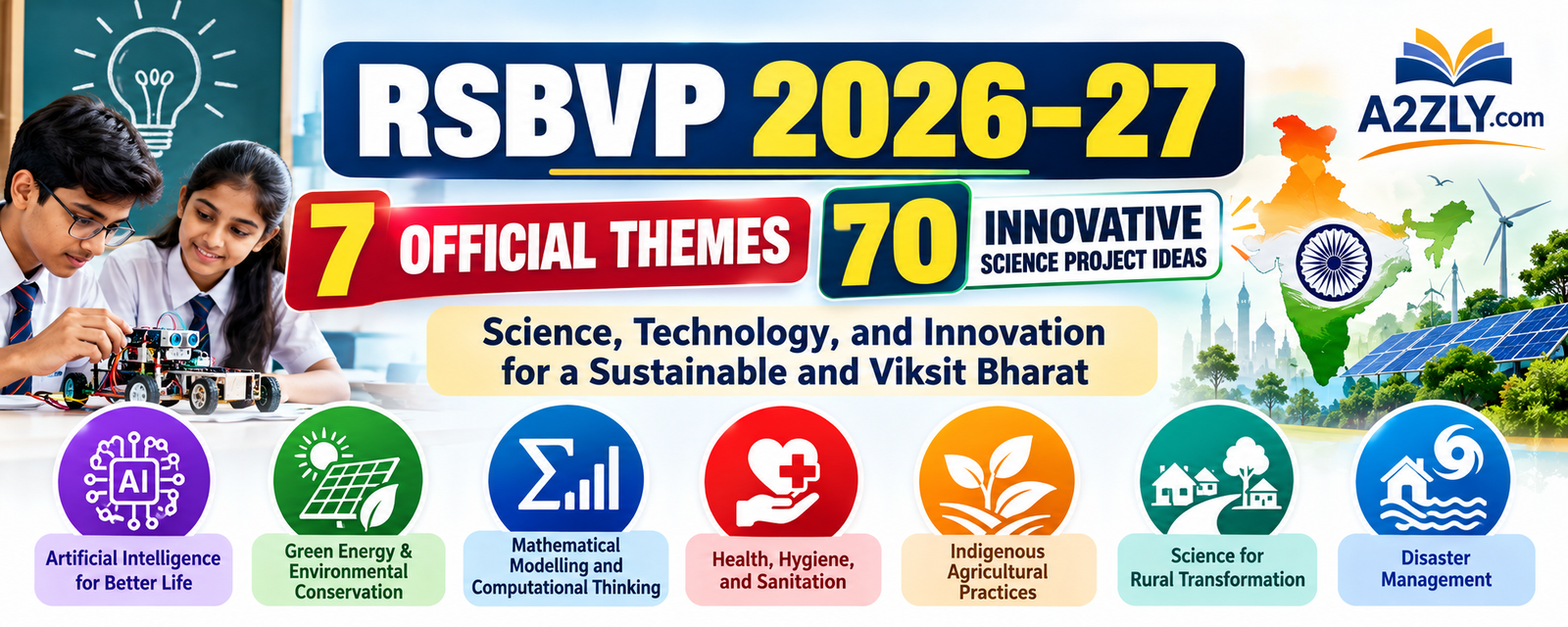
Science, Technology, and Innovation for a Sustainable and Viksit Bharat
Suggested Sub-Themes
7 Interdisciplinary Sub-Themes
Seminar Topics Included
2 Key Topics (Climate Action & Lifestyle Health)
NCERT Notification Date
28 August 2026 (Letter No: 12-4/DESM/ACM/2026-27/)
KVS HQ Directive Date
13 October 2026 (Letter No: 11350/2026-2027/KVS (HQ)/Acad/RBVP)
Educational Disclaimer: The 70 detailed project concepts catalogued in this guide are original pedagogical blueprints compiled by A2ZLY.com to aid classroom conceptualization. They are not an official mandatory list prescribed by NCERT.
What Is RSBVP & Core Educational Objectives
Rajya Stariya Bal Vaigyanik Pradarshani (RSBVP) serves as the state and regional bridge leading to the prestigious national RBVP. Designed to break rote memorization, it challenges middle and secondary school students to use empirical observation, scientific inquiry, and design thinking.
Primary Learning Outcomes of RSBVP:
Nurturing an investigative mindset, empirical inquiry, and scientific temper.
Encouraging students to build scalable, low-cost prototypes for hyper-local problems.
Integrating cross-disciplinary concepts: combining Physics, Biology, Chemistry, and Mathematics with modern computing and algorithmic logic.
Polishing analytical presentation, public communication, and scientific report drafting skills.
Fostering environmental consciousness aligned with the UN Sustainable Development Goals (SDGs).
Official Main Theme of RSBVP 2026–27
Science, Technology, and Innovation for a Sustainable and Viksit Bharat
सतत एवं विकसित भारत के लिए विज्ञान, प्रौद्योगिकी और नवाचार।
The central theme underscores the role of youth-driven innovation in achieving a carbon-neutral, self-reliant, and developed India (Viksit Bharat). Exhibitors are expected to demonstrate how modern science can be harmonized with sustainability across key sectors: agriculture, public sanitation, energy transition, and resilient infrastructure.
The 7 Suggested Sub-Themes (NCERT Notification)
Per NCERT’s letter dated 28 August 2026, the 7 suggested sub-themes are:
Artificial Intelligence (AI) for Better Life
Green Energy & Environmental Conservation
Mathematical Modelling and Computational Thinking
Health, Hygiene, and Sanitation
Indigenous Agricultural Practices
Science for Rural Transformation
Disaster Management
NCERT Clarification: These sub-themes are suggestive. Schools and students are free to present cross-cutting innovations under the broader umbrella of “Science and Technology for Society.”
Sub-Theme 1
Artificial Intelligence (AI) for Better Life
बेहतर जीवन के लिए कृत्रिम बुद्धिमत्ता
This sub-theme focuses on how machine learning, computer vision, and predictive algorithms can solve practical societal bottlenecks. Evaluators prioritize models featuring real software code, trained edge models, or functional microcontrollers over passive mockups.
1. AI-Powered Smart Waste Segregation Bin
Concept: Automated sorting of dry, wet, and recyclable items via computer vision.
Mechanism: A web camera captures the discarded object; a lightweight MobileNet/Teachable Machine model classifies it and triggers a servo motor to tilt the flap into the correct bin.
10. AI Predictive Hydrological Basin Flood Forecaster
Concept: Early warning system based on upstream precipitation data.
Mechanism: Time-series LSTM/regression model that computes downriver water surges using rainfall and reservoir outflow rates.
Curriculum Link: Hydrology, Predictive Data Analytics.
Important Exhibition Tip: Judges will verify if your project uses genuine machine learning or simple logic gates. An Arduino paired with an ultrasonic sensor is an automated system, not AI. Use platforms like Edge Impulse, Teachable Machine, or Python OpenCV to demonstrate genuine ML models.
Sub-Theme 2
Green Energy & Environmental Conservation
हरित ऊर्जा एवं पर्यावरण संरक्षण
Focuses on renewable energy generation, carbon footprint reduction, circular economy frameworks, and responsible resource conservation.
1. Dual-Axis Solar Photovoltaic Heliostat Tracker
Concept: Maximizing panel irradiance throughout daylight hours.
Mechanism: 4 LDR sensors in a cross formation trigger dual servo motors to align the solar panel normal to the incident light.
Concept: Round-the-clock off-grid power generation for coastal or hilly schools.
Mechanism: Vertical-axis wind turbine captures low-velocity omnidirectional breeze while monocrystalline panels supply daylight power through a shared charge controller.
Curriculum Link: Aerodynamics, Electrical Energy Storage.
3. Stepped Multi-Stage Solar Water Desalination Still
Concept: Affordable potable water generation from brackish water sources.
Mechanism: Solar thermal box with black-absorber stepped trays, condensing water vapour along an angled glass condenser into collection troughs.
Curriculum Link: Phase Changes, Solar Thermal Dynamics.
4. Roadway Piezoelectric Kinetic Energy Harvesting Grid
Concept: Generating clean electricity from vehicular speed breakers.
Mechanism: PZT ceramic disc array embedded beneath a speed bump converts mechanical impact pressure into voltage stored in a capacitor bank.
Curriculum Link: Solid State Physics, Piezoelectricity.
5. Microbial Fuel Cell (MFC) from Organic Sludge
Concept: Generating bio-electricity while treating sewage/sludge.
Mechanism: Anaerobic microbes oxidize organic matter at the anode, releasing electrons that travel through a circuit to an aerated cathode.
8. Self-Cleaning Toilet Flush Automation with Odor Detection
Concept: Maintaining sanitation standards in public school restrooms.
Mechanism: Infrared usage counters trigger high-pressure flushes, while an ammonia sensor turns on exhaust fans when odor levels rise.
Curriculum Link: Automation, Community Sanitation.
9. Biological Mosquito Larvae Trap using Fermentation CO2
Concept: Eco-friendly vector control to prevent dengue and malaria.
Mechanism: Yeast and brown sugar fermentation produces CO2 to lure adult mosquitoes into a funnel trap, interrupting breeding cycles without pesticides.
Curriculum Link: Vector Biology, Chemical Ecology.
Curriculum Link: Human Nutrition, Metabolic Biochemistry.
Sub-Theme 5
Indigenous Agricultural Practices
स्वदेशी कृषि पद्धतियाँ
Validating traditional Indian agrarian wisdom using modern scientific methods: natural pest management, seed preservation, soil conservation, and zero-budget organic farming.
1. Sub-Surface Earthen Pot (Matka) Auto-Drip Irrigation
Concept: Water-saving irrigation for arid, drought-prone belts.
Mechanism: Buried unglazed clay pots release water through their porous walls based on the soil-moisture tension created by plant roots.
3. Traditional Mud Silo (Kuthi) vs. Modern Hermetic Seed Storage
Concept: Preventing weevil attacks in stored indigenous food grains.
Mechanism: Comparing seed germination rates across storage mediums: traditional clay-straw containers mixed with dry neem leaves versus standard plastic bags.
Designing practical, affordable innovations that solve everyday challenges for rural communities: drinking water access, post-harvest losses, and farm mechanization.
Concept: Preventing post-harvest loss of perishable farm produce.
Mechanism: Double-walled brick enclosure packed with wet sand; continuous evaporation keeps the interior 8–12°C cooler with 90% humidity.
Curriculum Link: Latent Heat of Vaporization, Rural Refrigeration.
2. Human-Powered Pedal Water Pump for Marginal Farmers
Concept: Fuel-free irrigation for small landholdings.
Mechanism: Repurposed bicycle frame linked via a chain-sprocket drive to a double-acting reciprocating piston pump, delivering 30L of water per minute.
Curriculum Link: Mechanical Advantage, Work and Energy Transfer.
3. Indirect Forced-Convection Solar Agro-Dehydrator
Concept: Clean dehydration of chili, ginger, and turmeric crops.
Mechanism: Glazed black solar air heater funnels hot air through stacked drying trays, protecting produce from UV bleaching and insect pests.
5. Forest Fire Detection Beacon with Wireless LoRa Mesh Alert
Concept: Detecting wildfires in national parks before they spread out of control.
Mechanism: Solar-powered canopy nodes combine gas (CO/smoke) and optical thermal sensors, transmitting alerts over long-range LoRa radio without cellular networks.
Concept: Sheltering stranded families during urban inundations.
Mechanism: High-buoyancy modular pontoons that rise with rising water levels, secured to vertical guide rails to maintain stability.
Curriculum Link: Archimedes’ Principle, Centre of Buoyancy.
9. Portable Emergency Solar & UV Water Purification Backpack
Concept: Treating contaminated water in post-flood refugee camps.
Mechanism: Backpack unit with a 12V diaphragm pump, 0.1-micron hollow-fiber membrane, and UV-C LED sterilizer to eliminate bacterial and viral pathogens.
10. Emergency Off-Grid Radio Hub for Cellular Outages
Concept: Civil communication during major storms and blackouts.
Mechanism: Hand-cranked and solar-powered transceiver hub using VHF/UHF bands to broadcast regional safety instructions.
Curriculum Link: Radio Frequency Propagation, Emergency Networks.
How to Select the Best Science Project for RSBVP 2026–27
A flashy model does not guarantee a top score at RSBVP or RBVP. National evaluators prioritize clear problem formulation, scientific rigor, and deep student understanding over store-bought hobby kits.
1
Identify a Genuine Local Bottleneck
Pinpoint a real problem in your school, town, farm, or local ecology (e.g., washroom water waste, unsegregated trash, hill road accidents, or farm storage losses).
2
Map Directly to an Official Sub-Theme
Align your project with the sub-theme that best highlights your innovation’s core mechanism (e.g., an automated water tank can fit either Rural Transformation or Disaster Management depending on its focus).
3
Formulate an Unambiguous Objective
Define a measurable goal. Instead of “Smart farming model”, use: “Designing an earthen-pot drip system that reduces water consumption by 35% compared to surface flooding.”
4
Highlight the Fundamental Scientific Law
Identify the underlying scientific principle: Bernoulli’s principle, latent heat of vaporization, Seebeck effect, capillary action, or graph theory.
5
Build, Test, and Record Empirical Data
Run controlled trials, log measurements in tables, calculate error margins, and document improvements across multiple prototype versions.
Standard Science Project Report Format (NCERT / KVS Aligned)
Your written documentation carries significant weight during judging. Prepare your project report following this structured 15-part format:
S.No.
Report Chapter
Required Contents
01
Project Title
Concise, descriptive title naming the scientific innovation.
02
Selected Sub-Theme
Exact official sub-theme name from the NCERT circular.
03
Introduction
Socio-economic background and local context of the problem.
04
Problem Statement
The specific bottleneck or inefficiency your model addresses.
05
Hypothesis & Objectives
Expected outcomes and testable hypotheses.
06
Scientific Principle
Core laws, chemical formulas, or equations demonstrated.
07
Bill of Materials
Itemized list of electronic, mechanical, or recycled components.
08
Design & Block Diagram
Labeled mechanical schematics, electrical circuits, or process flowcharts.
09
Methodology & Assembly
Step-by-step fabrication, calibration, and coding procedure.
10
Observations & Data
Experimental data, trial results, and comparative graphs.
11
Results & Discussion
Analysis of findings and proof of working concept.
12
Practical Applications
Scalability, target users, and commercial/communal feasibility.
13
Limitations
Operational boundaries, sensor tolerances, and environmental limits.
14
Future Enhancements
Planned upgrades (e.g., IoT links, higher battery life, solar integration).
15
References & Citations
NCERT textbooks, scientific research papers, and software libraries used.
One-Day Seminar Topics for RSBVP 2026–27
In alongside model displays, NCERT organizes a competitive one-day student seminar on two selected national topics:
Seminar Topic 1: STEM for Climate Action
Focuses on how cross-disciplinary Science, Technology, Engineering, and Mathematics (STEM) can combat accelerating global climate volatility. Students should prepare presentations addressing:
Green hydrogen production, battery storage chemistries, and decentralized renewable microgrids.
Smart climate sensors for tracking local carbon footprints and microclimates.
Indigenous nature-based solutions: wetland restoration, mangrove conservation, and regenerative agriculture.
Empirical data on regional climate patterns, heat-island effects, and water tables.
Highlights public health approaches to mitigating the rise of non-infectious, lifestyle-driven medical conditions. Recommended presentation focus areas:
Epidemiology of cardiovascular disorders, juvenile diabetes, hypertension, and asthma in school-age groups.
Quantitative tracking of ultra-processed food consumption, sleep deprivation, and sedentary screen time.
Public health innovations: affordable diagnostics, school nutritional report cards, and community fitness policies.
Medical disclaimers: grounding all presentations in verified medical research from the WHO and ICMR, avoiding unsupported alternative health claims.
Official Circulars, Schedule & Critical Reference Dates
Preparations for RSBVP 2026–27 and RBVP 2027 are guided by three official notifications:
Issuing Authority
Reference & Circular ID
Notification Date
Core Administrative Directive
NCERT (DESM)
Letter No. 12-4/DESM/ACM/2026-27/
28 August 2026
Release of Main Theme, 7 Sub-Themes, and 2 Seminar Topics.
KVS Headquarters
No. 11350/2026-2027/KVS(HQ)/Acad/RBVP
13 October 2026
Directives to all 25 regions to begin student preparations during autumn break.
KVS Silchar Region
Academic Circular / RSBVP 2026
14 October 2026
Regional operationalization for school-level science project mentoring.
School Level Competitions
Internal School Calendar
To Be Announced
Screening of entries and selection for regional exhibition.
RBVP National Meet
NCERT Calendar
Early 2027
Culminating national exhibition of top state and regional winners.
Frequently Asked Questions (FAQs)
Q1: Can a team participate with a project outside the 7 listed sub-themes?
Yes. NCERT’s official communication states that the 7 sub-themes are suggestive. Any creative project addressing the central theme—Science, Technology, and Innovation for a Sustainable and Viksit Bharat—is eligible for submission.
Q2: Is a fully functioning working model compulsory for RSBVP?
While high-quality static educational exhibits and mathematical models are permitted, judges strongly favor functional working models and empirical experiments that clearly demonstrate cause-and-effect relationships.
Q3: Are commercially bought DIY science project kits allowed?
Strictly discouraged. Evaluators prioritize original student innovation and fabricated solutions. Projects built from pre-packaged commercial kits without significant student modification typically receive low scores in innovation and critical understanding.
Q4: What safety regulations must be observed during the live exhibition?
Exhibits must use low-voltage DC power (under 12V). Open flames, hazardous chemicals, pathogenic bacterial cultures, and high-pressure setups are strictly prohibited under NCERT safety protocols.
Q5: Where can teachers and students download official updates and circulars?