
By a2zly.com | Special Education Policy Feature | February 2026
The Supreme Court NCERT textbook ban 2026 has emerged as one of the most significant developments in India’s education landscape this year. What began as a textbook controversy quickly escalated into a historic judicial intervention, a nationwide halt in distribution, and a promise of an unconditional apology and chapter rewrite.
This is not just a legal story.
It is a story about education, constitutional values, institutional dignity, and the responsibility of shaping young minds.
Let’s explore the entire episode in a structured, detailed, and reader-friendly manner.
🏛️ The Institution at the Centre: Supreme Court of India
The Supreme Court of India is the highest judicial authority in the country. It safeguards:
- The Constitution of India
- Fundamental Rights
- The Basic Structure Doctrine
- Federal balance and democratic accountability
When the Court takes suo motu cognisance, it means it acts on its own initiative — without waiting for a petition.
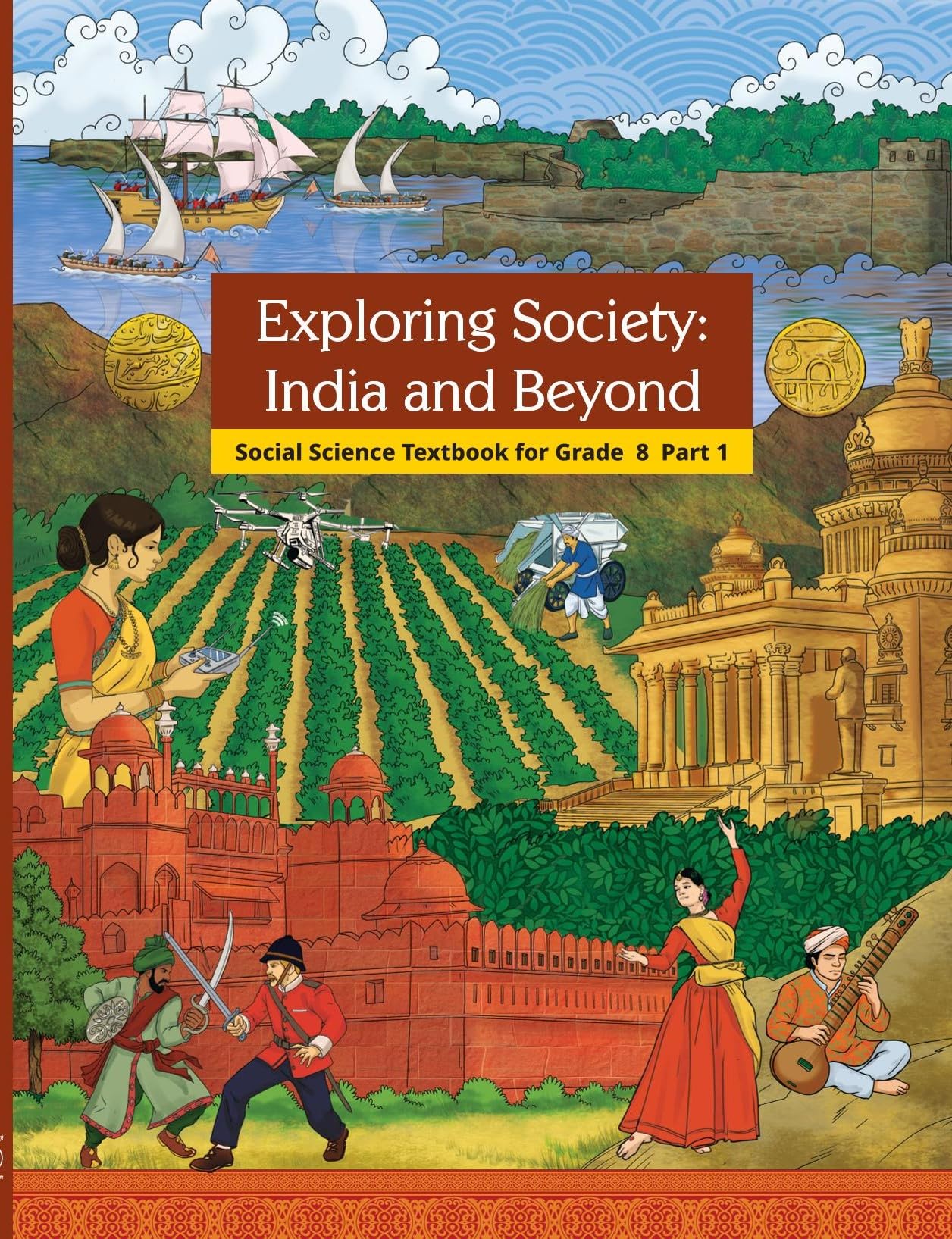
In this case, the Court stepped in after concerns were raised about content in a Class 8 Social Science textbook.
📘 What Triggered the Controversy?
The controversy revolved around a chapter titled:
“The Role of the Judiciary in Our Society”
The chapter mentioned that among the challenges faced by the judicial system were:
- Corruption
- Massive backlog of cases
- Shortage of judges
- Judicial code of conduct
While the chapter attempted to discuss institutional challenges, the reference to “corruption in the judiciary” triggered serious objections.
The Court observed that the narrative appeared selective and allegedly did not sufficiently highlight the judiciary’s constitutional contributions.
⚖️ The Bench That Heard the Case
The matter was heard by a three-judge Bench comprising:
- Chief Justice of India Surya Kant
- Justice Joymalya Bagchi
- Justice Vipul M. Pancholi
The case was titled:
“In Re: Social Science Textbook for Grade-8 (Part 2) published by NCERT and ancillary issues.”
🔥 Key Observations from the Supreme Court
The Court made several strong observations during the hearing.
📌 On Student Impact
The Bench stated that exposing students at a “tender age” to what it termed as biased misconceptions could have lasting consequences.
📌 On Constitutional Role
The Court noted that the chapter allegedly failed to adequately mention:
- The judiciary’s role in upholding constitutional values
- Protection of Fundamental Rights
- The Basic Structure doctrine
- Legal aid and access to justice reforms
📌 On Democratic Balance
Importantly, the Court clarified:
“We do not propose to initiate proceedings to stifle legitimate criticism.”
This line reaffirmed that dissent remains vital in a democracy.
🚫 Blanket Ban Ordered by Supreme Court

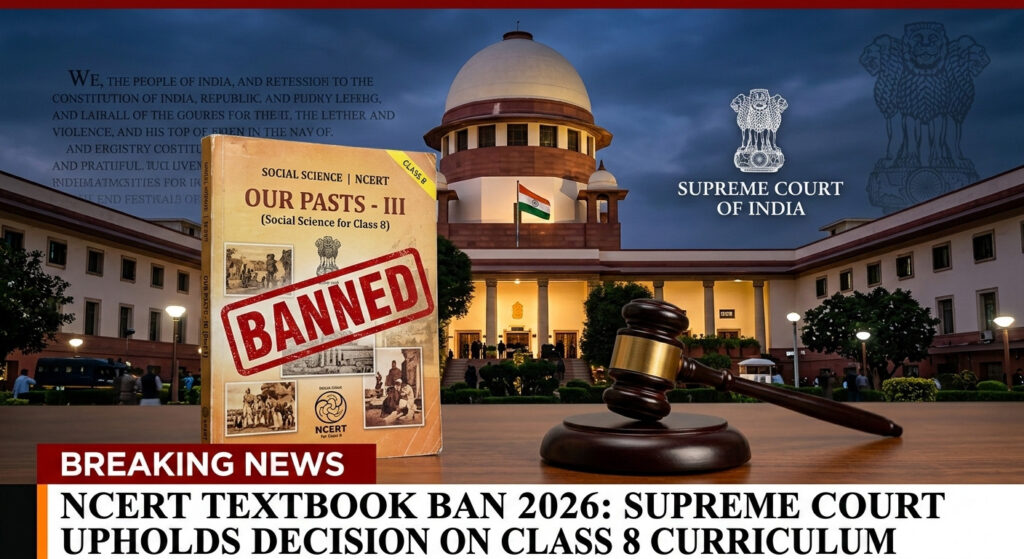
On February 26, 2026, the Supreme Court issued sweeping directions:
✅ 1. Complete Ban on Reprinting
No further printing of the textbook is allowed.
✅ 2. Ban on Digital Circulation
PDF versions and digital copies must be removed immediately.
✅ 3. Immediate Seizure
Physical copies already distributed must be withdrawn.
✅ 4. Compliance Report
Education Secretaries must submit compliance reports within two weeks.
✅ 5. Personal Accountability
The NCERT Director and school principals were made personally responsible.
The Court warned that any circulation would amount to defiance.
🏫 The Role of NCERT
The National Council of Educational Research and Training (NCERT) is India’s apex body for curriculum design and textbook publication.
Following the Court’s intervention, NCERT issued a formal statement acknowledging:
- “Inappropriate textual material”
- “Error in judgement”
- Content that had “inadvertently crept” into the chapter
NCERT clarified:
- It holds the judiciary in the highest esteem.
- There was no intention to diminish any constitutional authority.
- The objective of the textbook is to strengthen constitutional literacy.
📦 Distribution Halted Before the Hearing
Government officials confirmed that:
- On February 24, distribution was placed on “strict hold.”
- Out of approximately 2.38 lakh printed copies, only a limited number had reached circulation.
- Directions were fully complied with.
This proactive administrative step prevented wider academic disruption.
📢 Unqualified Apology & Rewrite Assured
During the hearing, Solicitor General Tushar Mehta informed the Court:
- An unqualified and unconditional apology will be published.
- Individuals involved in drafting the chapter will not be associated with future ministry work.
- The chapter will be rewritten.
NCERT confirmed the revised chapter will be introduced in the academic session 2026–27.
📅 Complete Timeline of Events
| Date | Event |
|---|---|
| Feb 24, 2026 | Distribution placed on strict hold |
| Feb 25, 2026 | Supreme Court registers suo motu case |
| Feb 25 Night | NCERT issues apology |
| Feb 26, 2026 | Blanket ban ordered; seizure directed |
🎓 What This Means for Class 8 Students
If you are a student or parent, here’s what you should know:
✔️ The controversial edition will not continue.
✔️ Revised content will be introduced in 2026–27.
✔️ Schools will follow updated instructions.
✔️ Academic continuity will be ensured.
There is no need for panic — syllabus structure remains intact.
🧠 Bigger Constitutional & Educational Questions
The Supreme Court NCERT textbook ban 2026 raises important national questions:
- Should textbooks discuss institutional weaknesses?
- How should such topics be framed for middle school students?
- Where is the line between awareness and institutional respect?
- What safeguards exist in textbook review systems?
This case may influence:
- Future curriculum drafting processes
- Editorial review standards
- Civic education frameworks
- Institutional accountability mechanisms
🌟 Why This Case Matters for India’s Education System
This episode highlights a delicate balance:
⚖️ Judicial independence
📚 Academic freedom
🏛️ Constitutional respect
🎓 Responsible pedagogy
The Court emphasised that democratic criticism is not being silenced — but it must be balanced and contextual.
🏁 Final Thoughts
The Supreme Court NCERT textbook ban 2026 is more than a headline — it is a defining moment in India’s educational governance.
It reminds us that:
- Education shapes public perception.
- Words in textbooks carry lasting influence.
- Institutional balance is sensitive.
- Curriculum design demands responsibility.
As compliance reports are filed and the chapter is rewritten, this case will likely become a benchmark reference in discussions on civic education and constitutional literacy.
For structured, verified, and student-friendly education updates, continue following a2zly.com.