Exercise Questions and Answers
Q1: Fill in the blanks:
(i) The solution used in a Voltaic cell is called ________.
(ii) A current carrying coil behaves like a ________.
A1:
(i) Electrolyte
(ii) Magnet (or Electromagnet)
Q2: Choose the correct option:
(i) Dry cells are less portable compared to Voltaic cells. (True/False)
(ii) A coil becomes an electromagnet only when electric current flows through it. (True/False)
(iii) An electromagnet, using a single cell, attracts more iron paper clips than the same electromagnet with a battery of 2 cells. (True/False)
A2:
(i) False (Dry cells are more portable than Voltaic cells.)
(ii) True
(iii) False (A battery of 2 cells provides more current, increasing the electromagnet’s strength and attracting more clips.)
Q3: An electric current flows through a nichrome wire for a short time.
(i) The wire becomes warm.
(ii) A magnetic compass placed below the wire is deflected.
Choose the correct option:
(a) Only (i) is correct
(b) Only (ii) is correct
(c) Both (i) and (ii) are correct
(d) Both (i) and (ii) are not correct
A3: (c) Both (i) and (ii) are correct
The wire becomes warm due to the heating effect of electric current, and the compass deflects due to the magnetic effect of the current.
Q4: Match the items in Column A with those in Column B.
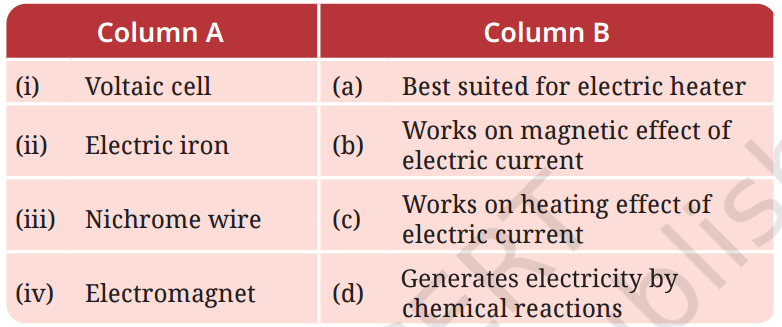
A4: Here’s the correct matching:
(i) Voltaic cell → (d) chemical reactions
(ii) Electric iron → (c) Works on heating effect of electric current
(iii) Nichrome wire → (a) Best suited for electric heater
(iv) Electromagnet → (b) Works on magnetic effect of electric current
Q5: Nichrome wire is commonly used in electrical heating
devices because it
(i) is a good conductor of electricity.
(ii) generates more heat for a given current.
(iii) is cheaper than copper.
(iv) is an insulator of electricity.
A5: The correct answer is: (ii) generates more heat for a given current.
Nichrome has high electrical resistance and can withstand high temperatures without oxidizing, which makes it ideal for heating elements.
Q6: Electric heating devices (like an electric heater or a stove) are often considered more convenient than traditional heating methods (like burning firewood or charcoal). Give reason(s) to support this statement considering societal impact.
A6: Electric heating devices are considered more convenient than traditional heating methods because:
- Cleaner for the environment – They do not produce smoke, ash, or harmful gases, reducing air pollution and health hazards.
- Time-saving – They heat quickly and require no time for gathering fuel or starting a fire.
- Easy to operate – Just switch on the device; no need for constant monitoring or adding fuel.
- Safety – Lower risk of burns from open flames and no sparks that could cause accidental fires.
- Space-friendly – Can be used indoors without the need for chimneys or ventilation for smoke.
- Reduced deforestation – No need to cut down trees for firewood, helping conserve forests.
Q7: Look at the Fig. 4.4a.
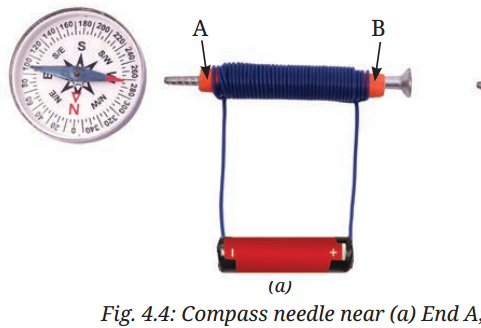
If the compass placed near the coil deflects:
(i) Draw an arrow on the diagram to show the path of the electric current.
(ii) Explain why the compass needle moves when current flows.
(iii) Predict what would happen to the deflection if you reverse the battery terminals.
A7: Here’s the solution for each part:
(i) Arrow showing current direction:
In the given diagram, the battery’s positive terminal is at the right and the negative terminal is at the left.
So, the electric current flows from the positive terminal (+) → through the wire to end B → through the coil towards end A → back to the negative terminal (–).
You would draw an arrow along the wire showing this path.
(ii) Why the compass needle moves:
When current flows through the coil, it produces a magnetic field around it.
The compass needle is a small magnet, so the coil’s magnetic field exerts a force on it, causing it to deflect from its usual north–south direction.
(iii) If the battery terminals are reversed:
Reversing the battery changes the direction of current in the coil.
This also reverses the coil’s magnetic polarity, so the compass needle will deflect in the opposite direction compared to before.
Q8: Suppose Sumana forgets to move the switch of her lifting electromagnet model to OFF position. After some time, the iron nail no longer picks up the iron paper clips, but the wire wrapped around the iron nail is still warm. Why did the lifting electromagnet stop lifting the clips? Give possible reasons.
A8:
Possible reasons:
- Cell/Battery Depletion: The cell or battery may have run out of charge, stopping the current flow and thus the magnetic field, causing the electromagnet to lose its ability to attract clips.
- Overheating: The wire remains warm due to the heating effect of the current before the cell depleted, as resistance in the wire converts electrical energy to heat.
- Circuit Issue: A loose connection or wire damage could have interrupted the current, stopping the magnetic effect while residual heat remains in the wire.
Q9: In Fig. 4.11, in which case the LED will glow when the switch is closed?
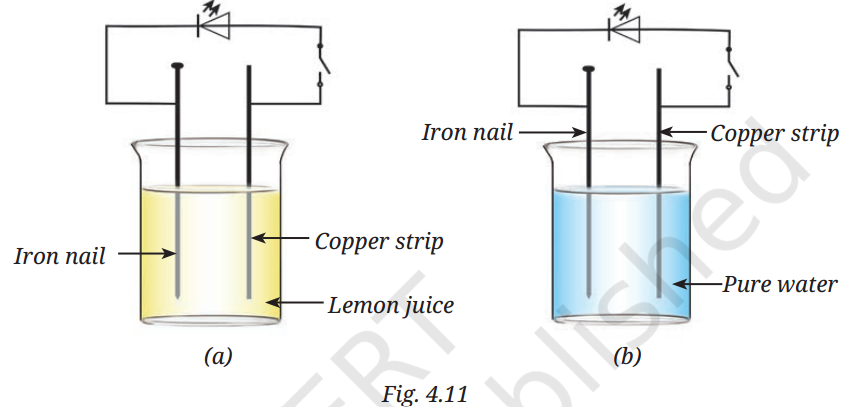
A9: The LED will glow in case (a) — when the electrodes are dipped in lemon juice.
Reason: In case (b), pure water is a poor conductor because it has very few ions, so the circuit will not complete, and the LED will not glow.
Lemon juice contains acids (citric acid), which produce ions in the solution, making it a good conductor of electricity.
Q10: Neha keeps the coil exactly the same as in activity 4.4 but slides the iron nail out, leaving only the coiled wire. Will the coil still deflect the compass? If yes, will the deflection be more or less than before?
A10: Yes, the coil will still deflect the compass even without the iron nail inside.
Reason: When current flows through the coiled wire, it produces a magnetic field, and this magnetic field can influence the compass needle.
Deflection: The deflection will be less than before because the iron nail acted as a soft iron core, which increased the strength of the magnetic field (by concentrating the magnetic lines of force). Without it, the magnetic field is weaker, so the compass needle will not deflect as much.
Q11: We have four coils, of similar shape and size, made up from iron, copper, aluminium, and nichrome as shown in Fig. 4.12.
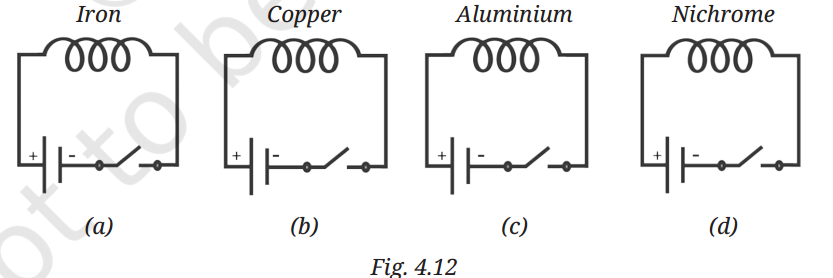
When current is passed through the coils, compass needles placed near the coils will show deflection.
(i) Only in circuit (a)
(ii) Only in circuits (a) and (b)
(iii) Only in circuits (a), (b), and (c)
(iv) In all four circuits.
A11: The correct answer is: (iv) In all four circuits.
Reason:
Any wire carrying an electric current produces a magnetic field, regardless of the material (iron, copper, aluminium, or nichrome). This magnetic field will cause a nearby compass needle to deflect. The difference between materials only affects the strength of the field — ferromagnetic materials like iron make the field stronger when used as a core, but the effect is present for all conducting coils.