Exercise Questions and Answers
Q1: Group the diseases shown in the images as communicable or non-communicable.
Cold and flu, Typhoid, Diabetes, Asthma, Chickenpox
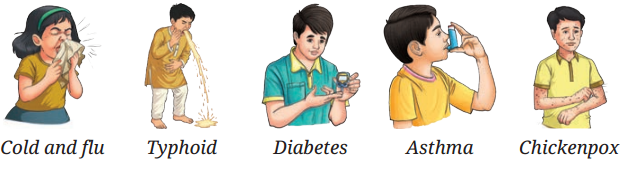
A1:
- Communicable diseases: Cold and flu, Typhoid, Chickenpox
- Non-communicable diseases: Diabetes, Asthma
Q2: From the options given below, identify the non-communicable diseases.
(i) Typhoid, (ii) Asthma, (iii) Diabetes, (iv) Measles
(a) (i) and (ii), (b) (ii) and (iii), (c) (i) and (iv), (d) (ii) and (iv)
A2: (b) (ii) and (iii)
Asthma and Diabetes are non-communicable diseases, while Typhoid and Measles are communicable.
Q3: There is a flu outbreak in your school. Several classmates are absent, while some are still coming to school coughing and sneezing.
(i) What immediate actions should the school take to prevent further spread?
(ii) If your classmate who shares the bench with you starts showing symptoms of the flu, how can you respond in a considerate way without being rude or hurtful?
(iii) How can you protect yourself and others from getting infected in this situation?
A3:
(i) The school should:
- Encourage sick students to stay home and recover.
- Promote handwashing and use of sanitizers.
- Enforce mask-wearing in crowded areas.
- Sanitize classrooms and common areas regularly.
- Educate students on covering their mouth/nose while coughing or sneezing.
(ii) Respond considerately by:
- Kindly suggesting they rest at home to recover quickly, e.g., “I hope you feel better soon! Maybe resting at home could help.”
- Offering to share class notes to support their recovery.
- Maintaining distance politely without making them feel isolated.
(iii) To protect yourself and others:
- Wear a mask and maintain physical distance.
- Wash hands frequently with soap and water.
- Avoid touching your face.
- Use tissues or elbow to cover coughs/sneezes.
- Avoid sharing personal items like water bottles or pens.
Q4: Your family is planning to travel to another city where malaria is prevalent.
(i) What precautions should you take before, during, and after the trip?
(ii) How can you explain the importance of mosquito nets or repellents to your sibling?
(iii) What could happen if travellers ignore health advisories in such areas?
A4:
(i) Precautions:
- Before: Consult a doctor for anti-malarial medication; get vaccinated if available; pack mosquito repellents and nets.
- During: Use mosquito nets while sleeping; apply repellents; wear long-sleeved clothing; avoid stagnant water areas.
- After: Monitor for symptoms like fever or fatigue; seek medical help if symptoms appear.
(ii) Explain to sibling:
- “Mosquito nets and repellents keep mosquitoes away, which carry malaria, a serious disease that can make you very sick. Using them is like wearing a helmet for safety—it protects us from harm.”
(iii) Consequences of ignoring advisories:
- Increased risk of contracting malaria, leading to fever, fatigue, or severe complications.
- Potential spread of the disease to others upon return.
- Higher medical costs and prolonged recovery time.
Q5: Your uncle has started smoking just to fit in with his friends, even though it is well known that smoking can seriously harm health and even cause death.
(i) What would you say to him to make him stop, without being rude?
(ii) What would you do if your friend offers you a cigarette at a party?
(iii) How can schools help prevent students from indulging in such harmful habits?
A5:
(i) To uncle:
- “I really care about you, and I’ve read that smoking can cause serious health problems like cancer. I’d love to see you stay healthy for a long time. Maybe we can find other ways to hang out with your friends?”
(ii) If offered a cigarette:
- Politely decline: “No thanks, I’m good. I’d rather stick to healthy habits.”
- Change the topic or suggest another activity to avoid pressure.
(iii) Schools can help by:
- Conducting awareness campaigns on the dangers of smoking.
- Organizing activities like sports or clubs to engage students positively.
- Inviting health professionals to discuss the impact of harmful substances.
- Enforcing strict no-smoking policies on campus.
Q6: Saniya claims to her friend Vinita that “Antibiotics can cure any infection, so we don’t need to worry about diseases.” What question(s) can Vinita ask her to help Saniya understand that her statement is incorrect?
A6: Vinita could ask:
- “Did you know antibiotics only work against bacterial infections, not viruses like the flu or COVID-19?”
- “What about antibiotic resistance? If we misuse antibiotics, don’t they stop working over time?”
- “How do you think vaccines or lifestyle changes help prevent diseases, since antibiotics can’t cure everything?”
Q7: The following table contains information about the number of dengue cases reported in a hospital over a period of one year:
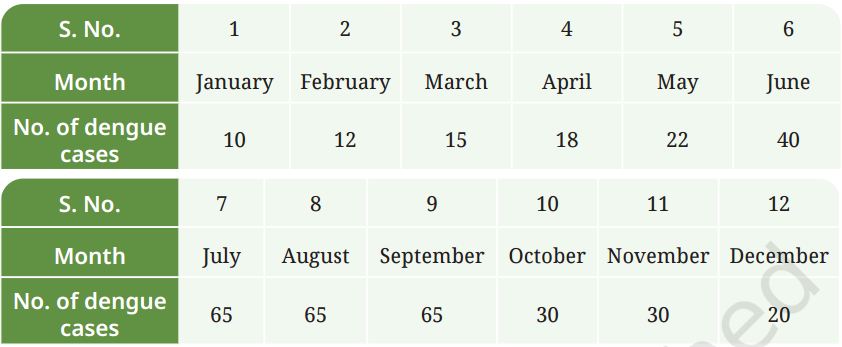
Make a bar graph of the number of cases on the Y-axis and the month on the X-axis. Critically analyse your findings and answer the following:
(i) In which three months were the dengue cases highest?
(ii) In which month(s) were the cases lowest?
(iii) What natural or environmental factors during the peak months might contribute to the increase in dengue cases?
(iv) Suggest a few preventive steps that the community or government can take before the peak season to reduce the spread of dengue.
A7:
Bar Graph:
Below is a textual representation of the bar graph :
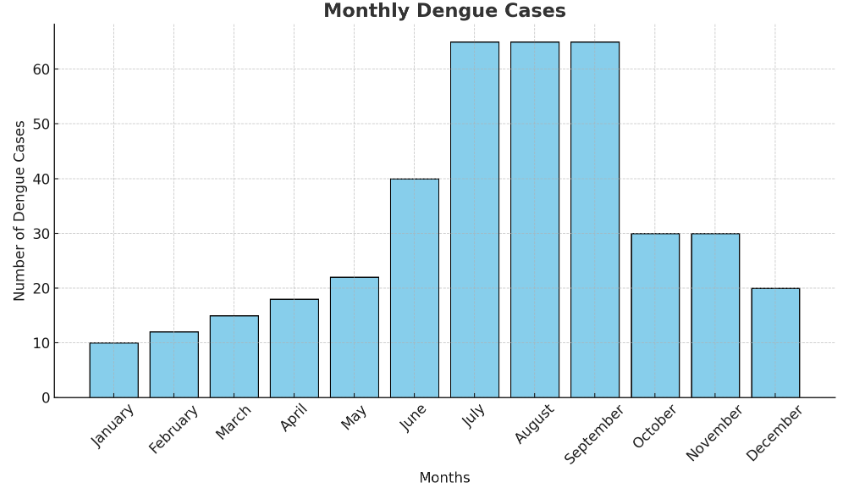
- X-axis: Months (January to December)
- Y-axis: Number of dengue cases
- Data: January (10), February (12), March (15), April (18), May (22), June (40), July (65), August (65), September (65), October (30), November (30), December (20)
(i) Highest three months: July, August, September (65 cases each).
(ii) Lowest month(s): January (10 cases).
(iii) Environmental factors:
- Monsoon season (July–September) brings heavy rainfall, leading to stagnant water, ideal for mosquito breeding.
- Warm temperatures during these months favor mosquito activity and reproduction.
- Poor drainage systems in communities increase breeding sites.
(iv) Preventive steps: - Conduct awareness campaigns on dengue prevention before monsoon.
- Clear stagnant water from drains, pots, and open containers.
- Use mosquito larvicides in water bodies and fogging in high-risk areas.
- Distribute mosquito nets and repellents to residents.
Q8: Imagine you are in charge of a school health campaign. What key messages would you use to reduce communicable and non-communicable diseases?
A8: Key messages:
- For Communicable Diseases: “Wash hands regularly, cover coughs and sneezes, and get vaccinated to stop the spread of infections like flu and typhoid.”
- For Non-Communicable Diseases: “Eat a balanced diet, exercise daily, manage stress, and avoid smoking to prevent diabetes, obesity, and heart disease.”
- General: “Keep your surroundings clean and prioritize mental health by spending time with loved ones.”
Q9: It is recommended that we should not take an antibiotic for a viral infection like a cold, a cough, or flu. Can you provide the possible reason for this recommendation?
A9: Antibiotics target bacteria, not viruses. Using antibiotics for viral infections is ineffective and can contribute to antibiotic resistance, making bacterial infections harder to treat in the future.
Q10: Which disease(s) among the following may spread if drinking water gets contaminated by the excreta from an infected person?
Hepatitis A, Tuberculosis, Poliomyelitis, Cholera, Chickenpox
A10: Diseases that may spread through contaminated drinking water:
- Hepatitis A
- Cholera
- Poliomyelitis
Tuberculosis and Chickenpox do not spread through contaminated water.
Q11: When our body encounters a pathogen for the first time, the immune response is generally low but on exposure to the same pathogen again, the immune response is much more compared to the first exposure. Why is it so?
A11: The first exposure to a pathogen triggers the immune system to produce antibodies and memory cells, which is a slower process. On subsequent exposures, memory cells recognize the pathogen quickly, leading to a faster and stronger immune response.