Exercise Questions and Answers (Keep the Curiosity Alive)
Q1: Various parts of a cell are given below. Write them in the appropriate places in the following diagram.
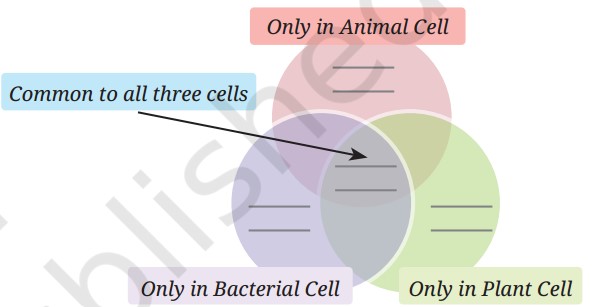
Common to all three cells: Nucleus, Cytoplasm, Cell membrane
Only in Plant Cell: Cell wall, Chloroplast
Only in Bacterial Cell: Nucleoid
A1:
- Animal Cell: Cell membrane, Cytoplasm, Nucleus
- Plant Cell: Cell membrane, Cytoplasm, Nucleus, Cell wall, Chloroplast
- Bacterial Cell: Cell membrane, Cytoplasm, Nucleoid, Cell wall
Q2: Anandi took two test tubes and marked them A and B. She put two spoonfuls of sugar solution in each of the test tubes. In test tube B, she added a spoonful of yeast. Then she attached two incompletely inflated balloons to the mouth of each test tube. She kept the set-up in a warm place, away from sunlight.
(i) What do you predict will happen after 3-4 days? She observed that the balloon attached to test tube B was inflated. What can be a possible explanation for this?
(a) Water evaporated in test tube B and filled the balloon with water vapour.
(b) The warm atmosphere expanded the air inside test tube B, which inflated the balloon.
(c) Yeast produced a gas inside test tube B which inflated the balloon.
(d) Sugar reacted with warm air, which produced gas, eventually inflating the balloon.
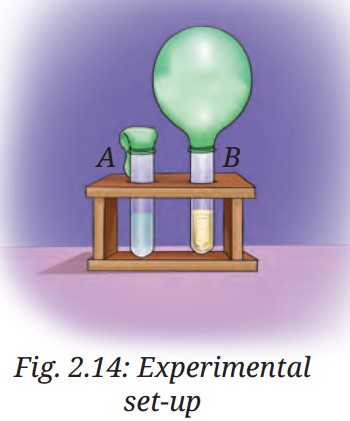
A2: Prediction: After 3-4 days, the balloon on test tube B will inflate, while test tube A’s balloon will not.
Observation and Explanation: The balloon on test tube B inflated because yeast, a fungus, ferments sugar, producing carbon dioxide gas that fills the balloon. Test tube A, without yeast, produces no gas, so its balloon remains uninflated (Page 13).
Answer: (c) Yeast produced a gas inside test tube B which inflated the balloon. Options (a), (b), and (d) are incorrect because:
(a) Water evaporation produces minimal vapor, insufficient to inflate a balloon significantly.
(b) Warmth alone cannot expand air enough to inflate the balloon noticeably.
(d) Sugar does not react with warm air to produce gas; fermentation requires a microorganism like yeast.
This is supported by the description of yeast fermentation , where yeast breaks down sugar in warm conditions, releasing carbon dioxide.
(ii) She took another test tube, 1/4 filled with lime water. She removed the balloon from test tube B in such a manner that the gas inside the balloon did not escape. She attached the balloon to the test tube with lime water and shook it well. What do you think she wants to find out?
A2 (ii): Anandi wants to confirm that the gas produced by yeast is carbon dioxide. When carbon dioxide is passed into lime water (calcium hydroxide), it reacts to form calcium carbonate, turning the lime water milky. This test identifies the gas as carbon dioxide (Page 14).
Q3: A farmer was planting wheat crops in his field. He added nitrogen-rich fertiliser to the soil to get a good yield of crops. In the neighbouring field, another farmer was growing bean crops, but she preferred not to add nitrogen fertiliser to get healthy crops. Can you think of the reasons?
A3: The farmer growing beans did not add nitrogen fertilizer because bean crops (legumes) have root nodules containing Rhizobium bacteria. These bacteria fix nitrogen from the air into compounds that enrich the soil, promoting healthy plant growth without additional fertilizers (Page 15).
Q4: Shehald dug two pits, A and B, in her garden. In pit A, she put fruit and vegetable peels and mixed it with dried leaves. In pit B, she dumped the same kind of waste without mixing it with dried leaves. She covered both pits with soil and observed after 3 weeks. What is she trying to test?
A4: Shehald is testing the effect of mixing dried leaves with fruit and vegetable peels on decomposition. Pit A, with mixed leaves, likely decomposes faster due to increased carbon content, aiding microbial activity (fungi, bacteria) to form nutrient-rich manure. Pit B, without leaves, decomposes slower due to less favorable conditions for microbes (Page 12).
Q5: Identify the following microorganisms:
(i) I live in every kind of environment and inside your gut.
(ii) I make bread and cakes soft and fluffy.
(iii) I live in the roots of pulse crops and provide nutrients for their growth.
A5:
- (i) Bacteria (e.g., gut bacteria like Lactobacillus), as they live in diverse environments, including the human gut, aiding digestion (Pages 11, 14).
- (ii) Yeast, a fungus that ferments sugar, releasing carbon dioxide to make bread and cakes soft and fluffy (Pages 13-14).
- (iii) Rhizobium, a bacterium living in root nodules of legumes, fixing nitrogen to provide nutrients for plant growth (Page 15).
Q6: Devise an experiment to test that microorganisms need optimal temperature, air, and moisture for their growth.
A6:
- Question: Do microorganisms need optimal temperature, air, and moisture to grow?
- Hypothesis: Microorganisms grow best in warm, moist conditions with air access.
- Experiment:
- Take four glass containers (A, B, C, D).
- In each, place 50 g of moist soil with vegetable peels.
- Container A: Keep at 25-30°C (warm), uncovered (air access), with moist soil.
- Container B: Keep at 5°C (cold, e.g., refrigerator), uncovered, with moist soil.
- Container C: Keep at 25-30°C, sealed (no air), with moist soil.
- Container D: Keep at 25-30°C, uncovered, with dry soil.
- After 2 weeks, observe decomposition (e.g., formation of dark manure) and use a microscope to check for microbial growth (e.g., fungi, bacteria).
- Prediction: Container A will show the most decomposition and microbial growth due to optimal warmth, air, and moisture. Containers B, C, and D will show less growth due to suboptimal conditions (cold, no air, or dry) (Pages 11-12).
Q7: Take 2 slices of bread. Place one slice in a plate near the sink. Place the other slice in the refrigerator. Compare after three days. Note your observations. Give reasons for your observations.
A7:
- Observations: After three days, the bread near the sink likely shows powdery or cotton-like microbial growth (e.g., mold) due to warmth, moisture, and air exposure. The bread in the refrigerator shows little or no growth, remaining mostly unchanged.
- Reasons: Microorganisms like fungi thrive in warm, moist conditions near the sink, promoting mold growth. The cold refrigerator (5°C) slows microbial activity, inhibiting growth (Pages 11, 14).
Q8: A student observed that when curd is left out for a day, it becomes more sour. What can be two possible explanations for this observation?
A8:
- Bacterial Activity: Lactobacillus bacteria in curd continue to ferment lactose (milk sugar) into lactic acid when left at room temperature, increasing sourness (Page 15).
- Temperature Effect: Warm conditions enhance bacterial growth and fermentation, producing more lactic acid, making the curd sourer compared to refrigerated curd, where cold slows bacterial activity (Page 14).
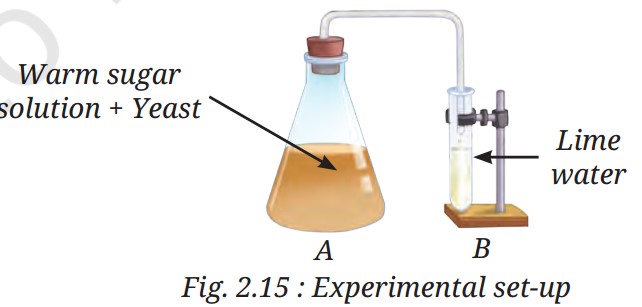
Q9: Observe the set-up given in Fig. 2.15 and answer the following questions.
(i) What happens to the sugar solution in flask A?
(ii) What do you observe in test tube B after four hours? Why do you think this happened?
(iii) What would happen if yeast was not added in flask A?
A9:
(iii) If yeast was not added to flask A, no fermentation would occur, so no carbon dioxide would be produced. Test tube B’s lime water would remain clear, as no gas would enter to react (Page 14).
(i) In flask A, yeast ferments the sugar solution, producing carbon dioxide gas and alcohol, causing bubbles and a change in smell (Pages 13-14).
(ii) After four hours, test tube B (containing lime water) turns milky because carbon dioxide from flask A reacts with lime water (calcium hydroxide) to form calcium carbonate, a milky precipitate (Page 14).