Exercise Questions and Answers
Q1: A light ray is incident on a mirror and gets reflected by it (Fig. 10.21). The angle made by the incident ray with the normal to the mirror is 40°. What is the angle made by the reflected ray with the mirror?
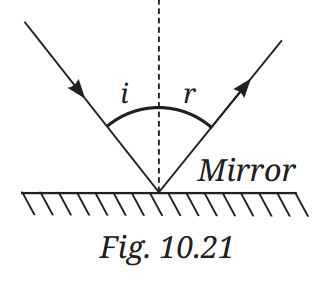
A1: According to the first law of reflection, the angle of incidence (i) equals the angle of reflection (r). If the angle of incidence is 40°, the angle of reflection is also 40°.
Answer: The angle made by the reflected ray with the normal is 40°.
Angle made by the reflected ray with the mirror is 50°.
Q2.
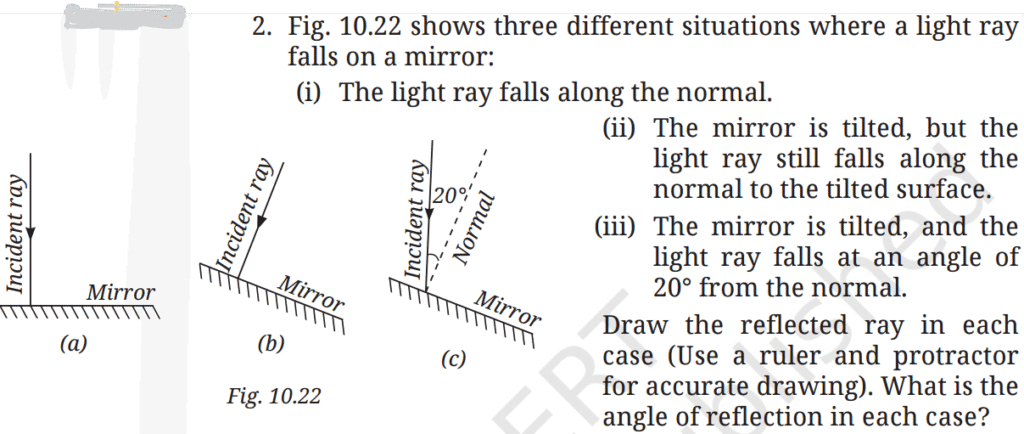
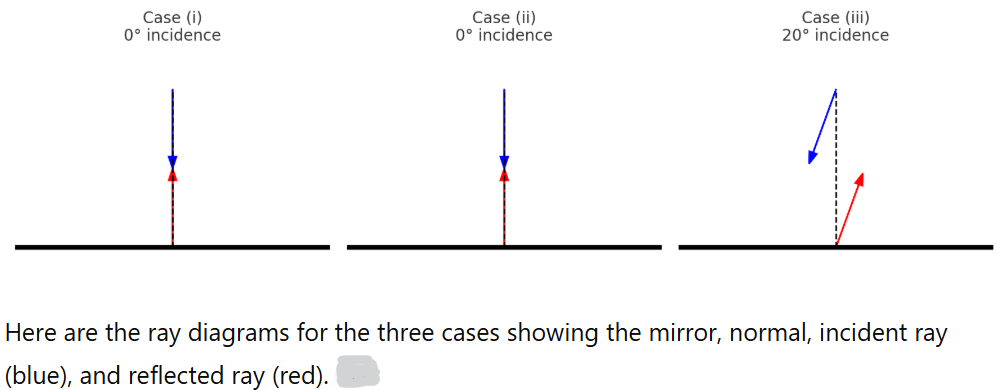
A2: (i) Light ray falls along the normal (Fig. 10.22a)
- Angle of incidence = 0°
- Angle of reflection = 0°
- The ray will be reflected back along the same path.
(ii) Mirror is tilted, but ray still falls along the normal to the tilted surface (Fig. 10.22b)
- Even though the mirror is tilted, the ray is incident along the normal to that tilted mirror.
- Angle of incidence = 0°
- Angle of reflection = 0°
- The ray will be reflected back along the same path (relative to the tilted surface).
(iii) Mirror tilted, light ray falls at 20° from the normal (Fig. 10.22c)
Reflected ray will make 20° with the normal, but in the opposite direction to the incident ray.
Angle of incidence = 20°
Angle of reflection = 20° (on the other side of the normal)
Q3:
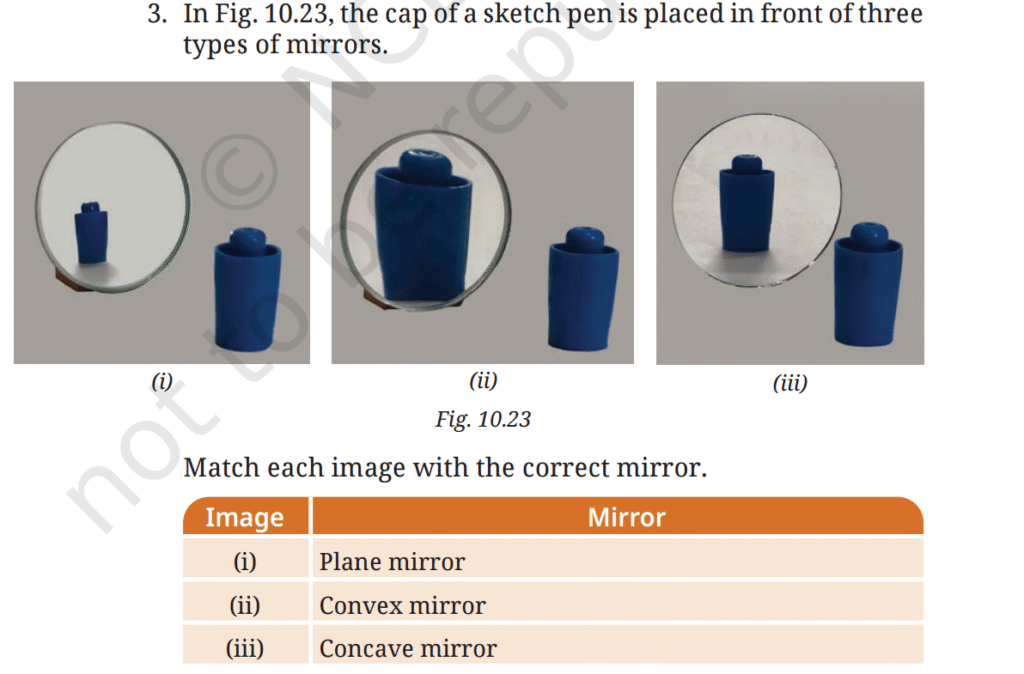
A3:Here’s the correct matching for the mirrors shown:
- (i)– Convex mirror → Image appears smaller than the object.
- (ii)– Concave mirror → Image appears larger (magnified) when object is close.
- (iii)- Plane mirror → Image is of the same size as the object.
Q4: In Fig. 10.24, the cap of a sketch pen is placed behind a convex lens, a concave lens, and a flat transparent glass piece – all at the same distance. Match each image with the correct optical element.
A4:
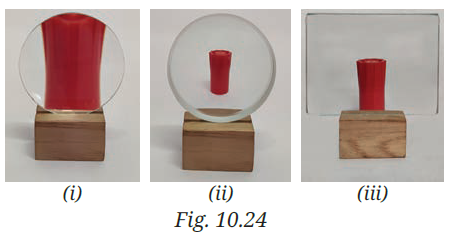
- Image (i): Erect and enlarged → Matches Convex Lens (objects close to a convex lens appear erect and enlarged).
- Image (ii): Erect and diminished → Matches Concave Lens (concave lenses always produce erect, diminished images).
- Image (iii): Same size as the object → Matches Flat Transparent Glass Piece (no bending of light, so the object appears unchanged).
Answer:
(i) Convex Lens
(ii) Concave Lens
(iii) Flat Transparent Glass Piece
Q5: When the light is incident along the normal on the mirror, which of the following statements is true:
(i) Angle of incidence is 90°
(ii) Angle of incidence is 0°
(iii) Angle of reflection is 90°
(iv) No reflection of light takes place in this case
A5:When light is incident along the normal on a mirror, the correct statement is (ii) Angle of incidence is 0°.
Explanation:
“Normal” means perpendicular to the surface. When light hits a mirror along the normal, it has no angle of incidence with the mirror’s surface, resulting in a reflected ray that also travels along the normal.
Q6: Three mirrors — plane, concave and convex are placed in Fig. 10.25. On the basis of the
images of the graph sheet formed in the mirrors, identify the mirrors and write their names above the mirrors.
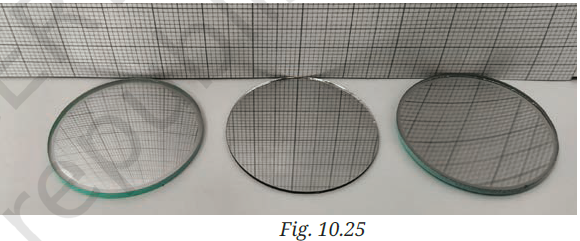
A6: Let’s carefully observe Fig. 10.25:
- Left mirror – The image of the graph sheet appears smaller than the actual size. This is the property of a convex mirror (diverging, produces diminished image).
- Middle mirror – The image of the graph sheet appears of the same size. This is the property of a plane mirror (produces same-sized image).
- Right mirror – The image of the graph sheet appears magnified. This is the property of a concave mirror (converging, can produce magnified image when object is close).
Q7: In a museum, a woman walks towards a large convex mirror (Fig. 10.26). She will see that:
(i) her erect image keeps decreasing in size.
(ii) her inverted image keeps decreasing in size.
(iii) her inverted image keeps increasing in size and eventually it becomes erect and magnified.
(iv) her erect image keeps increasing in size.
A7:
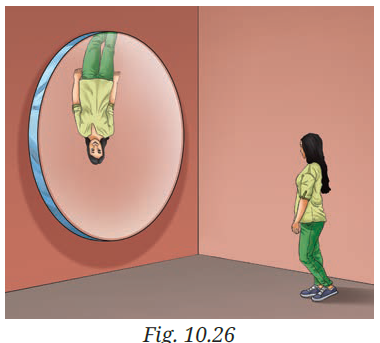
The question is about a large convex mirror.
But in the picture (Fig. 10.26), the artist has drawn the image inverted, which actually happens with a concave mirror, not a convex one.
- Convex mirror → always forms an erect, diminished image (never inverted). As the woman walks closer, the image size increases but always remains erect and smaller than her.
Correct option: (i) her erect image keeps decreasing in size. - Concave mirror (if this was the real situation in the figure) → the image can be inverted or erect depending on distance. If she moves closer, the inverted image enlarges, then eventually becomes erect and magnified when she is within the focal length.
In that case, correct option would be (iii).
So, based on the text of the question (convex mirror) → Answer is (i).
Based on the figure shown (which looks like a concave mirror image) → Answer is (iii).
Q8: Hold a magnifying glass over text and identify the distance where you can see the text bigger than they are written. Now move it away from the text. What do you notice? Which type of lens is a magnifying glass?
A8: Observation with a magnifying glass
- When held close to the text (within focal length):
- The letters look bigger than their actual size.
- The image is erect, virtual, and magnified.
- When you move the glass farther away (beyond focal length):
- The letters no longer appear magnified.
- The image appears inverted and smaller (not useful for reading).
Conclusion– A magnifying glass is a convex lens.
It works as a magnifier only when the object is placed within its focal length.
Q9:
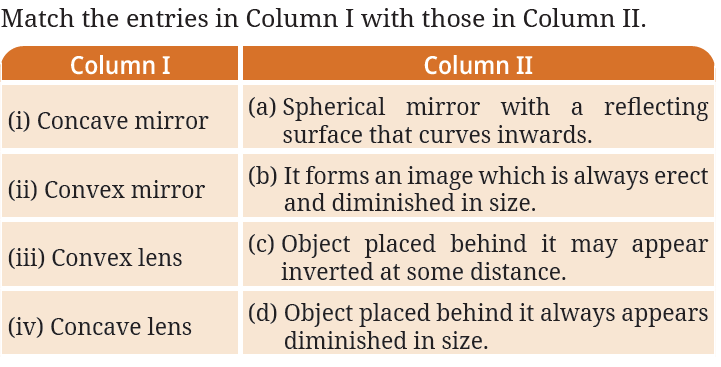
A9: Answer:
(i) Concave mirror → (a)
(ii) Convex mirror → (b)
(iii) Convex lens → (c)
(iv) Concave lens → (d)
Q10: The following question is based on Assertion/Reason.
Assertion: Convex mirrors are preferred for observing the traffic behind us.
Reason: Convex mirrors provide a significantly larger view area than plane mirrors.
Choose the correct option:
(i) Both Assertion and Reason are correct and Reason is the correct explanation for Assertion.
(ii) Both Assertion and Reason are correct but Reason is not the correct explanation for Assertion.
(iii) Assertion is correct but Reason is incorrect.
(iv) Both Assertion and Reason are incorrect.
A10: (i) Both Assertion and Reason are correct and Reason is the correct explanation for Assertion.
Explanation: Convex mirrors form virtual, erect, and diminished images, so they give a wider field of view than plane mirrors. This larger view area (and reduced blind spots) is why convex mirrors are preferred for observing traffic behind us.
Q11:
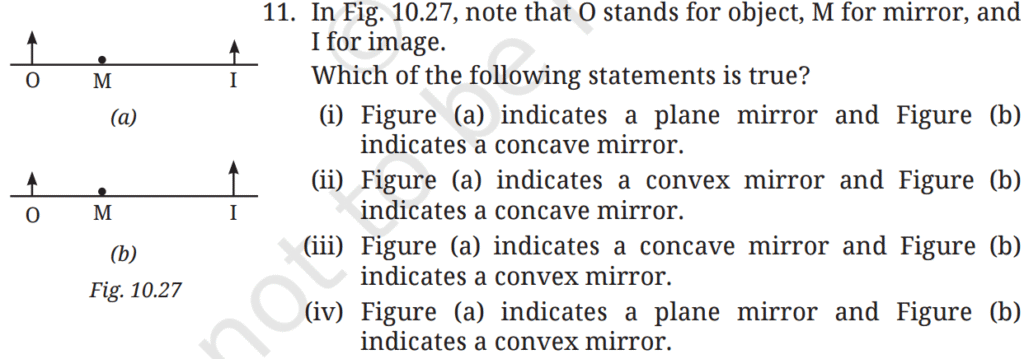
A11:
Correct Answer:
(ii) Figure (a) indicates a convex mirror and Figure (b) indicates a concave mirror.
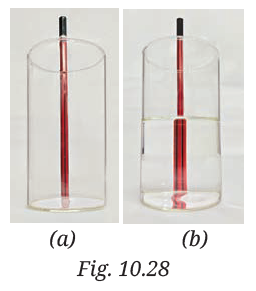
Q12: Place a pencil behind a transparent glass tumbler (Fig. 10.28a). Now fill the tumbler halfway with water (Fig. 10.28b). How does the pencil appear when viewed through the water? Explain why its shape appears changed.
A12:
Appearance: The pencil appears bent at the water’s surface when viewed through the tumbler filled halfway with water.
Explanation: This is due to the refraction of light. When light travels from water (a denser medium) to air (a less dense medium), it bends away from the normal, causing the submerged part of the pencil to appear at a different angle than the part in air. This creates the illusion of a bent pencil at the air-water interface (Fig. 10.28b).