Exercise Questions and Answers
Q1: State whether the statements given below are True [T] or False [F]. Correct the false statement(s).
(i) Oxygen gas is more soluble in hot water rather than in cold water.
(ii) A mixture of sand and water is a solution.
(iii) The amount of space occupied by any object is called its mass.
(iv) An unsaturated solution has more solute dissolved than a saturated solution.
(v) The mixture of different gases in the atmosphere is also a solution.
A1: Here’s the answer with corrections for the false statements:
(i) False (F) – Oxygen gas is more soluble in cold water rather than in hot water.
(ii) False (F) – A mixture of sand and water is not a solution, it is a suspension.
(iii) False (F) – The amount of space occupied by any object is called its volume, not mass.
(iv) False (F) – An unsaturated solution has less solute dissolved than a saturated solution.
(v) True (T) – The mixture of different gases in the atmosphere is indeed a solution (a gaseous solution).
Q2: Fill in the blanks.
(i) The volume of a solid can be measured by the method of displacement, where the solid is submerged in water and the rise in water level is measured.
(ii) The maximum amount of solute dissolved in a solvent at a particular temperature is called solubility at that temperature.
(iii) Generally, the density decreases with increase in temperature.
(iv) The solution in which glucose has completely dissolved in water, and no more glucose can dissolve at a given temperature, is called a saturated solution of glucose.
Q3: You pour oil into a glass containing some water. The oil floats on top. What does this tell you?
(i) Oil is denser than water.
(ii) Water is denser than oil.
(iii) Oil and water have the same density.
(iv) Oil dissolves in water.
A3: (ii) Water is denser than oil.
Explanation: Oil floats on water because it is less dense than water (e.g., oil’s density is ~0.91 g/cm³, water’s is 1 g/cm³). Oil does not dissolve in water, and their densities is not the same.
Q4: A stone sculpture weighs 25 g and has a volume of 90 cm³. Calculate its density and predict whether it will float or sink in water.
A4:
Density Calculation:
Density = Mass / Volume = 25 g / 90 cm³ = 0.278 g/cm³.
Prediction: The stone will float in water because its density (0.278 g/cm³) is less than water’s density (1 g/cm³). Objects with lower density than water float.
Q5: Which one of the following is the most appropriate statement, and why are the other statements not appropriate?
(i) A saturated solution can still dissolve more solute at a given temperature.
(ii) An unsaturated solution has dissolved the maximum amount of solute possible at a given temperature.
(iii) No more solute can be dissolved into the saturated solution at that temperature.
(iv) A saturated solution forms only at high temperatures.
A5: (iii) No more solute can be dissolved into the saturated solution at that temperature.
Explanation:
- (iii) Correct: A saturated solution has dissolved the maximum amount of solute possible at a given temperature, so no more can dissolve without changing conditions.
- (i) Incorrect: A saturated solution cannot dissolve more solute at the same temperature.
- (ii) Incorrect: An unsaturated solution can dissolve more solute, not the maximum amount.
- (iv) Incorrect: Saturated solutions can form at any temperature, not only high temperatures.
Q6: You have a bottle with a volume of 2 liters. You pour 50 mL of water into it. How much more water can the bottle hold?
A6:
Calculation:
2 liters = 2000 mL.
Water poured = 50 mL.
Remaining capacity = 2000 mL – 50 mL = 1950 mL.
Answer: The bottle can hold 1950 mL more water.
Q7: An object has a mass of 400 g and a volume of 40 cm³. What is its density?
A7: Density of the object Density=Mass/Volume
Mass = 400 g, Volume = 40 cm³ Density=400/40=10 g/cm3
Answer: 10 g/cm³
Q8: Analyse Fig. 9.25a and 9.25b. Why does the unpeeled orange float, while the peeled one sinks? Explain.
A8:
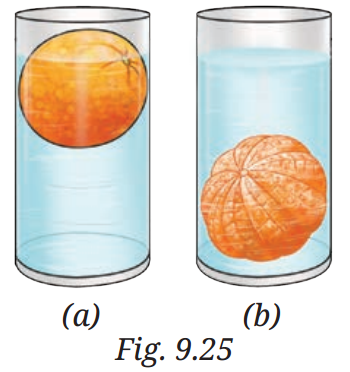
Floating and sinking of oranges (Fig. 9.25a & 9.25b)
Unpeeled orange: The peel contains tiny air pockets, making its average density less than water. This helps it float.
Peeled orange: Removing the peel removes the trapped air, increasing the density so it becomes greater than water’s density, and it sinks.
Reason: Floating or sinking depends on density compared to water — less dense objects float, denser objects sink.
Q9: Object A has a mass of 200 g and a volume of 40 cm³. Object B has a mass of 240 g and a volume of 60 cm³. Which object is denser?
A9: Comparing densities of Object A and B
For Object A: Density=200/40=5 g/cm3
For Object B: Density=240/60=4 g/cm3
Answer: Object A is denser because 5 g/cm3>4 g/cm3
Q10: Reema has a piece of modeling clay that weighs 120 g. She first moulds it into a compact cube that has a volume of 60 cm³. Later, she flattens it into a thin sheet. Predict what will happen to its density.
A10: The density of the modeling clay will remain the same.
Explanation: Density = Mass / Volume. The mass (120 g) remains constant, and changing the shape (from cube to thin sheet) does not affect the volume of the material itself. Thus, the density remains 120 g / 60 cm³ = 2 g/cm³.
Q11: A block of iron has a mass of 600 g and a density of 7.9 g/cm³. What is its volume?
A11:
Calculation:
Density = Mass / Volume.
Volume = Mass / Density = 600 g / 7.9 g/cm³ ≈ 75.95 cm³.
Answer: The volume of the iron block is approximately 75.95 cm³.
Q12: You are provided with an experimental setup as shown in Fig. 9.26a and 9.26b. On keeping the test tube (Fig. 9.26b) in a beaker containing hot water (~70 °C), the water level in the glass tube rises. How does it affect the density?
A12:
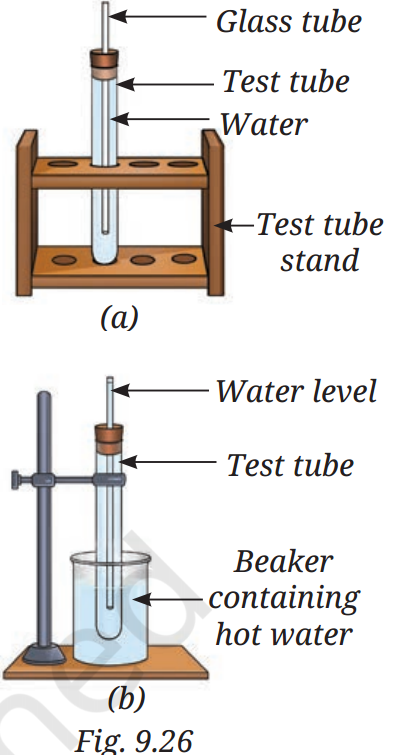
When the test tube in Fig. 9.26(b) is placed in hot water:
- The water inside the test tube absorbs heat.
- On heating, the water molecules move faster and spread farther apart → volume increases (thermal expansion).
- Mass stays the same, but volume increases.
Since Density=Mass/Volume
and volume ↑ while mass stays constant → density decreases.
Final Answer:
The density of the water decreases because heating makes it expand, so the same mass now occupies a larger volume. The rise in water level in the glass tube is due to this expansion.