Exercise Questions and Answers
Q1: Consider the following reaction where two substances, A and B, combine to form a product C: A + B → C. Assume that A and B cannot be broken down into simpler substances by chemical reactions. Which of the following statements is correct?
(i) A, B, and C are all compounds and only C has a fixed composition.
(ii) C is a compound, and A and B have a fixed composition.
(iii) A and B are compounds, and C has a fixed composition.
(iv) A and B are elements, C is a compound, and has a fixed composition.
A1: (iv) A and B are elements, C is a compound, and has a fixed composition.
Explanation: Since A and B cannot be broken down into simpler substances, they are elements. When they combine to form C, it is a compound with a fixed composition, as compounds are formed by elements chemically combining in a fixed ratio.
Q2: Assertion: Air is a mixture. Reason: A mixture is formed when two or more substances are mixed, without undergoing any chemical change.
(i) Both Assertion and Reason are true and Reason is the correct explanation for Assertion.
(ii) Both Assertion and Reason are true, but Reason is not the correct explanation for Assertion.
(iii) Assertion is true, but Reason is false.
(iv) Assertion is false, but Reason is true.
A2: (i) Both Assertion and Reason are true and Reason is the correct explanation for Assertion.
Explanation: Air is a mixture of gases (nitrogen, oxygen, etc.) that retain their properties and do not undergo chemical changes when mixed. The reason correctly explains why air is a mixture.
Q3: Water, a compound, has different properties compared to those of the elements oxygen and hydrogen from which it is formed. Justify this statement.
A3: Water (H₂O) is a compound formed by the chemical combination of hydrogen and oxygen in a fixed ratio (2:1). Hydrogen is a flammable gas, and oxygen supports combustion, but water is a liquid that extinguishes fire, showing distinct properties. This is because the chemical bonding in water creates a new substance with different characteristics than its constituent elements.
Q4: In which of the following cases are all the examples correctly matched? Give reasons in support of your answer:
(i) Elements – water, nitrogen, iron, air.
(ii) Uniform mixtures – minerals, seawater, bronze, air.
(iii) Pure substances – carbon dioxide, iron, oxygen, sugar.
(iv) Non-uniform mixtures – air, sand, brass, muddy water.
A4: (iii) Pure substances – carbon dioxide, iron, oxygen, sugar.
Reasons:
- (i) Incorrect: Water is a compound, and air is a mixture, not elements. Only nitrogen and iron are elements.
- (ii) Incorrect: Minerals are mostly compounds or elements, not mixtures. Seawater, bronze, and air are uniform mixtures.
- (iii) Correct: Carbon dioxide and sugar are compounds, and iron and oxygen are elements, all of which are pure substances (single type of particle).
- (iv) Incorrect: Air and brass are uniform mixtures, not non-uniform. Sand and muddy water are non-uniform mixtures.
Q5: Iron reacts with moist air to form iron oxide, and magnesium burns in oxygen to form magnesium oxide. Classify all the substances involved in the above reactions as elements, compounds, or mixtures, with justification.
A5:
- Iron: Element – It is a pure substance made of identical iron atoms, not breakable into simpler substances.
- Moist air: Mixture – It is a uniform mixture of gases (nitrogen, oxygen, etc.) and water vapor, with components retaining their properties.
- Iron oxide: Compound – Formed by iron and oxygen chemically combining in a fixed ratio, with different properties (e.g., rust is not magnetic).
- Magnesium: Element – A pure substance made of identical magnesium atoms.
- Oxygen: Element – A pure substance made of identical oxygen atoms or molecules (O₂).
- Magnesium oxide: Compound – Formed by magnesium and oxygen chemically combining, with different properties than its elements (e.g., a white solid, unlike the metal or gas).
Q6: Classify the following as elements, compounds, or mixtures in Table 8.3: Carbon dioxide, sand, seawater, magnesium oxide, muddy water, aluminium, gold, oxygen, rust, iron sulfide, glucose, air, water, fruit juice, nitrogen, sodium chloride, sulfur, hydrogen, baking soda.
A6:
Table 8.3
| Elements | Compounds | Mixtures |
|---|---|---|
| Aluminium | Carbon dioxide | Sand |
| Gold | Magnesium oxide | Seawater |
| Oxygen | Rust (iron oxide) | Muddy water |
| Nitrogen | Iron sulfide | Air |
| Sulfur | Glucose | Fruit juice |
| Hydrogen | Water | |
| Sodium chloride | ||
| Baking soda (sodium bicarbonate) |
Pure substances: Carbon dioxide, magnesium oxide, rust, iron sulfide, glucose, water, sodium chloride, baking soda, aluminium, gold, oxygen, nitrogen, sulfur, hydrogen.
Explanation: Elements are pure substances with one type of atom. Compounds are pure substances with two or more elements chemically combined. Mixtures contain multiple substances retaining their properties. Sand and muddy water are non-uniform mixtures; seawater, air, and fruit juice are uniform mixtures.
Q7: What new substance is formed when a mixture of iron filings and sulfur powder is heated, and how is it different from the original mixture? Also, write the word equation for the reaction.
A7: When a mixture of iron filings and sulfur powder is heated, iron sulfide is formed.
Differences:
- The original mixture (Sample A) has visible black (iron) and yellow (sulfur) particles, is magnetic (iron attracted), and iron reacts with hydrochloric acid to produce hydrogen gas, while sulfur does not.
- Iron sulfide (Sample B) is a black, uniform compound with no magnetic properties, and reacts with hydrochloric acid to produce hydrogen sulfide gas (rotten egg odor).
Word Equation: Iron + Sulfur → Iron sulfide
Q8: Is it possible for a substance to be classified as both an element and a compound? Explain why or why not.
A8: No, a substance cannot be classified as both an element and a compound. An element is a pure substance made of identical atoms that cannot be broken down further (e.g., oxygen, iron). A compound is a pure substance formed by two or more elements chemically combined in a fixed ratio (e.g., water, iron sulfide). By definition, a substance is either one type of atom (element) or a combination of different atoms (compound), making it impossible to be both.
Q9: How would our daily lives be changed if water were not a compound but a mixture of hydrogen and oxygen?
A9: If water were not a compound (H₂O) but simply a mixture of hydrogen and oxygen gases, life would be drastically different — and mostly impossible. Here’s why:
- No liquid water – A mixture of hydrogen and oxygen at room temperature would remain as separate gases, not a liquid, so rivers, lakes, and oceans wouldn’t exist.
- No universal solvent – Water’s unique ability to dissolve many substances (which supports chemical reactions in living organisms) comes from its molecular structure. Without it, processes like digestion, nutrient transport in plants, and cleaning would fail.
- Dangerous to store – Hydrogen and oxygen gases together are highly explosive. A simple spark could ignite them, causing violent explosions. This means even a glass of “water” would be a potential bomb.
- No support for life – All living things rely on water’s chemical properties for metabolism. A mixture of gases couldn’t sustain the biochemical reactions that keep cells alive.
- Weather and climate collapse – Rain, snow, clouds, and the water cycle depend on H₂O’s ability to change states between solid, liquid, and gas. With only gases, there’d be no precipitation and no stable climate patterns.
In short: without water as a compound, Earth would be a dry, lifeless, and dangerous planet.
Q10:
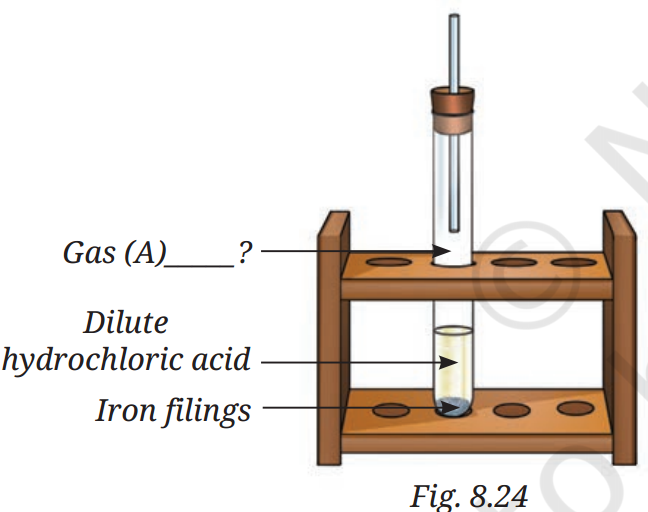
Analyse Fig. 8.24. Identify Gas A. Also, write the word equation of the chemical reaction.
A10: In Fig. 8.24, when dilute hydrochloric acid reacts with iron filings, Gas A is Hydrogen gas (H₂).
Word equation of the reaction:
Iron + Hydrochloric acid ⟶ Iron chloride + Hydrogen
In symbols:
Fe + 2HCl ⟶ FeCl₂ + H₂ ↑
The hydrogen gas is collected in the test tube above.
Q11: Write the names of any two compounds made only from non-metals, and also mention two uses of each of them.
A11: Here are two examples:
Carbon dioxide (CO₂)
Use 1: Used in fire extinguishers. Use 2: Used in carbonated drinks.
Sulphur dioxide (SO₂)
Use 1: Used as a preservative in dried fruits. Use 2: Used in the manufacture of sulphuric acid.
Q12: How can gold be classified as both a mineral and a metal?
A12: Gold can be classified as both a mineral and a metal because:
- As a mineral:
Gold occurs naturally in the Earth’s crust, often found in rocks, veins, and alluvial deposits. When it is present in its natural, pure form, it is considered a mineral because it meets the definition — naturally occurring, inorganic, and having a definite chemical composition (elemental gold, Au). - As a metal:
Gold is also a metallic element with properties such as high malleability, ductility, good electrical conductivity, and metallic lustre. These physical and chemical properties classify it as a metal in the periodic table.
In short, gold in nature is a mineral, and gold as an element is a metal.