Exercise Questions and Answers
Q1: State whether the following statements are True or False.
(i) We can only see that part of the Moon which reflects sunlight towards us.
(ii) The shadow of Earth blocks sunlight from reaching the Moon causing phases.
(iii) Calendars are based on various astronomical cycles which repeat in a predictable manner.
(iv) The Moon can only be seen at night.
A1: Here’s the evaluation of the statements:
(i) We can only see that part of the Moon which reflects sunlight towards us.
✅ True
(ii) The shadow of Earth blocks sunlight from reaching the Moon causing phases.
❌ False (Phases are due to changing positions of the Moon and Earth; Earth’s shadow causes lunar eclipses, not phases.)
(iii) Calendars are based on various astronomical cycles which repeat in a predictable manner.
✅ True
(iv) The Moon can only be seen at night.
❌ False (The Moon is often visible during the day also, depending on its phase and position in the sky
Q2: Amol was born on 6th of May on a full Moon day. Does his birthday fall on the full Moon day every year? Explain your answer.
A2: No, Amol’s birthday will not fall on a full Moon day every year. Here’s why:
Sometimes a full Moon may fall close to 6th May, but in most years it will occur on different dates in May (or even late April or early June).
A year (based on Earth’s revolution around the Sun) is about 365 days, while the lunar cycle (time from one full Moon to the next) is about 29.5 days. These two cycles are not in exact sync. That means the date of a full Moon keeps shifting in the calendar every year.
Q3:
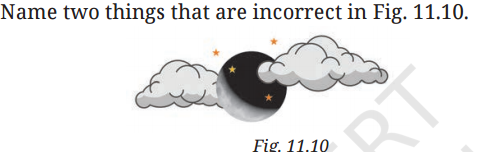
A3: Two things shown incorrectly are:
- Cause of the dark part of the Moon –
The figure shows clouds (or Earth’s shadow) covering the Moon to explain its dark part.
This is wrong.
The dark part of the Moon is actually due to the Moon not receiving sunlight there, not because something covers it. - Stars visible in front of the Moon –
In the figure, stars are drawn in front of the Moon (overlapping).
This is wrong because stars are much farther away, so they can never appear in front of the Moon.
Q4:
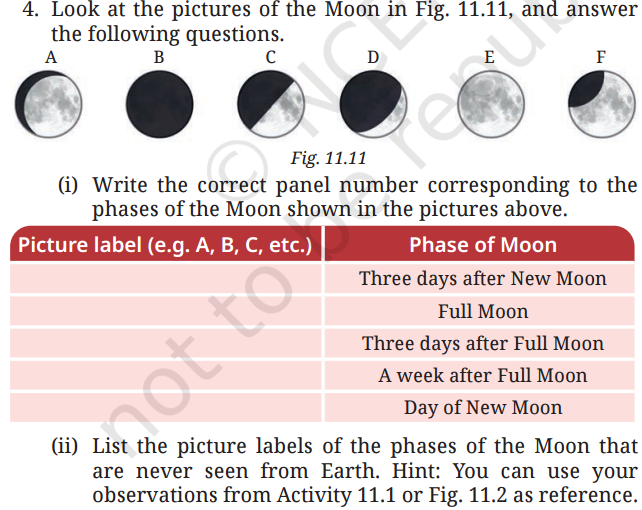
A4: (i) Match picture labels with phases of the Moon:
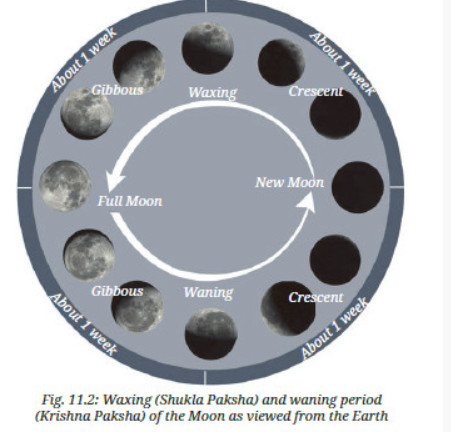
- Three days after New Moon → D (small crescent visible on right side).
- Full Moon → E (complete bright circle).
- Three days after Full Moon → A (slightly dark edge on right, waning gibbous).
- A week after Full Moon → C (half lit on left, last quarter).
- Day of New Moon → B (completely dark).
(ii) Phases of the Moon that are never seen from Earth:
- Picture B – On a new Moon day, only the non-illuminated side of the Moon faces the Earth, so it is not visible from Earth.
- Picture F – This is not a phase of the Moon. So, it can never be seen from Earth
Q5: Malini saw the Moon overhead in the sky at sunset. (i) Draw the phase of the Moon that Malini saw. (ii) Is the Moon in the waxing or the waning phase?
A5: (i) At sunset, the Moon appears overhead only during the first quarter phase, which occurs about one week after the New Moon. In this phase, the right half of the Moon is illuminated while the left half remains dark. Therefore, we should draw a half Moon with the right side bright and the left side shaded.

(ii) It is the waxing phase because it occurs after the New Moon, and the illuminated portion of the Moon is increasing day by day.
Q6: Ravi said, “I saw a crescent Moon, and it was rising in the East, when the Sun was setting.” Kaushalya said, “Once I saw the gibbous Moon during the afternoon in the East.” Who out of the two is telling the truth?
A6: Kaushalya is correct because a gibbous Moon can be seen in the eastern sky during the afternoon.
Ravi’s statement is incorrect because a crescent Moon does not rise in the east at sunset. A crescent Moon appears either just after the New Moon (waxing crescent) or just before the New Moon (waning crescent).
- A waxing crescent is seen after sunset in the western sky, not rising in the east.
- A waning crescent rises before sunrise, not at sunset.
Therefore, Kaushalya’s statement is true, while Ravi’s statement is false.
Q7: Scientific studies show that the Moon is getting farther away from the Earth and slower in its revolution. Will luni-solar calendars need an intercalary month more often or less often?
A7: Luni-solar calendars would need an intercalary month (Adhika Maasa) less often. The reason is simple: an extra month is added because a lunar year (about 354 days) is shorter than a solar year (about 365 days), leaving a gap of roughly 11 days each year.
If the Moon’s revolution slows down, the lunar month—the time between one full cycle of phases—would become longer. A longer lunar month would make the lunar year longer as well.
As a result, the difference between the lunar and solar years would shrink. This mismatch would build up more slowly over time, meaning an extra month would be required less frequently to keep the calendar aligned with the seasons.
Q8: A total of 37 full Moons happen during 3 years in a solar calendar. Show that at least two of the 37 full Moons must happen during the same month of the solar calendar.
A8: Yes, at least two full Moons must occur within the same solar month.
A solar calendar has 12 months per year, so in 3 years there are:
12 × 3 = 36 months.
If there are 37 full Moons in these 36 months, then by necessity, at least one month must contain two full Moons.
Q9: On a particular night, Vaishhali saw the Moon in the sky from sunset to sunrise. What phase of the Moon would she have noticed?
A9: If the Moon is visible from sunset to sunrise, it is up all night, which occurs when it is nearly opposite the Sun in the sky. This corresponds to the full Moon phase, when the Moon rises at sunset and sets at sunrise (Fig. 11.5a, position A).
Answer: Full Moon.
Q10: If we stopped having leap years, in approximately how many years would the Indian Independence Day happen in winter?
A10: A leap year adds about one extra day every four years. Without leap years, the calendar would gradually shift by one day every four years. There are roughly 183 days between 15 August (monsoon season) and mid-February (winter).
So, the time required for this shift would be:
183 × 4 = 732 years . Therefore, in approximately 730–732 years, 15 August would fall during winter if leap years were not included.
Q11: What is the purpose of launching artificial satellites?
A11: Artificial satellites are launched for communication, navigation, weather monitoring, disaster management, and scientific research, such as mapping (e.g., ISRO’s Cartosat) and studying celestial objects (e.g., AstroSat) (Page 16).
Answer: For communication, navigation, weather monitoring, disaster management, and scientific research.
Q12: On which periodic phenomenon are the following measures of time based: (i) day (ii) month (iii) year?
A12:
- (i) Day: Based on Earth’s rotation on its axis, causing the cycle of day and night (mean solar day, ~24 hours) (Activity 11.3).
- (ii) Month: Based on the Moon’s phases, completing a cycle from new Moon to new Moon in ~29.5 days (Page 10).
- (iii) Year: Based on Earth’s revolution around the Sun, taking ~365.25 days, linked to the cycle of seasons (Page 10).
Answer:
(i) Day: Earth’s rotation
(ii) Month: Moon’s phases
(iii) Year: Earth’s revolution around the Sun