Understand the concept of distributive properties and multiplication tricks. Using these Class 8 Maths Ganita Prakash NCERT Solutions, students can learn practical applications of multiplication easily.
Textbook Page 142
Q1. Observe the multiplication grid below. Each number inside the grid is formed by multiplying two numbers. If the middle number of a 3 × 3 frame is given by the expression pq, as shown in the figure, write the expressions for the other numbers in the grid.
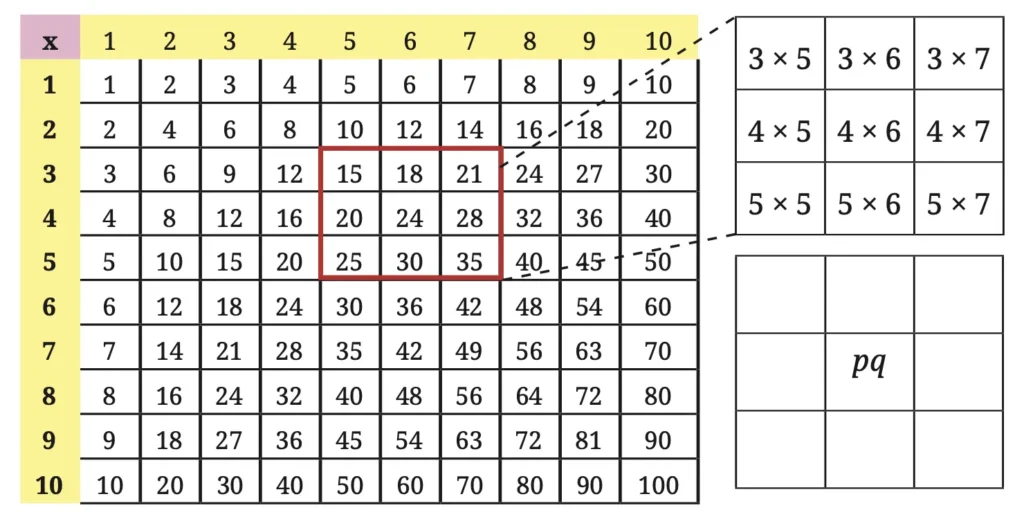
Solution:
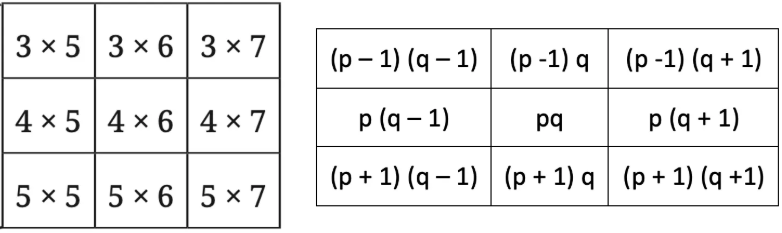
Q2. Expand the following products.
(i) (3 + u) (v – 3)
(ii) 2/3 (15 + 6a)
(iii) (10a+ b) (10c + d)
(iv) (3 – x) (x– 6)
(v) (–5a + b) (c+ d)
(vi) (5 + z) (y+ 9)
Solution:
(i) (3+u)(v–3)
=(3+u)v−(3+u)3=3v+uv−9−3u=uv+3v−3u−9
(ii) 23(15+6a)
=23×15+23×6a=10+4a
(iii) (10a+b)(10c+d)
=(10a+b)(10c)+(10a+b)d=100ac+10bc+10ad+bd
(iv) (3–x)(x–6)
=(3−x)x−(3−x)6=3x−x2−18+6x=−x2+9x−18
(v) (−5a+b)(c+d)
=(−5a+b)c+(−5a+b)d=−5ac+bc−5ad+bd=−5ac−5ad+bc+bd
(vi) (5+z)(y+9)
=(5+z)y+(5+z)9=5y+zy+45+9z=zy+5y+9z+45
Q3. Find 3 examples where the product of two numbers remains unchanged when one of them is increased by 2 and the other is decreased by 4.
Solution:
If the two numbers are x and y, then
x×y=(x+2)(y−4)
Expanding,
xy=xy+2y−4x−80=2y−4x−82y=4x+8⇒y=2x+4
Examples:
(i) For x=1, y=6:
Product =1×6=6
Check: (1+2)(6−4)=3×2=6
(ii) For x=2, y=8:
Product =2×8=16
Check: (2+2)(8−4)=4×4=16
(iii) For x=5, y=14:
Product =5×14=70
Check: (5+2)(14−4)=7×10=70
Therefore, (1,6),(2,8),(5,14) are valid solutions.
Q4. Expand (i) (a + ab – 3b2) (4 + b), and (ii) (4y + 7) (y + 11z – 3).
Solution:
(i) (a+ab–3b2)(4+b)
=(a+ab–3b2)⋅4+(a+ab–3b2)⋅b=4a+4ab−12b2+ab+ab2−3b3 =−3b3−12b2+ab2+5ab+4a
(ii) (4y+7)(y+11z−3)
=(4y+7)y+(4y+7)(11z)−(4y+7)3=4y2+7y+44yz+77z−12y−21=4y2−5y+44yz+77z−21
Q5. Expand (i) (a – b) (a + b), (ii) (a – b) (a2 + ab + b2), and (iii) (a – b)(a3 + a2b + ab2 + b3), Do you see a pattern? What would be the next identity in the pattern that you see? Can you check it by expanding?
Solution:
(i) (a−b)(a+b)
=a2−ab+ab−b2 =a2−b2
(ii) (a−b)(a2+ab+b2)
=a3−a2b+a2b−ab2+ab2−b3 =a3−b3
(iii) (a – b)(a3 + a2b + ab2 + b3)
=a4−a3b+a3b−a2b2+a2b2−ab3+ab3−b4=a4−b4
Thus, the next identity is:
(a−b)(a4+a3b+a2b2+ab3+b4)=a5−b5
This follows the general formula:
(a−b)(an−1+an−2b+⋯+abn−2+bn−1)=an−bn